A Federal High Court, Abuja, on Tuesday, retrained the Corporate Affairs Commission (CAC) from suspending or appointing trustees of the Christian Association of Nigeria and the churches.

Justice Inyang Ekwo, in a judgment, held that the provisions of Sections 17 (1), 839 (1) and (7) (a), 842 (1) and (2), 851 and 854 of the Companies and Allied Matters Act (CAMA), 2020 and Regulations 28, 29 and 30 of the Companies Regulations (CR), 2021 were not applicable to CAN and the churches, including mosques, as a religious body.
The Registered Trustees of CAN, in the originating summons marked: FHC/ABJ/CS/84/2022 field by Joe Gadzama, SAN, had sued the CAC and the Minister of Industry, Trade and Investment as 1st and 2nd defendants respectively.
The plaintiff, in the suit, had posed five questions for determination.
CAN had asked the court to determine whether Section 839, Subsections (1), (7) (a) and (10) of the CAMA, 2020 and regulations 28 – 30 of the CR, 2021 are inconsistent with Sections 4 (8), 6 (6) (b) and 40 of the 1999 Constitution (as amended) which guarantees the its right to freedom of association and the right to seek redress in court, among others.
It, therefore, sought 13 reliefs which include a declaration that Section 839 (1), (7) (a) and (10) of the CAMA and Sections 28 – 30 of the CR are inconsistent with |Section 40 of the 1999 Constitution, and thus unconstitutional, null and void.
“An order striking down Sections 839(1), (7) (a) and (10), 842(1) and (2), 843, 851 and 854 of the CAMA for being unconstitutional.
“A declaration that Section 17(2) (a) and (d) of the CAMA demand an impossible and impracticable action; thus, void and for being impracticable and unknown to Law.”
CAN also prayed for an order of perpetual injunction restraining and barring the defendants from taking any step to give effect to the provisions of Sections 17(2) (a) and (d), 839(1), 842(1) and (2), 842(1) and (2), 842, 843, 851 and 854 of the CAMA against it as mentioned in Article 4 of its constitution, to prevent further contravention of the provisions of Sections 4(8), 6(6)(b), 251(1)(e) and 251(3) of the 1999 Constitution.
It argued if CAC was allowed to suspend its trustees and appoint interim managers to manage its affairs, it would be usurping its powers under the constitution and the powers of the standing committee and the plenary session which would not be in line with the constitution.
Delivering the judgment, Justice Ekwo said that the CAC did not controvert the averment of CAN that it was constituted by the churches.
“It is settled law that averments without contradicting evidence or averments are deemed admitted.
“There is a need at this point to define what a church Is in order to see how applicable the provisions of the CAMA 2020 can be applicable to it,” he said.
Citing a previous case, the judge said “a church in its true definition is the body of Christ. One person cannot constitute the body of Christ; it connotes a congregation, an assembly of people. An individual cannot own a church. A church property must be the collective responsibility of all the members.”
He said the summary of the above was that “the church is an ecclesiastical being.
“Each church is characterised by its distinct dogma or creed and same for each congregation and denomination that constitute the church.
“It is on this ground that it is impossible for one church to be administered by another church and the church being what it is for the soul of man, the doctrinal distinctness and difference must be respected by the authorities within and without.
“This being so, it is then impracticable for the church or a denomination thereof to be administered by secular arrangement such as interim manager or managers stated in
Section 839 of the CAMA 2020 or any other arrangement put in place by the CAMA which does not take into account the doctrinal composition of the church.
“It is also my opinion that to suspend the trustees and appoint an interim manager or managers to manage the affairs of the church will conflict with the sacerdotal order of its divine administration and desecrate same.”
Justice Ekwo, who observed that the Minister of Trade (2nd defendant) neither filed any application nor represented in court despite being served by the plaintiff, held that the effect of the failure of a defendant to file pleadings is that the assertions of the claimant stands unchallenged and are deemed admitted and established.
According to him, therefore, the case of the plaintiff succeeds on the merit.
The judge, consequently, made seven declarations, which include a declaration that Section 839 (1), (7) (a) and (10) of the CAMA 2020 and Regulations 28, 29 and 30 of the CR, 2021 are not applicable to religious organisation as CAN and the churches as they violated the right to worship guaranteed by Section 40 of the 1999 Constitution (as amended).
He also made an order of perpetual Injunction, “restraining the defendants from taking any step to give effect to or implementing and/or continuing with any act to implement the provisions of Sections 839 (1), 842 (1) and (2), 842, 843, 851 and 854 of the CAMA 2020.
Justice Ekwo, however, did not make the generic order striking down the sections of the CAMA 2020 as prayed by the plaintiff.
He said such an order would affect other bodies and organisations registered under Part F of the Act.
“These provisions are applicable in respect of the administration, supervision and regulation of other bodies like company, limited liability partnership, business name or incorporated trustee registered for other purposes stated in Section 823 (1) of the CAMA 2020.
“The court is also unable to strike down the provision of Section 17 (2) (a) and (d) of the CAMA 2020 which provides for mandatory pre-action notice to the 1st defendant, as prayed, as the practicability of compliance with such provision depends on the circumstance of each case thereby affected,” he said.
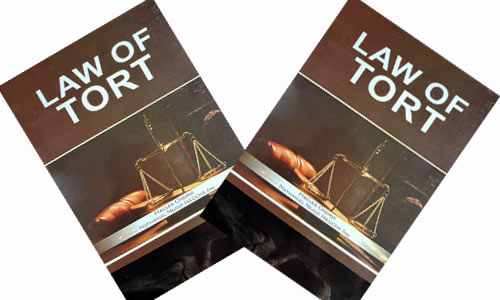 The book, titled The Law of Torts in Nigeria: A Functional Approach, authored by Professor Hagler Sunny Okorie Ph.D and Ikeocha, Nathaniel Ngozi Esq, offers law students, practitioners, and academics a comprehensive guide to understanding and applying tort law in Nigerian courts. Interested buyers can place orders via the following contact numbers: 08028636615, 08037667945, 08032253813, or +234 902 196 2209.
______________________________________________________________________
[A MUST HAVE] Evidence Act Demystified With Recent And Contemporary Cases And Materials
The book, titled The Law of Torts in Nigeria: A Functional Approach, authored by Professor Hagler Sunny Okorie Ph.D and Ikeocha, Nathaniel Ngozi Esq, offers law students, practitioners, and academics a comprehensive guide to understanding and applying tort law in Nigerian courts. Interested buyers can place orders via the following contact numbers: 08028636615, 08037667945, 08032253813, or +234 902 196 2209.
______________________________________________________________________
[A MUST HAVE] Evidence Act Demystified With Recent And Contemporary Cases And Materials

 ARTIFICIAL INTELLIGENCE FOR LAWYERS: A COMPREHENSIVE GUIDE
Reimagine your practice with the power of AI “...this is the only Nigerian book I know of on the topic.” — Ohio Books Ltd
Authored by Ben Ijeoma Adigwe, Esq., ACIArb (UK), LL.M, Dip. in Artificial Intelligence, Director, Delta State Ministry of Justice, Asaba, Nigeria.
Bonus:
Get a FREE eBook titled “How to Use the AI in Legalpedia and Law Pavilion” with every purchase.
ARTIFICIAL INTELLIGENCE FOR LAWYERS: A COMPREHENSIVE GUIDE
Reimagine your practice with the power of AI “...this is the only Nigerian book I know of on the topic.” — Ohio Books Ltd
Authored by Ben Ijeoma Adigwe, Esq., ACIArb (UK), LL.M, Dip. in Artificial Intelligence, Director, Delta State Ministry of Justice, Asaba, Nigeria.
Bonus:
Get a FREE eBook titled “How to Use the AI in Legalpedia and Law Pavilion” with every purchase.
How to Order: 📞 Call, Text, or WhatsApp: 08034917063 | 07055285878 📧 Email: benadigwe1@gmail.com 🌐 Website: www.benadigwe.com
Ebook Version: Access directly online at: https://selar.com/prv626
________________________________________________________________________ The Law And Practice Of Redundancy In Nigeria: A Practitioner’s Guide, Authored By A Labour & Employment Law Expert Bimbo Atilola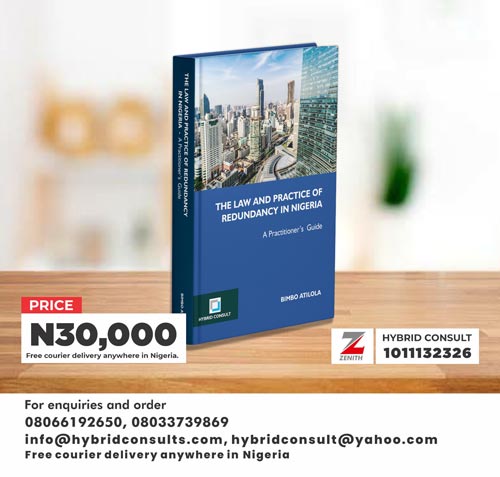 _______________________________________________________________________
“Enhance Legal Practice With Authoritative Reports” — Alexander Payne Offers Comprehensive Law Reports, Spanning Over A Century Of Nigerian Jurisprudence
_______________________________________________________________________
“Enhance Legal Practice With Authoritative Reports” — Alexander Payne Offers Comprehensive Law Reports, Spanning Over A Century Of Nigerian Jurisprudence
 Interested buyers are encouraged to place their orders and enquiries via:
0704 444 4777, 0704 444 4999, 0818 199 9888
Website: www.alexandernigeria.com
Interested buyers are encouraged to place their orders and enquiries via:
0704 444 4777, 0704 444 4999, 0818 199 9888
Website: www.alexandernigeria.com