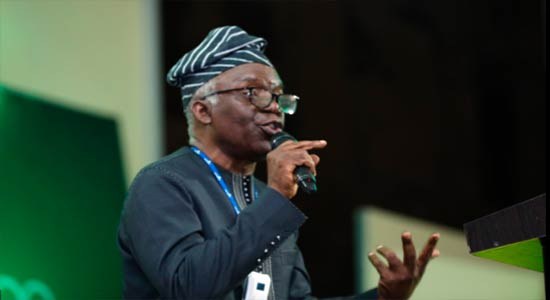
Rights activist and Senior Advocate of Nigeria, Femi Falana, has accused the International Monetary Fund and the World Bank of colluding with the Central Bank of Nigeria to frustrate currency swap in the country and promote the dominance of the United States Dollar.

Falana, who described the alleged move of the IMF and World Bank as “economic sabotage”, noted that the Federal Government has also continued to “dollarise” the Nigerian economy “while other nations are making arrangements to promote their local currencies.”
The legal luminary stated this in a statement titled, ‘Why Nigeria must join BRICS’, released on Monday.
“About five years ago, the Federal Government of Nigeria and China entered into a currency exchange agreement. The transaction, which was valued at Renminbi (RMB) 16 billion or N720 billion was aimed at providing adequate local currency liquidity to Nigerian and Chinese industrialists and other businesses, thereby, reducing difficulties encountered in the search for the United States Dollar. The swap was also designed to improve the speed, convenience and volume of transactions between the two countries,” Falana stated.
“But the International Monetary Fund and the World Bank which superintend the Central Bank of Nigeria have colluded with the Central Bank of Nigeria to frustrate the currency swap. The purpose of the economic sabotage is to promote the dominance of the United States Dollar in Nigeria. Even though Nigeria has since become an important source of oil and petroleum for China’s rapidly growing economy, the Federal Government has continued to demand for payment in Dollar instead of Naira,” he added.
He continued, “While other nations are making arrangements to promote their local currencies, the Federal Government has continued to dollarise the Nigerian economy.”
Citing Kenya, Russia and India as examples of countries that have begun to transact in their respective local currencies, Falana noted that Brazil, Russia, India, China, and South Africa “have concluded plans to launch a new international currency to be used for cross-border trade by the member nations.”
“Ahead of the August summit of the BRICS scheduled to hold (sic) in South Africa, a total of 24 nations are now looking to build a strategic alliance that will challenge the US dollar’s decades-long role as the world’s reserve currency. The 24 nations include Saudi Arabia, Iran, Argentina, the United Arab Emirates, Algeria, Egypt, Bahrain, Indonesia and a couple of African countries.
“This trend to reject neo-liberal orthodoxy policy formulation is captured by the South Korean development economist of the University of London, Ha-Joon Chang, in his recent book, Edible Economics, as follows: ‘The rejection of the neo-liberal Washington Consensus policies has been less visible in other parts of the developing world, such as Asia and Africa. In Asia, it was mainly because the countries in the region had not followed the Washington Consensus policies in the first place as rigidly as did the Latin American countries. Their generally good economic performance has meant that relatively few Asian countries have had to borrow heavily from the Washington institutions, making it less necessary for them to adopt neo-liberal policies.
“‘Moreover, many Asian countries have had a less ideological approach to economic policies, so, even when they adopted neo-liberal policies, those policies were usually not implemented in their extreme forms, as they were in Latin America. The African countries, even though they have suffered even more than did the Latin American countries from the Washington Consensus policies, have found it more difficult to openly reject them, given their greater dependence the Washington institutions for financing. Even so, in the last decade or so, there has been an increasing recognition across the African continent of the need for a much more active role for the state than what is recommended by the Washington Consensus.’”
He advised that Nigeria should “take a lead in the execution of the African Union (AU)’s project of African Continental Free Trade Area (AfCFTA) which took effect two years ago. The country should strive for the benefits of promoting trade at such a regional level as an alternative to the increasing dollarisation of a vulnerable economy.”
Calling for an urgent action by the Federal Government to save the country’s economy from the current “dollarisation”, Falana said, “instead of the failed redesign of the Naira, the federal government should take urgent steps to save the Naira by renewing the currency swap between Nigeria and China.”
He added that “similar agreements should be undertaken with other friendly nations so that Nigeria can pay for imports in Naira. In particular, buyers of Nigeria’s crude oil and natural gas should henceforth be made to pay in Naira.”
Falana advised that “the federal government should join forces with the BRICS to promote a new international currency. This is in line with Section 19(e) of the Constitution, which has imposed a duty on the Government of Nigeria to promote a just world economic order.”
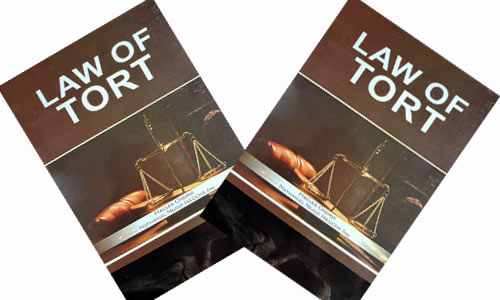 The book, titled The Law of Torts in Nigeria: A Functional Approach, authored by Professor Hagler Sunny Okorie Ph.D and Ikeocha, Nathaniel Ngozi Esq, offers law students, practitioners, and academics a comprehensive guide to understanding and applying tort law in Nigerian courts. Interested buyers can place orders via the following contact numbers: 08028636615, 08037667945, 08032253813, or +234 902 196 2209.
______________________________________________________________________
[A MUST HAVE] Evidence Act Demystified With Recent And Contemporary Cases And Materials
The book, titled The Law of Torts in Nigeria: A Functional Approach, authored by Professor Hagler Sunny Okorie Ph.D and Ikeocha, Nathaniel Ngozi Esq, offers law students, practitioners, and academics a comprehensive guide to understanding and applying tort law in Nigerian courts. Interested buyers can place orders via the following contact numbers: 08028636615, 08037667945, 08032253813, or +234 902 196 2209.
______________________________________________________________________
[A MUST HAVE] Evidence Act Demystified With Recent And Contemporary Cases And Materials

 ARTIFICIAL INTELLIGENCE FOR LAWYERS: A COMPREHENSIVE GUIDE
Reimagine your practice with the power of AI “...this is the only Nigerian book I know of on the topic.” — Ohio Books Ltd
Authored by Ben Ijeoma Adigwe, Esq., ACIArb (UK), LL.M, Dip. in Artificial Intelligence, Director, Delta State Ministry of Justice, Asaba, Nigeria.
Bonus:
Get a FREE eBook titled “How to Use the AI in Legalpedia and Law Pavilion” with every purchase.
ARTIFICIAL INTELLIGENCE FOR LAWYERS: A COMPREHENSIVE GUIDE
Reimagine your practice with the power of AI “...this is the only Nigerian book I know of on the topic.” — Ohio Books Ltd
Authored by Ben Ijeoma Adigwe, Esq., ACIArb (UK), LL.M, Dip. in Artificial Intelligence, Director, Delta State Ministry of Justice, Asaba, Nigeria.
Bonus:
Get a FREE eBook titled “How to Use the AI in Legalpedia and Law Pavilion” with every purchase.
How to Order: 📞 Call, Text, or WhatsApp: 08034917063 | 07055285878 📧 Email: benadigwe1@gmail.com 🌐 Website: www.benadigwe.com
Ebook Version: Access directly online at: https://selar.com/prv626
________________________________________________________________________ The Law And Practice Of Redundancy In Nigeria: A Practitioner’s Guide, Authored By A Labour & Employment Law Expert Bimbo Atilola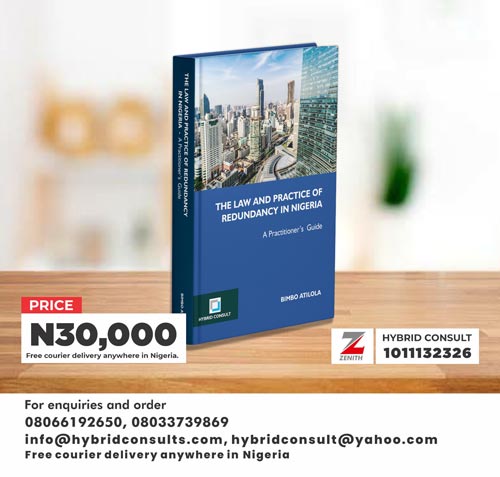 _______________________________________________________________________
“Enhance Legal Practice With Authoritative Reports” — Alexander Payne Offers Comprehensive Law Reports, Spanning Over A Century Of Nigerian Jurisprudence
_______________________________________________________________________
“Enhance Legal Practice With Authoritative Reports” — Alexander Payne Offers Comprehensive Law Reports, Spanning Over A Century Of Nigerian Jurisprudence
 Interested buyers are encouraged to place their orders and enquiries via:
0704 444 4777, 0704 444 4999, 0818 199 9888
Website: www.alexandernigeria.com
Interested buyers are encouraged to place their orders and enquiries via:
0704 444 4777, 0704 444 4999, 0818 199 9888
Website: www.alexandernigeria.com