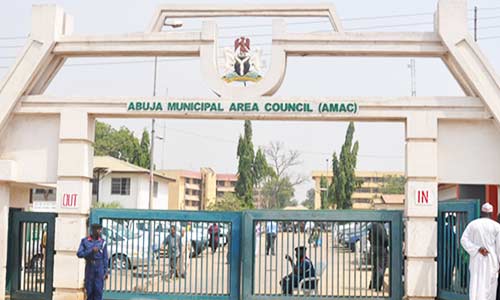
The Abuja Municipal Area Council (AMAC) has faulted recent statements by the FCT Public Health Department and the FCT Administration (FCTA) regarding the collection of levies and regulation of business premises within the council’s jurisdiction.

In a statement issued on Monday, January 5, 2026, AMAC accused the FCTA of attempting to undermine the constitutional functions of local government and called for the FCT Minister’s intervention.
The statement, signed by Kingsley Madaki, Senior Special Assistant on Media and Public Affairs to the Executive Chairman, Hon. Christopher Zakka Maikalangu, described a recent stakeholders’ meeting organized by the FCTA as “a direct attempt to undermine the constitutional functions of the Third Tier of Government.”
AMAC emphasized that under the 1999 Constitution (as amended), specifically the Fourth Schedule, the functions of local governments and area councils are clearly defined and protected.
“It is essential to remind the FCTA and the general public that the FCT Public Health Department is a service-oriented administrative body, not a revenue-generating agency,” the statement read.
According to AMAC, the Constitution grants area Councils exclusive functions including provision and maintenance of health services, control and regulation of shops, kiosks, restaurants, bakeries and other food outlets, regulation of slaughterhouses and markets, as well as assessment of privately owned houses and tenements.
“The Constitution is supreme; any administrative regulation or law that conflicts with these specific provisions is unconstitutional, null, and void,” the council stated.
The FCTA Public Health Department had reportedly cited a High Court judgment in Suit No. CV/1642/2024 (Devyani International Nig. Limited v. Abuja Municipal Area Council) to describe AMAC’s operations as illegal.
However, AMAC clarified that the judgment in question relied on a previous default judgment (Dunes Investment and Global Service v. Abuja Municipal Area Council), which has since been set aside.
“Consequently, AMAC has appealed the Devyani judgment on the grounds that the trial court did not consider the constitutional provisions or the fact that the precedent (Dunes) was voided,” the statement explained.
The council noted that an order for Stay of Execution has been filed, maintaining that the matter is sub judice and that the FCTA has no legal standing to unilaterally declare the council’s activities illegal pending the outcome of the appeal.
AMAC drew a clear distinction between revenue generation and service delivery, arguing that the FCT Public Health Department’s role is limited to policy formulation and clinical oversight.
“It has no constitutional backing to compete for revenue with a democratically elected local administration,” the council stated.
The statement warned that by attempting to commercialize health inspections and sideline the area council, the FCTA is encouraging institutional conflict that deprives grassroots government of funds needed for critical development projects, including rural electrification, primary healthcare, and local road construction and maintenance.
The Executive Chairman of AMAC, Hon. Christopher Zakka Maikalangu, urged business owners to remain law-abiding while remaining mindful of their statutory obligations to the council.
“We are committed to an ‘Ease of Doing Business’ environment, but we will not stand by while the constitutional powers of the Third Tier of Government are eroded by agencies that lack the legal mandate to collect such levies,” the chairman stated.
AMAC called on the FCT Minister to intervene and ensure that the FCTA Public Health Department focuses on its primary mandate of clinical excellence rather than interfering in the revenue structures of the area council.
“AMAC remains confident in the judicial process and asserts that its right to generate Internal Revenue (IGR) cannot be extinguished by administrative fiat,” the statement concluded.
The dispute highlights ongoing tensions between the FCT Administration and area councils over revenue collection rights and jurisdictional boundaries in the nation’s capital.
 ARTIFICIAL INTELLIGENCE FOR LAWYERS: A COMPREHENSIVE GUIDE
Reimagine your practice with the power of AI “...this is the only Nigerian book I know of on the topic.” — Ohio Books Ltd
Authored by Ben Ijeoma Adigwe, Esq., ACIArb (UK), LL.M, Dip. in Artificial Intelligence, Director, Delta State Ministry of Justice, Asaba, Nigeria.
Bonus:
Get a FREE eBook titled “How to Use the AI in Legalpedia and Law Pavilion” with every purchase.
ARTIFICIAL INTELLIGENCE FOR LAWYERS: A COMPREHENSIVE GUIDE
Reimagine your practice with the power of AI “...this is the only Nigerian book I know of on the topic.” — Ohio Books Ltd
Authored by Ben Ijeoma Adigwe, Esq., ACIArb (UK), LL.M, Dip. in Artificial Intelligence, Director, Delta State Ministry of Justice, Asaba, Nigeria.
Bonus:
Get a FREE eBook titled “How to Use the AI in Legalpedia and Law Pavilion” with every purchase.
How to Order: 📞 Call, Text, or WhatsApp: 08034917063 | 07055285878 📧 Email: benadigwe1@gmail.com 🌐 Website: www.benadigwe.com
Ebook Version: Access directly online at: https://selar.com/prv626
________________________________________________________________________ The Law And Practice Of Redundancy In Nigeria: A Practitioner’s Guide, Authored By A Labour & Employment Law Expert Bimbo Atilola _______________________________________________________________________
[A MUST HAVE] Evidence Act Demystified With Recent And Contemporary Cases And Materials
_______________________________________________________________________
[A MUST HAVE] Evidence Act Demystified With Recent And Contemporary Cases And Materials