It has become an integral part of man’s existence on earth to desire to sell or acquire properties like land in his lifetime. This is usually considered to be a form of investment of a man’s wealth or resources. It also serves as a sort of tangible collateral to its owner particularly in the event of an ugly turn-around of a man’s fortunes. In Nigeria, apart from customary land transactions which must not be evidenced on paper or documented, land transactions are expected to be captured in a documented form. This is in line with the relevant provisions of law regulating land transactions in Nigeria.

Unarguably, the permitted and safest mode of transferring ownership of land in Nigeria is by a document known as Deed. It could be a deed of gift, transfer, assignment or conveyance as the case may be. This is in so far as there is a sufficient certainty or complete agreement of the parties involved, the property to be transacted over, the consideration or purchase price of the property and the nature of interest to be granted as held by the Court of Appeal (Jos Division) in the case of GEGE V. NANDE (2006) 10NWLR; Pt. 988, pg 265. Accordingly, a deed is a formal instrument of sale by which the unexpired residue or remaining interest in a property like land is transferred or conveyed to another who becomes the owner or vendor.
However, there is recently an increasing but unhealthy resort by land sellers and purchasers alike to the improper use of the instrument of Power of Attorney as a means of transferring ownership of land. This is a sorry situation and must be condemned in the strongest and earliest possible terms before it entirely wrecks the ship of land transactions in Nigeria thereby occasioning a litany of bitter litigations over land ownership as is currently the case.
To start with, a Power of Attorney is a document or instrument in writing, usually but not necessarily in the form of a deed, by which a person called the ‘Donor’ appoints another known as ‘Donee’ and confers authority and/or powers on the donee to do or perform certain acts on behalf of the donor. A Power of Attorney is infact an instrument of delegation and not alienation which can be deployed for a long list of purposes; for instance, to prosecute or defend a suit in court, to enter into an agreement, to negotiate or sign a contract, to execute a project, to sell a property or to attend a meeting on behalf of the donating authority. The common denominator in a Power of Attorney is that the acts to be performed by the donee are confined to the ones expressly or impliedly authorized and exhaustively contained in the donating instrument. It must be noted that if the Power of Attorney authorizes a certain donee to execute a deed, then the donating instrument must be by a deed and must be signed and sealed. This is the position of the court in ABINA V. FARHAT (1938) 14NLR; Pt. 17.
Unfortunately, the Power of Attorney has been arrogated more power than the law permitted for it. It has been glorified to the realm of documents through which ownership of land can be conveyed or acquired. But this is wrong and procedurally improper. Research has also revealed that two-third of cases over land in courts today are traceable to defective titles to land acquired through improper modes. This is particularly the stock-in-trade of unqualified estate agents, quack architects, untrained surveyors, uncertified town planners and even lawyers who engage in such sharp or jankara practices just to hit quick money.
The abuse arising from the unprofessional use of Power of Attorney as a document of land ownership transfer is monumental and only attracts disdain to property and conveyancing practice in Nigeria. The abundance of conveyancing legislations, the application of ancient conveyancing laws and the obvious difficulty in the interpretation of our laws on property and conveyancing largely contribute to this whole mess. Also, professional incompetence, high illiteracy rate and the frustrating nature of the different land registries who have consistently failed to properly regulate the engagement of professionals in land transactions is not unconnected to this quagmire which has bedeviled land administration in Nigeria.
It appears that the Conveyancing Act which is the legislation regulating land transactions in the east allows the use of Power of Attorney in land transactions but the Supreme Court has bluntly and in several decided cases disagreed with this system and further described the practice as fraudulent. In UDE V. NWARA (1993) 2NWLR Pt. 278, the Supreme Court held that ‘a Power of Attorney warrants and authorizes the donee to do certain acts in the stead of the donor and so is not an instrument which confers, transfers, limits, charges or alienates any title to land to the donee. It only acts as a vehicle through which these acts could be done’. Also in AMADI V. NSIRIM (2004) 17NWLR Pt.901; pg 111, it was held that a purchaser therefore of land with only a Power of Attorney is only an agent of the real land owner still as the title to the land still rests wholly and solely on the seller. In a nutshell therefore, a donee of a Power of Attorney does not possess the legal personality or locus standi to sue in a land case where the Power of Attorney stipulates that he is only an agent of the principal or donor. The donee in such circumstance must sue in the name of the donor who may no longer be the land vendor having transferred ownership of the land vested on him. This is the position of the law in VULCAN GASES LTD V. G.F IND. A.G (2001) 9NWLR Pt.719; pg 610 and VINZ INT’L (NIG.) LTD V. MOROHUNDIYA (2009) 11NWLR Pt. 1153; pg 562.
In the light of the above, there is an urgent need to vigorously educate the Nigerian populace; both elites and illiterates on the complications already steaming from the use of Power of Attorney to convey interest in land or acquire same. It is thus important that purchasers of land anywhere in Nigeria must be smart enough to consult a professional particularly a lawyer who is seasoned in land transactions whenever they are engaging in any such transaction involving land. They must also insist on a deed as evidence of land ownership transfer. Whether a Power of Attorney is revocable or irrevocable, it cannot confer clear and marketable title to land. This is the reason why land purchasers or even sellers must take great caution not to be swindled or deceived into accepting a Power of Attorney as an instrument of alienation of title to land. It is already common knowledge that the popularity of the use of a Power of Attorney is sequel to the misconceived fact that it is used to avoid payment of high stamp duties to government and moreso, it does not require Governor’s consent at registration. While this may be somewhat true, a Power of Attorney cannot be safely deemed a substitute for deed in respect of any land dealing or transaction in Nigeria.
Prince Chigbo Okoli, Esq., DRS. (ceebeeokoli@gmail.com) is a legal practitioner, seasoned researcher and certified Dispute Resolution Specialist with amazing experience cutting across litigation, alternative dispute resolution and property/real estate management and practice. He is also into legal resource consultancy and has over 50 reputable essays and articles to his credit.
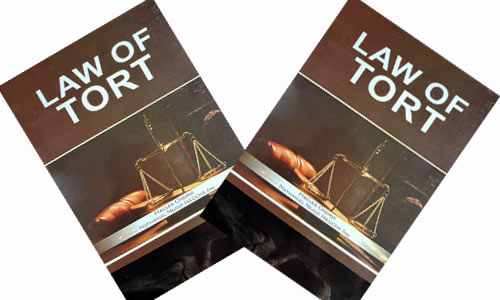 The book, titled The Law of Torts in Nigeria: A Functional Approach, authored by Professor Hagler Sunny Okorie Ph.D and Ikeocha, Nathaniel Ngozi Esq, offers law students, practitioners, and academics a comprehensive guide to understanding and applying tort law in Nigerian courts. Interested buyers can place orders via the following contact numbers: 08028636615, 08037667945, 08032253813, or +234 902 196 2209.
______________________________________________________________________
[A MUST HAVE] Evidence Act Demystified With Recent And Contemporary Cases And Materials
The book, titled The Law of Torts in Nigeria: A Functional Approach, authored by Professor Hagler Sunny Okorie Ph.D and Ikeocha, Nathaniel Ngozi Esq, offers law students, practitioners, and academics a comprehensive guide to understanding and applying tort law in Nigerian courts. Interested buyers can place orders via the following contact numbers: 08028636615, 08037667945, 08032253813, or +234 902 196 2209.
______________________________________________________________________
[A MUST HAVE] Evidence Act Demystified With Recent And Contemporary Cases And Materials

 ARTIFICIAL INTELLIGENCE FOR LAWYERS: A COMPREHENSIVE GUIDE
Reimagine your practice with the power of AI “...this is the only Nigerian book I know of on the topic.” — Ohio Books Ltd
Authored by Ben Ijeoma Adigwe, Esq., ACIArb (UK), LL.M, Dip. in Artificial Intelligence, Director, Delta State Ministry of Justice, Asaba, Nigeria.
Bonus:
Get a FREE eBook titled “How to Use the AI in Legalpedia and Law Pavilion” with every purchase.
ARTIFICIAL INTELLIGENCE FOR LAWYERS: A COMPREHENSIVE GUIDE
Reimagine your practice with the power of AI “...this is the only Nigerian book I know of on the topic.” — Ohio Books Ltd
Authored by Ben Ijeoma Adigwe, Esq., ACIArb (UK), LL.M, Dip. in Artificial Intelligence, Director, Delta State Ministry of Justice, Asaba, Nigeria.
Bonus:
Get a FREE eBook titled “How to Use the AI in Legalpedia and Law Pavilion” with every purchase.
How to Order: 📞 Call, Text, or WhatsApp: 08034917063 | 07055285878 📧 Email: benadigwe1@gmail.com 🌐 Website: www.benadigwe.com
Ebook Version: Access directly online at: https://selar.com/prv626
________________________________________________________________________ The Law And Practice Of Redundancy In Nigeria: A Practitioner’s Guide, Authored By A Labour & Employment Law Expert Bimbo Atilola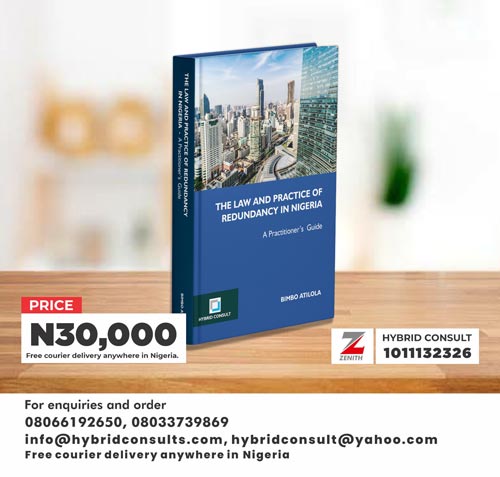 _______________________________________________________________________
“Enhance Legal Practice With Authoritative Reports” — Alexander Payne Offers Comprehensive Law Reports, Spanning Over A Century Of Nigerian Jurisprudence
_______________________________________________________________________
“Enhance Legal Practice With Authoritative Reports” — Alexander Payne Offers Comprehensive Law Reports, Spanning Over A Century Of Nigerian Jurisprudence
 Interested buyers are encouraged to place their orders and enquiries via:
0704 444 4777, 0704 444 4999, 0818 199 9888
Website: www.alexandernigeria.com
Interested buyers are encouraged to place their orders and enquiries via:
0704 444 4777, 0704 444 4999, 0818 199 9888
Website: www.alexandernigeria.com