
The Independent National Electoral Commission (INEC) is set to conduct a nationwide mock election on Saturday, November 28, 2026, to test network connectivity, the Bimodal Voter Accreditation System (BVAS) and the electronic uploading of results to its Result Viewing Portal (IReV) ahead of the 2027 general elections.

The exercise is designed to identify potential technological failures, assess the capacity of the commission’s electoral systems and address challenges that could affect voter accreditation and the transmission of election results.
INEC’s Deputy Director of Voter Education and Publicity, Wilfred Ifogah, disclosed the objectives of the exercise during an appearance on Channels Television’s Politics Today on Friday.
He explained that the nationwide test would enable the commission to determine the reliability of network connections required for uploading polling-unit results to the INEC Result Viewing Portal.
According to him, the commission intends to identify and resolve technical difficulties before the general elections rather than encounter them during the actual voting exercise.
“The mock election is important to check the network that will ensure seamless uploads of results on the IReV and tackle issues that may come up during the general elections,” Ifogah said.
The INEC official explained that the exercise would provide an opportunity to assess the functionality of the commission’s electoral technology under conditions intended to replicate aspects of an actual election.
He said preparations had been concluded, with materials already deployed to the states and officials assigned to supervise the exercise dispatched to their respective locations.
Ifogah also clarified that the mock election would not involve political parties or candidates, as its purpose was strictly to assess the performance of the commission’s technological systems.
He explained that plain ballot papers would be used instead of those bearing the names or symbols of political parties.
According to him, the arrangement would enable INEC to test how BVAS devices capture images of result sheets and how those images are subsequently uploaded.
“They are not using it for partisan events. It is just plain. We just want to see how the BVAS will capture the photographs of whatever we agreed is going to be the result sheets. So, no party is represented,” he stated.
The clarification was intended to emphasise that the exercise was a technical assessment rather than an electoral contest between political parties.
Beyond testing the devices used for voter accreditation, the commission will assess the processes involved in capturing and uploading results electronically.
The exercise will particularly examine network availability and the ability of BVAS devices to transmit images of polling-unit result sheets to IReV.
By testing these processes ahead of the elections, INEC hopes to identify challenges that may require technical adjustments or other corrective measures.
On logistics, Ifogah disclosed that the commission would replicate arrangements previously adopted during the Ekiti and Osun governorship elections.
He explained that the experience gained from those exercises would guide preparations for the nationwide mock poll.
The commission’s focus on logistics and technology forms part of its efforts to assess its operational readiness ahead of the 2027 elections.
Also speaking on the planned exercise, the Executive Director of Yiaga Africa, Samson Itodo, described the nationwide mock election as an important opportunity to evaluate INEC’s technological preparedness.
Itodo noted that the exercise would be the first nationwide test of BVAS and IReV since the 2023 general elections.
According to him, the nationwide assessment would provide an opportunity to examine the performance of systems expected to play significant roles in the conduct of the 2027 polls.
He disclosed that the exercise would involve testing the 57,000 BVAS machines procured and tested by the commission, alongside the electronic EC8A result sheets.
Itodo explained that although the electronic EC8A result sheets had previously been deployed during elections in the Federal Capital Territory, Ekiti and Osun states, the mock election would provide an opportunity to assess their use on a nationwide scale.
The electronic EC8A is an important component of the commission’s result management process, making its functionality a central aspect of the planned exercise.
According to the Yiaga Africa executive director, testing the devices and electronic result sheets across the country would help reveal potential operational and technical difficulties before the general elections.
He maintained that the exercise would also provide Nigerians with an opportunity to assess the commission’s preparedness and the reliability of the technologies it intends to deploy.
The planned nationwide test comes as attention increasingly turns to INEC’s ability to conduct the 2027 general elections with reliable accreditation and result management systems.
The use of technology in elections remains an important issue in public discussions about electoral transparency, particularly the effectiveness of BVAS and the electronic uploading of polling-unit results.
INEC’s planned assessment is therefore intended to examine whether the systems can function effectively under the conditions anticipated during the general elections.
The commission will also seek to identify network limitations that could interfere with timely result uploads and determine what technical measures may be required to address them.
While Ifogah emphasised the commission’s preparations and the deployment of personnel and materials, Itodo stressed the importance of using the exercise to evaluate the performance of the technologies on a national scale.
Both identified the mock election as an opportunity to detect and address challenges before Nigerians return to the polls in 2027.
[A MUST HAVE] Evidence Act Demystified With Recent And Contemporary Cases And Materials
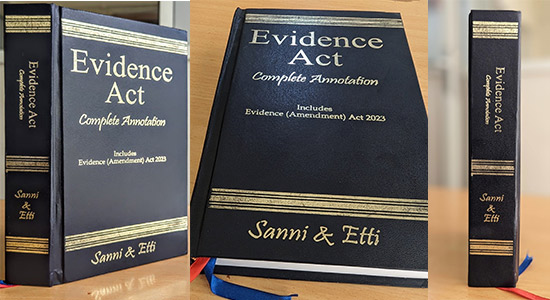
Available now for NGN 40,000 at ASC Publications, 10, Boyle Street, Onikan, Lagos. Beside High Court, TBS. Email publications@ayindesanni.com or WhatsApp +2347056667384. Purchase Link: https://paystack.com/buy/evidence-act-complete-annotation
______________________________________________________________________ “Enhance Legal Practice With Authoritative Reports” — Alexander Payne Offers Comprehensive Law Reports, Spanning Over A Century Of Nigerian Jurisprudence Interested buyers are encouraged to place their orders and enquiries via:
0704 444 4777, 0704 444 4999, 0818 199 9888
Website: www.alexandernigeria.com
“A Comprehensive Guide To Evidence Law” — Releases Second Edition In Three Volumes, Covering 4,051 Cases
For enquiries and orders, contact: 08035526491 Email: jerryamadisilk@gmail.com
 Prof. Jerry Amadi’s Evidence Law, Second Edition (2026), contains 3,314 pages in three volumes, covering the Evidence Act 2011, its 2023 amendment, and 4,051 Nigerian and English cases.