The Nigerian Bar Association (NBA), Nigerian Law Reform Commission and Code of Conduct Bureau (CCB) have called for urgent reforms of Nigeria’s anti-corruption justice system, warning that prolonged trials, weak enforcement of laws, institutional failures and delays in court proceedings are undermining accountability and public confidence in the fight against corruption.

The three institutions expressed concern that Nigeria’s anti-corruption campaign could lose its effectiveness if investigations, arrests and prosecutions continued without timely, credible and fair judicial outcomes.
They made their positions known on Thursday, November 26, 2026, in Abuja, during the public presentation of a publication by the Centre for Social Justice (CSJ), titled “Sample High Profile Corruption Cases in Nigeria (As at October 2026).”
The publication examined 30 high-profile corruption trials pending before Nigerian courts, alongside an audit of cases before the Code of Conduct Tribunal, highlighting challenges affecting the investigation, prosecution and determination of corruption cases.
While the Nigerian Law Reform Commission pledged to examine the findings and recommend legislative changes where necessary, the NBA called for stronger judicial and prosecutorial capacity, improved funding, better institutional coordination and technology-driven case management.
The Code of Conduct Bureau also supported legislative and institutional reforms aimed at strengthening the Code of Conduct Tribunal but warned that anti-corruption efforts must respect the constitutional rights of defendants, judicial independence and the presumption of innocence.
Speaking at the event, the Chairman of the Nigerian Law Reform Commission, Professor Dakas C. J. Dakas, SAN, represented by Ozo Osarodion, described corruption as one of the greatest threats to Nigeria’s development, democratic institutions and public confidence in governance.
He maintained that Nigeria’s major challenge was not necessarily the absence of laws against corruption but the weaknesses affecting their implementation.
According to him, the existence of numerous anti-corruption laws had not translated into an effective justice system because of fragmented legislation, overlapping statutory provisions, prolonged court proceedings and inadequate enforcement.
“Having many laws is not the same as having an effective legal framework. Our challenge is not the absence of law. It is fragmentation, overlap, delay, weak enforcement, and a gap between the law on paper and the law in practice,” Dakas said.
The commission chairman explained that corruption deprived the country of resources needed to provide essential services and infrastructure, including education, healthcare, roads, water and security.
He added that corrupt practices distorted public procurement, undermined electoral processes and weakened the institutions responsible for delivering public services.
Dakas described the CSJ publication as an important contribution to the country’s anti-corruption efforts because it provided a documented account of major corruption cases and the progress made in prosecuting them.
He said the publication identified individuals facing charges, the allegations against them, the courts handling their cases and significant developments in the proceedings.
According to him, the documentation served four major purposes: preserving records of corruption cases, educating the public, exposing weaknesses in the justice system and promoting accountability.
He expressed concern that some corruption cases could be instituted, repeatedly adjourned and eventually abandoned without meaningful resolution.
The chairman maintained that consistent documentation of court proceedings was necessary to prevent such cases from disappearing from public attention and to provide institutions with reliable information for reform.
Dakas identified recurring problems in the justice system, including excessive delays, interlocutory appeals, plea bargaining arrangements lacking transparency, asset recovery without sufficient accountability and prosecutions that collapse because of inadequate investigations or poor handling of cases.
“These are not isolated failures. They are systemic failures, and systemic failures require systemic reform,” he declared.
He disclosed that the Nigerian Law Reform Commission would study the CSJ publication and use its findings to guide its law reform programme.
The areas to be examined, according to him, include criminal investigation, prosecution, asset recovery, sentencing, whistle-blower protection and measures for preventing corruption.
Dakas explained that where the findings revealed deficiencies in existing substantive laws, the commission would incorporate the identified issues into its legislative reform programme.
He added that where delays resulted from procedural difficulties, the commission would examine ways of simplifying and expediting the relevant legal processes.
The chairman further pledged that where new legislation became necessary, appropriate recommendations would be made to the Attorney-General of the Federation and the National Assembly.
Beyond legal and institutional reforms, Dakas emphasised that corruption was not exclusively a legal problem but also a moral, cultural and leadership challenge requiring wider societal involvement.
He advocated the introduction and strengthening of anti-corruption education at different levels of the educational system, including primary and secondary schools, universities, professional training institutions and the public service.
He argued that promoting integrity from an early age would help develop a culture in which corruption was rejected rather than tolerated.
“If we do not teach integrity early, we will spend a lifetime punishing its absence,” he said.
In its contribution, the Nigerian Bar Association expressed concern that prolonged corruption trials were weakening public confidence in the justice system and reducing the deterrent value of anti-corruption laws.
The association’s position was presented by its Second Vice President, Nuhu Egya, who represented the NBA President, Mrs. Oyinkansola Badejo-Okusanya, SAN.
The NBA maintained that the success of the fight against corruption should not be determined merely by the number of investigations initiated, suspects arrested or criminal charges filed.
Instead, the association argued that attention must also be given to the fairness, credibility, efficiency and eventual outcomes of judicial proceedings.
It described the CSJ publication as an important resource for examining the institutional and procedural obstacles preventing the timely resolution of corruption cases.
The NBA specifically drew attention to Section 36(1) of the 1999 Constitution, as amended, which guarantees the right to a fair hearing within a reasonable time.
The association maintained that the constitutional protection must remain central to anti-corruption prosecutions, irrespective of the seriousness of the allegations involved.
“The objective must be to achieve both accountability and fairness: a justice system that is effective without being arbitrary, expeditious without compromising due process, and firm in the enforcement of the law without sacrificing constitutional guarantees,” the NBA stated.
It identified the Administration of Criminal Justice Act (ACJA) 2015 as an important legislative framework for improving criminal justice administration but emphasised that legislation alone could not resolve the challenges facing the system.
According to the association, effective implementation of the Act required proper institutional cooperation, adequate resources, improved case management and the strategic application of technology.
The NBA consequently advocated the strengthening of judicial and prosecutorial case management systems, increased institutional capacity and adequate funding for justice-sector institutions.
It also called for the introduction and expansion of technology-driven systems for tracking corruption cases, maintaining records and monitoring the progress of court proceedings.
The association stressed the importance of better coordination among agencies responsible for investigating, prosecuting and adjudicating corruption-related matters.
It further urged sustained monitoring and evaluation of reform programmes to ensure that recommendations were translated into practical improvements rather than remaining unimplemented.
The NBA maintained that fighting corruption was a collective national responsibility that could not be left solely to government officials and anti-corruption agencies.
It called on the judiciary, legislature, legal profession, civil society organisations, development partners, media and the Nigerian public to contribute to building a more accountable and effective justice system.
The Code of Conduct Bureau, in its contribution, similarly identified delays in the determination of corruption-related cases as a major challenge confronting Nigeria’s justice system.
The bureau called for stronger case management, improved institutional capacity, more efficient judicial processes and greater use of technology.
Its position was presented by the Director of its Legal Service Department, Mrs. Sambo Sa’adat Omotayo, who delivered a goodwill message on behalf of the CCB Chairman.
Omotayo maintained that an effective anti-corruption campaign required more than investigating alleged offenders and prosecuting them before the courts.
According to her, strong institutions, effective legislation, efficient judicial processes and public commitment to integrity were equally necessary to achieve sustainable results.
She described the CSJ publication as a timely contribution to discussions on accountability and institutional reform, particularly because of its examination of 30 high-profile corruption cases and its audit of matters before the Code of Conduct Tribunal.
The CCB representative explained that the bureau occupied a strategic position in Nigeria’s anti-corruption framework because of its constitutional responsibilities concerning the conduct of public officers.
She identified those responsibilities as receiving and examining asset declarations submitted by public officers, investigating alleged breaches of the Code of Conduct for Public Officers and referring appropriate matters to the Code of Conduct Tribunal.
Omotayo reaffirmed the bureau’s commitment to strengthening its internal processes, improving investigative and legal capacity, encouraging inter-agency cooperation and developing appropriate mechanisms for addressing violations of the Code of Conduct.
She also welcomed the proposed legislative memorandum aimed at strengthening the Code of Conduct Tribunal.
According to her, the bureau looked forward to examining the recommendations and engaging relevant stakeholders on measures to improve the tribunal’s effectiveness, independence and operational capacity.
Omotayo supported a review of existing legislation, judicial procedures and institutional practices to eliminate avoidable delays in the handling of corruption cases.
She further advocated improvements in the capacity of investigators and legal practitioners involved in handling such matters.
However, the CCB representative cautioned that the pursuit of accountability must not result in interference with pending judicial proceedings or the erosion of the rights of individuals facing criminal allegations.
She urged anti-corruption advocates and other stakeholders to respect the presumption of innocence, the rights of parties before the courts and the sub judice rule.
According to her, public advocacy should strengthen the administration of justice rather than undermine confidence in the institutions responsible for determining criminal allegations.
The bureau maintained that corruption cases should be pursued firmly while ensuring that defendants receive fair hearings and that courts are allowed to exercise their constitutional responsibilities independently.
Beyond their individual recommendations, the NBA, the Nigerian Law Reform Commission and the Code of Conduct Bureau emphasised the need to convert the findings of the CSJ publication into concrete legislative, procedural and institutional reforms.
Dakas stated that the Law Reform Commission would work with the Centre for Social Justice and other stakeholders to identify specific areas requiring legislative intervention.
The NBA also pledged continued engagement with relevant institutions and stakeholders in efforts to strengthen accountability, social justice and the administration of justice.
The Code of Conduct Bureau urged the Centre for Social Justice to ensure that the findings and recommendations in the publication were presented to relevant government institutions and policymakers for consideration and implementation.
The institutions commended the centre for its sustained advocacy on transparency, fiscal accountability and good governance.
They described the publication as a useful reference document for citizens, policymakers, legal practitioners and institutions involved in the administration of justice.
They also warned against allowing the research to become another publication whose recommendations were acknowledged but never implemented.
Instead, they urged stakeholders to use the findings as a basis for addressing longstanding weaknesses in corruption investigations, prosecutions, judicial administration and institutional accountability.
The three institutions agreed that effective anti-corruption reform must combine strong laws with credible institutions, competent investigations, professional prosecutions, efficient court processes and respect for constitutional safeguards.
Their position was that Nigeria’s anti-corruption efforts should ultimately be measured not simply by the number of people investigated, arrested or brought before the courts, but by the capacity of the justice system to determine cases properly, fairly and within a reasonable time.
They maintained that lasting public confidence in the fight against corruption would depend on whether the country could translate its anti-corruption laws and policy commitments into timely, credible judicial outcomes and meaningful institutional accountability.
[A MUST HAVE] Evidence Act Demystified With Recent And Contemporary Cases And Materials
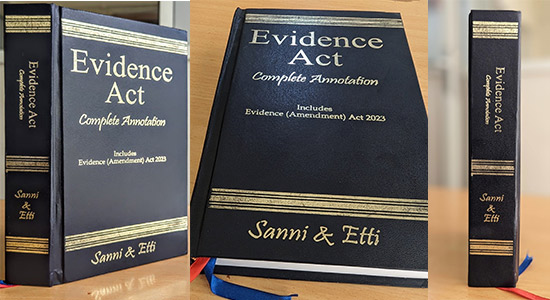
Available now for NGN 40,000 at ASC Publications, 10, Boyle Street, Onikan, Lagos. Beside High Court, TBS. Email publications@ayindesanni.com or WhatsApp +2347056667384. Purchase Link: https://paystack.com/buy/evidence-act-complete-annotation
______________________________________________________________________ “Enhance Legal Practice With Authoritative Reports” — Alexander Payne Offers Comprehensive Law Reports, Spanning Over A Century Of Nigerian Jurisprudence Interested buyers are encouraged to place their orders and enquiries via:
0704 444 4777, 0704 444 4999, 0818 199 9888
Website: www.alexandernigeria.com
“A Comprehensive Guide To Evidence Law” — Releases Second Edition In Three Volumes, Covering 4,051 Cases
For enquiries and orders, contact: 08035526491 Email: jerryamadisilk@gmail.com
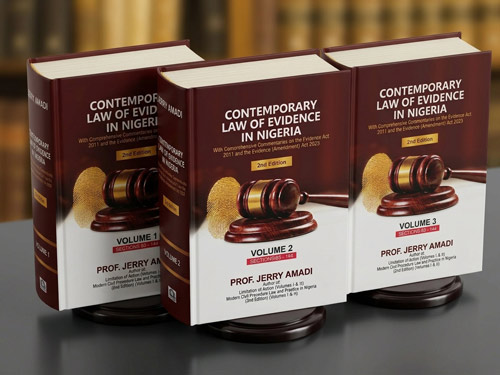 Prof. Jerry Amadi’s Evidence Law, Second Edition (2026), contains 3,314 pages in three volumes, covering the Evidence Act 2011, its 2023 amendment, and 4,051 Nigerian and English cases.