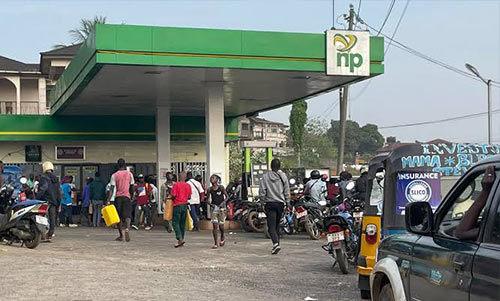
A severe fuel shortage has left motorists queuing for hours at filling stations across Sierra Leone, with some residents paying almost twice the official pump price as the scarcity disrupts transportation and daily activities.

The situation has been particularly difficult in the capital, Freetown, where long queues have formed at fuel stations, while residents carrying jerrycans move from one location to another in search of petrol.
The Sierra Leonean government has attributed the shortage to difficulties in accessing foreign exchange, particularly United States dollars, which are required to pay for imported petroleum products.
Fuel is imported into the country using US dollars but sold locally in leones, the national currency. The shortage of dollars has delayed payments for fuel shipments, affecting the availability of petroleum products.
As supplies become increasingly difficult to obtain, motorists and commuters have expressed frustration over the growing queues and the emergence of black-market sellers charging almost twice the normal price.
One Freetown resident, who spoke anonymously, said the shortage became noticeable last Thursday and had since made it increasingly difficult for people to purchase fuel at filling stations.
Describing the situation, the resident told the BBC that queues had spread across the city, with desperate motorists and other residents carrying jerrycans in search of petrol.
“All ova di city na queues and you see pipo wit jerrycans in desperate search of fuel. Black market dey now dey trend as pipo pay almost twice per litre,” the resident said.
The resident further claimed that people without personal connections to filling station owners were finding it extremely difficult to buy fuel.
“If you no dey connected or no know di owner of a fuel station, you no go get any drop in your tank,” the resident added.
The shortage is also affecting people who depend on public transportation to get to work, visit markets and carry out other essential activities.
Another Freetown resident, Osman Sesay, said travellers had been left stranded as the shortage made transportation increasingly difficult.
According to him, the situation was not only affecting motorists but also people who relied on vehicles to move goods and access markets.
“Dis creates lot of inconveniences becos most pipo dey struggle for transportation. Wen we get dis fuel scarcity, pipo go get dia basic commodities from marketplaces and those going to work are facing a lot of challenges,” Sesay said.
The challenges described by residents show how the shortage is affecting everyday life, with workers struggling to reach their workplaces and traders and customers facing difficulties moving to and from markets.
As frustration grows, the government has assured the public that efforts are underway to improve fuel availability and ease the difficulties facing importers.
In a statement issued on Tuesday, the Ministry of Information and Civic Education said authorities were working with relevant institutions to address the foreign exchange challenges responsible for the supply disruption.
The ministry explained that the government was engaging financial institutions, the National Petroleum Regulatory Authority and oil marketing companies to improve access to dollars and facilitate payments for fuel imports.
According to the ministry, the measures are intended to address the difficulties that have delayed fuel shipments and contributed to the shortage.
The government also assured residents that fuel prices would not increase before the end of 2026, despite the ongoing supply challenges.
The assurance comes as motorists complain of paying inflated prices through unofficial sellers because of the difficulties obtaining fuel through normal channels.
Fuel prices have previously been a sensitive issue in Sierra Leone, where increases in the cost of petroleum products have contributed to public dissatisfaction over the rising cost of living.
In 2022, increases in fuel prices were among the major factors behind widespread cost-of-living protests that resulted in the deaths of 21 people and six police officers.
With long queues continuing at filling stations and residents struggling to access transportation, attention is now focused on the government’s efforts to resolve the foreign exchange difficulties and restore fuel supplies.
[A MUST HAVE] Evidence Act Demystified With Recent And Contemporary Cases And Materials
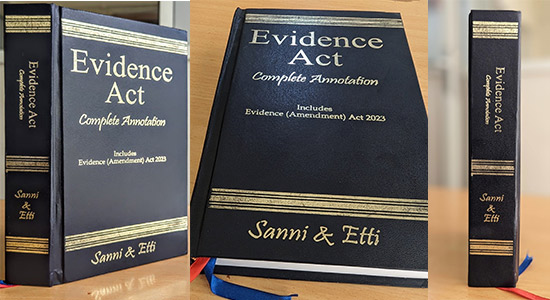
Available now for NGN 40,000 at ASC Publications, 10, Boyle Street, Onikan, Lagos. Beside High Court, TBS. Email publications@ayindesanni.com or WhatsApp +2347056667384. Purchase Link: https://paystack.com/buy/evidence-act-complete-annotation
______________________________________________________________________ “Enhance Legal Practice With Authoritative Reports” — Alexander Payne Offers Comprehensive Law Reports, Spanning Over A Century Of Nigerian Jurisprudence Interested buyers are encouraged to place their orders and enquiries via:
0704 444 4777, 0704 444 4999, 0818 199 9888
Website: www.alexandernigeria.com
“A Comprehensive Guide To Evidence Law” — Releases Second Edition In Three Volumes, Covering 4,051 Cases
For enquiries and orders, contact: 08035526491 Email: jerryamadisilk@gmail.com
 Prof. Jerry Amadi’s Evidence Law, Second Edition (2026), contains 3,314 pages in three volumes, covering the Evidence Act 2011, its 2023 amendment, and 4,051 Nigerian and English cases.