By Ebun-Olu Adegboruwa, SAN

INTRODUCTION
From the humble community of Kiribo in Ondo State to the corridors of student activism, investigative journalism, human-rights advocacy and presidential politics, Omoyele Sowore has built a public career around challenging authority and demanding accountability. As Nigeria approaches the 2027 presidential election, his journey deserves a closer examination. Like or hate him, Omoyele Sowore is a tested symbol of the revolution.
Sowore’s Early Life, Family Background and Upbringing
Omoyele Stephen Sowore, popularly known as Yele Sowore, or Baba Sho, was born on February 16, 1971, in Kiribo, Ese-Odo Local Government Area of Ondo State, Nigeria. He grew up in a rural environment in the riverine area of Ondo State, where fishing, farming and other traditional occupations formed part of everyday life. His upbringing exposed him to the realities of ordinary Nigerians, particularly the challenges of rural communities, poverty, inadequate infrastructure and limited opportunities. He occupies a unique place in the life of Nigeria, partly Niger-Delta of the oppressed and exploited regions of Nigeria and partly Yoruba, one of the dominant ethnic groups holding Nigeria by the jugular. Sowore has spoken about his early childhood and the influence of his father, who was a teacher. According to his account, his father home-schooled him while he travelled with him before he eventually enrolled in formal education. He attended Local Authority Primary School in Kiribo and subsequently proceeded to Community High School, Kiribo, in 1980. He also attended Ofedepe High School in Okitipupa, Ondo State. His childhood experiences and exposure to the difficulties confronting ordinary people would later become important influences on his political philosophy and commitment to social justice. Although he has become a prominent national figure, Sowore has consistently maintained an attachment to his roots and the community where he grew up.
Educational Background: From Ondo State to Columbia University
Sowore’s educational journey took him from the rural communities of Ondo State to one of Nigeria’s leading universities and subsequently to the United States. He gained admission into the University of Lagos (UNILAG), where he studied Geography and Regional Planning. His university education was particularly significant because it was during this period that he became deeply involved in student politics, activism and the struggle against military dictatorship. At UNILAG, he developed an interest in political organisation, public communication, human rights and the responsibilities of government to citizens, for which he suffered persecution on many fronts. Following his undergraduate studies, Sowore proceeded to the United States, where he obtained a master’s degree in Public Administration from Columbia University, New York. His academic background provided him with an understanding of governance, public policy, development administration and the institutional responsibilities of government. Interestingly, although he studied Geography and Regional Planning, his professional journey would eventually take him into journalism, human-rights activism and electoral politics.
Sowore the Student Activist: His Struggles at the University of Lagos
Perhaps one of the most defining chapters of Sowore’s life was his involvement in student activism at the University of Lagos during the late 1980s and early 1990s. Nigeria was experiencing serious political instability under military rule. University campuses had become centres of resistance against authoritarianism, poor governance, inadequate educational facilities and the suppression of democratic freedoms. Sowore emerged as one of the outspoken student activists of his generation. He became involved in student union politics and eventually served as President of the University of Lagos Students’ Union. He was also associated with the National Association of Nigerian Students (NANS), where he participated in wider campaigns for students’ rights and democratic governance. His activism brought him into frequent confrontations with university authorities, security agencies and the military establishment. Student protests during this period were often met with intimidation, arrests, disciplinary proceedings and the closure of educational institutions. Sowore also faced disciplinary difficulties and interruptions to his academic journey because of his activism. His political consciousness was further strengthened by the conviction that Nigerian students should not remain passive spectators while the country was being governed by military rulers. For Sowore, the struggle for students’ welfare was inseparable from the broader struggle for democracy, accountability and social justice. His experience at UNILAG established the pattern that would define much of his subsequent public life: challenging powerful institutions, organising resistance and refusing to remain silent in the face of perceived injustice.
Sowore the Human Rights Activist and Pro-Democracy Campaigner
After his university days, Sowore continued his involvement in pro-democracy activities. Nigeria’s military administrations, particularly during the years of General Ibrahim Babangida and General Sani Abacha, witnessed widespread suppression of political opposition, restrictions on press freedom and human-rights violations. Sowore became associated with the wider democratic movement demanding an end to military dictatorship and the restoration of civilian government. His activism was not restricted to university campuses. He participated in campaigns challenging corruption, political repression, economic inequality and the concentration of political power. He eventually relocated to the United States in 1999, a period during which he continued his advocacy and developed new approaches to communicating with Nigerians at home and abroad. One of the most defining moments of his activism came in August 2019, when he announced the #RevolutionNow movement. The movement called for nationwide peaceful demonstrations against corruption, unemployment, insecurity, poverty and poor governance. On August 2, 2019, Sowore was arrested by operatives of the Department of State Services (DSS), shortly before the planned demonstrations. He was subsequently charged with offences including treasonable felony and conspiracy to commit treason. His detention generated widespread national and international criticism. The United Nations Working Group on Arbitrary Detention subsequently issued an opinion concerning his detention, while the American Bar Association’s human-rights report raised serious concerns about the proceedings and their implications for freedom of expression and peaceful assembly. In February 2024, the Federal Government discontinued the treason-related prosecution, and the Federal High Court struck out the charges. These experiences strengthened his reputation among supporters as a politician and activist willing to confront government institutions, although his methods and revolutionary adventures have also attracted criticism and controversy.
Sowore the Journalist: The Birth of Sahara Reporters
One of Sowore’s most significant contributions to Nigerian public life is the establishment of SaharaReporters in 2006. Founded in New York, SaharaReporters emerged as an online investigative and citizen-journalism platform focused primarily on Nigeria and Africa. At a time when traditional media organisations faced considerable political and commercial pressures, SaharaReporters adopted an unconventional approach to journalism. Its reporting focused on: government corruption and financial misconduct, abuse of public office, human-rights violations, political accountability, security challenges and institutional failures, investigations involving influential individuals and organisations. The platform embraced citizen journalism, encouraging Nigerians to contribute information, documents, photographs and eyewitness accounts concerning events in their communities. SaharaReporters became particularly influential because it provided an alternative platform for information that might otherwise have received limited attention in conventional media. One notable example of its international visibility was its reporting on Umar Farouk Abdulmutallab, the Nigerian involved in the attempted bombing of an American passenger aircraft on Christmas Day 2009. SaharaReporters’ investigative approach attracted both recognition and criticism. Supporters praised its willingness to investigate powerful political figures, while critics questioned aspects of its reporting practices and editorial approach. Nevertheless, its establishment marked an important development in Nigeria’s digital media landscape. For Sowore, journalism was not simply a commercial enterprise. He has described it as an extension of his activism and a means of empowering citizens with information to demand accountability. In many respects, SaharaReporters became the media instrument through which he expanded his activism beyond the university environment and into national and international affairs.
Sowore the Politician: From Activism to Presidential Ambition
Sowore’s transition into electoral politics represented another important stage in his political evolution. In 2018, he founded the African Action Congress (AAC), a political party established around his vision of political transformation, economic justice, accountability and an alternative to Nigeria’s established political parties. He contested the 2019 presidential election under the AAC platform. Although he did not win, his campaign attracted attention, particularly among young Nigerians who were dissatisfied with the country’s political establishment. He campaigned against corruption, unemployment, insecurity, poverty and what he considered the failure of successive governments to deliver meaningful development. His campaign also popularised the idea that Nigeria required a fundamental departure from the traditional political order. In the 2019 presidential election, he received 33,953 votes. He contested again in 2023, also under the AAC, polling 14,608 votes. While these results demonstrated the difficulties of converting activist popularity into nationwide electoral support, Sowore maintained that his political project should not be abandoned. In May 2026, he emerged as the African Action Congress’s consensus presidential candidate for the 2027 general election, making it his third consecutive presidential contest. His political message continues to emphasise revolutionary change, anti-corruption, economic opportunities, security, social justice and greater participation in governance. His candidacy presents Nigerians with another opportunity to evaluate his ideas, political experience, organisational capacity and proposed solutions to the country’s longstanding challenges.
His Arrests, Legal Battles and Political Challenges
Sowore’s political journey has not been without significant personal and institutional challenges. Over the years, he has experienced arrests, detention, court proceedings and confrontations with security agencies. His 2019 arrest over #RevolutionNow became one of the most widely discussed episodes in Nigeria’s recent human-rights history. He has also faced other legal disputes arising from his public statements and criticism of government officials. In 2025 and 2026, he faced another prosecution involving allegations of criminal defamation and cybercrime arising from statements about President Bola Tinubu. These matters have generated further debate about freedom of expression, the limits of political criticism and the relationship between government institutions and opposition voices. In June 2026, the Federal High Court in Abuja granted him bail under specified conditions in connection with the proceedings. These continuing legal and political challenges demonstrate the difficult environment in which he has pursued his activism and political ambitions. However, they also raise important questions about how effectively he can translate his confrontational political approach into the consensus-building and institutional leadership required of a president.
Conclusion
Omoyele Sowore’s life is a story of activism, resistance, journalism, political ambition and personal sacrifice. From his upbringing in Kiribo, Ondo State, to his student leadership at the University of Lagos, his academic experience at Columbia University, the establishment of SaharaReporters and his presidential campaigns, his journey has been characterised by a willingness to challenge established authority. Whether one agrees with his methods, ideology or political strategies, it is difficult to discuss contemporary Nigerian activism and opposition politics without acknowledging his contributions. His 2027 presidential ambition presents another chapter in his long-running campaign for political change. Ultimately, the Nigerian electorate will determine whether the activist who spent decades demanding accountability from those in power can convince the country that he is prepared to assume the responsibility of governing it. For me, it is OMOYELE SOWORE FOR PRESIDENT 2027: From the struggle for democracy to the quest for presidential leadership, the journey continues.
[A MUST HAVE] Evidence Act Demystified With Recent And Contemporary Cases And Materials
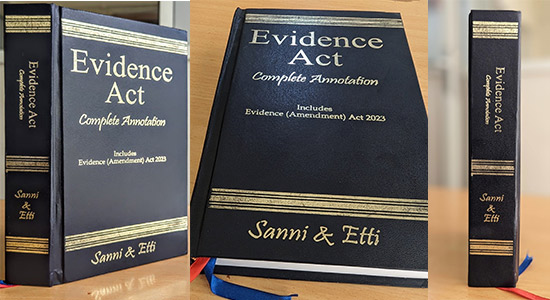
Available now for NGN 40,000 at ASC Publications, 10, Boyle Street, Onikan, Lagos. Beside High Court, TBS. Email publications@ayindesanni.com or WhatsApp +2347056667384. Purchase Link: https://paystack.com/buy/evidence-act-complete-annotation
______________________________________________________________________ “Enhance Legal Practice With Authoritative Reports” — Alexander Payne Offers Comprehensive Law Reports, Spanning Over A Century Of Nigerian Jurisprudence Interested buyers are encouraged to place their orders and enquiries via:
0704 444 4777, 0704 444 4999, 0818 199 9888
Website: www.alexandernigeria.com
“A Comprehensive Guide To Evidence Law” — Releases Second Edition In Three Volumes, Covering 4,051 Cases
For enquiries and orders, contact: 08035526491 Email: jerryamadisilk@gmail.com
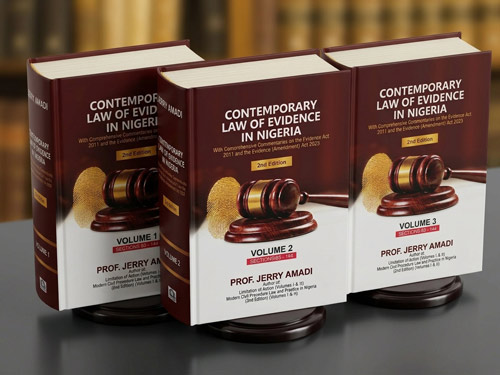 Prof. Jerry Amadi’s Evidence Law, Second Edition (2026), contains 3,314 pages in three volumes, covering the Evidence Act 2011, its 2023 amendment, and 4,051 Nigerian and English cases.