

A Deputy Director of the Legal Aid Council of Nigeria (LACON) has told the Federal High Court sitting in Abuja that four suspected members of the proscribed Indigenous People of Biafra (IPOB), standing trial over the alleged kidnapping and killing of a State Security Service (SSS) operative, Ekpeyong Owoh, voluntarily made confessional statements without being subjected to torture or intimidation.

The witness, identified as Mmaduabuchi, maintained that she was present when the defendants made their statements at the SSS office in Awka, Anambra State, and that their fundamental rights were not violated during the process.
She gave the testimony on Monday, November 23, 2026, before Justice Joyce Abdulmalik during a trial-within-trial ordered by the court to determine whether the defendants’ alleged confessional statements were made voluntarily and could be admitted in evidence.
The four defendants, Michael Okafor, also known as Onyechimeleze; Chinedu Chukwudozie, alias Kante; Chibunna Olisa; and Chigozie Olisa, also known as Ability, are facing a six-count charge bordering on terrorism and kidnapping.
The Federal Government alleged that the defendants conspired to commit acts of terrorism and kidnapped Owoh in 2022 while he was travelling from Port Harcourt, Rivers State, to Awka, Anambra State.
The prosecution further alleged that the defendants took the security operative hostage and subsequently killed him.
They were also accused of belonging to the proscribed IPOB and its armed wing, the Eastern Security Network (ESN), as well as unlawfully possessing firearms, including an AK-47 rifle and a pump-action gun, in connection with the alleged offences.
The defendants were arraigned before Justice Abdulmalik on September 28, 2026, and pleaded not guilty to the charges.
The controversy over the alleged confessional statements arose after the defendants, through their lawyers, challenged their admissibility, insisting that the statements were not obtained voluntarily.
Consequently, the court ordered a trial-within-trial to determine the circumstances surrounding the statements before deciding whether they could be admitted as evidence in the substantive criminal proceedings.
The Federal Government opened its case in the trial-within-trial on November 11, when an SSS investigator, identified only as “AAA” for security reasons, testified as the first prosecution witness.
The investigator tendered the defendants’ alleged confessional statements and audio-visual recordings of the statement-taking sessions.
At Monday’s proceedings, Mmaduabuchi, who is attached to the Anambra State office of the Legal Aid Council, testified as the second prosecution witness.
Led in evidence by the Director of Public Prosecutions of the Federation, Rotimi Oyedepo, SAN, she told the court that she personally witnessed the statement-taking sessions involving the four defendants at the SSS office in Awka.
According to her, the sessions were audio-visually recorded, and her presence was intended to ensure compliance with the legal requirements governing the taking of statements from suspects.
She explained that she did not participate in interrogating the defendants but attended the sessions in her professional capacity as a Legal Aid Council official responsible for protecting their rights.
“I only went there because I was supposed to be there to witness the taking of their statements in compliance with the provisions of the constitution,” she testified.
The witness maintained that the defendants were not compelled to make statements and that they had the opportunity to decline if they did not wish to speak.
She rejected suggestions that the defendants might have been tortured or forced to confess, insisting that her professional responsibilities would not permit her to witness such treatment without intervening.
“I think it will not be reasonable that I will say that I will be there to witness how they were being tortured as a Deputy Director of Legal Aid Council of Nigeria,” she said.
Mmaduabuchi maintained that all four defendants voluntarily made their statements and that no violation of their fundamental rights occurred in her presence.
“That was why I was there. They voluntarily made their statements.
“They were asked whether they don’t want to make statements or they want to and if they did not want to, they would have said no, and nothing will happen.
“And if they said no and they were forced, that is when I will protect them,” she explained.
The witness further told the court that the role of the Legal Aid Council was to safeguard the rights of vulnerable persons, including suspects involved in criminal investigations.
Under cross-examination by counsel to the first and second defendants, K. C. Ekwe, Mmaduabuchi was questioned about her professional experience and the circumstances surrounding the statement-taking sessions.
She told the court that she had practised law for 21 years and was called to the Nigerian Bar in 2003.
“I have been practising for 21 years now. I was called in 2003,” she said.
When asked about the official opening hours of the SSS office where the statements were taken, the witness said she could not provide that information because she was not an employee of the security agency.
“I don’t work with DSS. I work with Legal Aid Council. So it is somebody who works with DSS that will know that,” she responded.
She reiterated that her presence during the sessions was required by law and was consistent with the Legal Aid Council’s responsibility to protect vulnerable members of society.
“This work I am doing, I don’t choose to do it. It is the provisions of the law,” she added.
The witness was also cross-examined by Geoffrey Oputa, counsel to the third and fourth defendants, who questioned her about the circumstances in which the alleged confessional statements were obtained.
Responding, Mmaduabuchi acknowledged that she could not recall the exact dates on which the statements were taken, explaining that the Legal Aid Council handled numerous cases daily.
She nevertheless maintained that she remembered the defendants’ physical condition and their conduct during the sessions.
According to her, none of the four defendants appeared to have been beaten or subjected to physical torture when she witnessed their statements being taken.
“They were okay. They were not looking beaten. They were sound even the DSS that interviewed them joked with them.
“With the kind of job I do, I will not be there while they were being tortured,” she testified.
The Deputy Director insisted that the circumstances she witnessed did not suggest that the statements had been extracted through force.
Her testimony supported the prosecution’s position that the statements were voluntarily obtained, although the defence continued to challenge their admissibility.
Following the conclusion of her evidence and cross-examination, Justice Abdulmalik discharged the witness from the witness box.
The court subsequently considered the next stage of the trial-within-trial, during which the defendants are expected to present evidence supporting their objection to the alleged confessional statements.
Following an agreement among counsel, Justice Abdulmalik adjourned the proceedings until December 7 and 8, 2026, for the defendants to open and conclude their defence in the trial-within-trial.
[A MUST HAVE] Evidence Act Demystified With Recent And Contemporary Cases And Materials
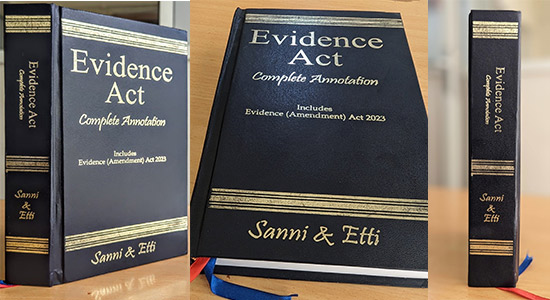
Available now for NGN 40,000 at ASC Publications, 10, Boyle Street, Onikan, Lagos. Beside High Court, TBS. Email publications@ayindesanni.com or WhatsApp +2347056667384. Purchase Link: https://paystack.com/buy/evidence-act-complete-annotation
______________________________________________________________________ “Enhance Legal Practice With Authoritative Reports” — Alexander Payne Offers Comprehensive Law Reports, Spanning Over A Century Of Nigerian Jurisprudence Interested buyers are encouraged to place their orders and enquiries via:
0704 444 4777, 0704 444 4999, 0818 199 9888
Website: www.alexandernigeria.com
“A Comprehensive Guide To Evidence Law” — Releases Second Edition In Three Volumes, Covering 4,051 Cases
For enquiries and orders, contact: 08035526491 Email: jerryamadisilk@gmail.com
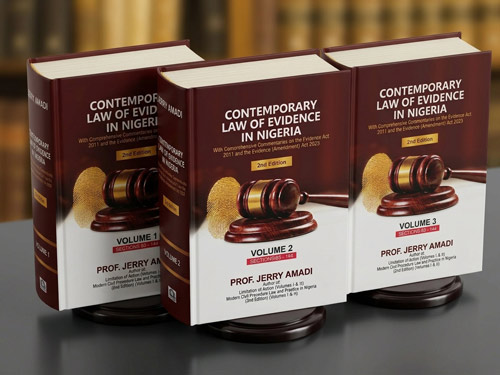 Prof. Jerry Amadi’s Evidence Law, Second Edition (2026), contains 3,314 pages in three volumes, covering the Evidence Act 2011, its 2023 amendment, and 4,051 Nigerian and English cases.