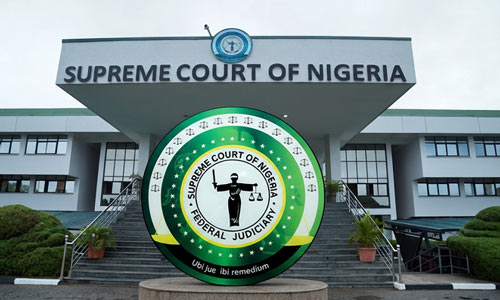
The Supreme Court of Nigeria has warned against the unauthorised use of its official vehicle registration plate numbers, urging the Nigeria Police Force and other security agencies to stop, question and, where circumstances warrant, arrest individuals found using such plates without lawful authorisation.

The apex court expressed concern that individuals who are neither members of its staff nor otherwise authorised to use its official vehicle registration plates could exploit the Court’s identity and privileges for improper purposes.
The warning was contained in a press release issued by the Office of the Chief Registrar of the Supreme Court and signed by the Chief Registrar, Kabir E. Akanbi, Esq.
According to the Court, the unauthorised use of its official registration plates poses a threat to its institutional integrity, dignity and reputation, particularly where individuals falsely present themselves as being associated with the judiciary.
The Court stated that it had become necessary to draw the attention of the public, particularly the Nigeria Police Force and other relevant security agencies, to the use of its official vehicle registration plate numbers by persons who are not authorised to do so.
It expressed concern over the practice, warning that it could create opportunities for impersonation and other activities capable of damaging public confidence in the judiciary.
The statement said the Court wished to draw attention to the unauthorised use of its official vehicle registration plate numbers “by person(s) who are neither staff members nor otherwise lawfully authorised to use them”.
The Supreme Court maintained that it “views this development with serious concern”, stressing that the misuse of its official registration plates could undermine the institution’s standing.
According to the statement, the unauthorised use of the plates “has the potential to undermine its integrity, dignity and institutional reputation”.
The Court further warned that the practice “may also create opportunities for individuals to falsely associate themselves with the Court, exploit its institutional identity and engage in activities capable of bringing the institution into disrepute”.
It consequently emphasised that possession or use of a vehicle bearing the Supreme Court’s official registration plate number must be supported by proper authorisation from the appropriate authorities.
The Court declared that “no individual is permitted to use an official Supreme Court of Nigeria vehicle registration plate number without the express authorisation of the appropriate authorities of the Court”.
It urged security agencies to remain vigilant and take appropriate steps whenever they encounter vehicles bearing official Supreme Court registration plates.
Specifically, the Court stated that police officers and other relevant security personnel were at liberty to stop and question individuals found using vehicles with official Supreme Court of Nigeria (SCN) registration plate numbers.
The statement urged the Nigeria Police Force and other relevant security agencies “to remain vigilant”, adding that they “are at liberty to stop and question any person found using a vehicle bearing an official SCN registration plate number”.
It explained that where the individual concerned could not satisfactorily establish that they were a member of the Court’s staff or provide evidence of lawful authorisation to use the registration plate, appropriate measures should follow.
The Court stated that where such a person “is unable to satisfactorily establish their identity as a staff of the Supreme Court of Nigeria or produce evidence of lawful authorisation to use the registration plate, appropriate lawful measures should be taken, including arrest where circumstances so warrant”.
The directive makes clear that the use of an official Supreme Court registration plate does not, by itself, exempt a person from identification or questioning by security agencies.
However, the Court’s statement also indicates that any arrest or other enforcement measure must be lawful and justified by the circumstances.
Beyond its warning to security agencies, the apex court appealed to members of the public to assist in identifying and reporting suspected misuse of its official vehicle registration numbers.
It encouraged citizens who encounter vehicles suspected of carrying unauthorised Supreme Court registration plates to report the matter promptly to the appropriate security authorities.
According to the Court, members of the public are “equally encouraged to promptly report any suspected instance of the unauthorised use of the Court’s official vehicle registration plate numbers to the appropriate security authorities”.
The Court stressed that protecting its official identity and privileges was essential to maintaining the credibility and dignity of the judiciary.
It maintained that its official insignia and other institutional privileges should not be exploited by persons who have no lawful connection with the institution.
The Supreme Court further reaffirmed its commitment to protecting its institutional identity, preserving public confidence in the judiciary and preventing the abuse of its official privileges.
It stated that it “remains committed to protecting its institutional identity, preserving public confidence in the Judiciary and ensuring that its official insignia and privileges are not abused by unauthorised persons”.
The Court consequently advised the public, the Nigeria Police Force and other relevant security agencies to take note of the warning and act accordingly.
Although the press release referred to the unauthorised use of the Court’s official registration plates, it did not identify any individual or disclose a particular incident that prompted the warning.
[A MUST HAVE] Evidence Act Demystified With Recent And Contemporary Cases And Materials

Available now for NGN 40,000 at ASC Publications, 10, Boyle Street, Onikan, Lagos. Beside High Court, TBS. Email publications@ayindesanni.com or WhatsApp +2347056667384. Purchase Link: https://paystack.com/buy/evidence-act-complete-annotation
______________________________________________________________________ “Enhance Legal Practice With Authoritative Reports” — Alexander Payne Offers Comprehensive Law Reports, Spanning Over A Century Of Nigerian Jurisprudence Interested buyers are encouraged to place their orders and enquiries via:
0704 444 4777, 0704 444 4999, 0818 199 9888
Website: www.alexandernigeria.com
“A Comprehensive Guide To Evidence Law” — Releases Second Edition In Three Volumes, Covering 4,051 Cases
For enquiries and orders, contact: 08035526491 Email: jerryamadisilk@gmail.com
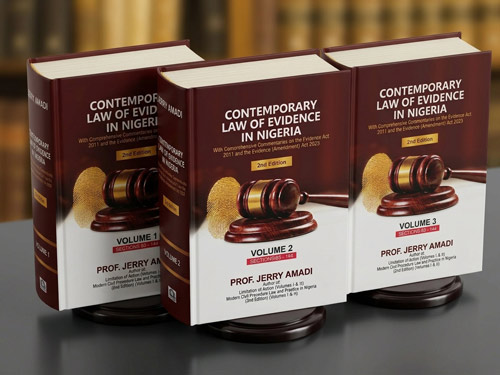 Prof. Jerry Amadi’s Evidence Law, Second Edition (2026), contains 3,314 pages in three volumes, covering the Evidence Act 2011, its 2023 amendment, and 4,051 Nigerian and English cases.