

Anti-immigration protesters in South Africa have called on the government to impose a total ban on Nigerian nationals entering the country, accusing Nigerians of involvement in drug trafficking and other activities they claim are contributing to social problems in South African communities.

The demand was made during a demonstration organised by the March and March movement in Pretoria on Wednesday, November 18, 2026, as protesters marched through parts of the city calling for stricter immigration controls and the deportation of undocumented foreign nationals.
The demonstration, led by the movement’s leader, Jacinta Ngobese-Zuma, took a confrontational turn in Sunnyside, a Pretoria suburb associated with a sizeable Nigerian community and sometimes referred to as “Little Lagos.”
Addressing the gathering, Ngobese-Zuma questioned the presence and influence of Nigerians in the neighbourhood, demanding to know why the area had acquired a nickname associated with Nigeria’s commercial capital.
“I am being told here that we’ve entered Sunnyside, the home of Nigerians. I am inviting Nigerians to come out, let’s talk to each other. We want to know who gave you this place and called it Nigeria. Who gave you permission to call this place Lagos or whatever you call it?” she asked.
She further questioned who had authorised Nigerian residents to identify parts of South African territory with their home country.
The protesters alleged that the growing presence of migrants was placing additional pressure on public resources and worsening frustrations among South African citizens.
The movement subsequently announced plans to present its grievances to the Department of Home Affairs, demanding tougher immigration restrictions, tighter controls on refugee admissions and accelerated deportation of undocumented foreign nationals.
However, the group’s legal representative, Xolani Zuma, went further by calling for an outright prohibition on Nigerians entering South Africa.
“The state must ban Nigerians from South Africa. They must ban Nigerians until they stop selling drugs to our people. The rest of Africa, we are fine, but we do not want Nigerians in South Africa anymore. That is what we are saying,” he declared.
The statement specifically singled out Nigerian nationals for exclusion, with the protesters linking their demand to allegations of drug trafficking.
The allegations were made by the protesters and were not accompanied by evidence establishing wrongdoing by the Nigerian community as a whole.
Beyond the proposed ban on Nigerians, the demonstrators also demanded that South Africa withdraw from the 1951 United Nations Convention Relating to the Status of Refugees.
They argued that the country’s obligations under the international agreement were no longer sustainable.
Ngobese-Zuma described the arrangement as “not sustainable and not feasible,” maintaining that South Africa needed to reconsider its immigration and refugee policies.
The latest demonstration comes amid recurring concerns about xenophobic hostility towards foreign nationals in South Africa, particularly Nigerians, and the implications for relations between the two countries.
It also follows a recent diplomatic disagreement involving Nigeria’s High Commissioner to South Africa, Femi Fani-Kayode, and the South African Presidency over the presentation of his credentials.
Fani-Kayode had complained about the exclusion of his prepared speech during the ceremony, describing the development as disrespectful to Nigeria.
However, the Nigerian envoy subsequently stated that the disagreement had been resolved following the intervention of South African President Cyril Ramaphosa and an invitation from the country’s Department of International Relations and Cooperation.
Fani-Kayode also disclosed that he had begun addressing concerns affecting Nigerians resident in South Africa since assuming office.
Speaking on recurring xenophobic incidents, the envoy maintained that those responsible for attacks against foreign nationals represented only a small minority of South Africans and should not be allowed to define the country’s population.
He described the majority of South Africans as decent and accommodating, expressing confidence that Nigeria and South Africa could resolve their differences without damaging their longstanding diplomatic relationship.
Nevertheless, Fani-Kayode warned that patience was running thin within Nigeria’s corridors of power over repeated attacks on Nigerian citizens.
He insisted that the Nigerian Government would not abandon its nationals to xenophobic violence.
The renewed anti-Nigerian campaign has therefore emerged against the backdrop of diplomatic efforts to address concerns over the treatment and safety of Nigerians living in South Africa.
While the March and March movement is demanding a complete ban on Nigerian nationals, Fani-Kayode has maintained that the actions of a minority responsible for xenophobic hostility should not be mistaken for the position of the wider South African population.
The protesters’ demands have not been presented as an official policy of the South African Government, and the report did not indicate that the authorities had approved any proposal to prohibit Nigerians from entering the country.
[A MUST HAVE] Evidence Act Demystified With Recent And Contemporary Cases And Materials
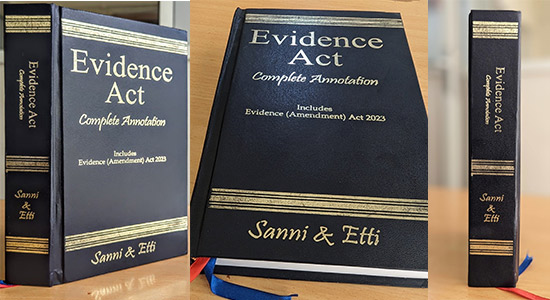
Available now for NGN 40,000 at ASC Publications, 10, Boyle Street, Onikan, Lagos. Beside High Court, TBS. Email publications@ayindesanni.com or WhatsApp +2347056667384. Purchase Link: https://paystack.com/buy/evidence-act-complete-annotation
______________________________________________________________________ “Enhance Legal Practice With Authoritative Reports” — Alexander Payne Offers Comprehensive Law Reports, Spanning Over A Century Of Nigerian Jurisprudence Interested buyers are encouraged to place their orders and enquiries via:
0704 444 4777, 0704 444 4999, 0818 199 9888
Website: www.alexandernigeria.com
“A Comprehensive Guide To Evidence Law” — Releases Second Edition In Three Volumes, Covering 4,051 Cases
For enquiries and orders, contact: 08035526491 Email: jerryamadisilk@gmail.com
 Prof. Jerry Amadi’s Evidence Law, Second Edition (2026), contains 3,314 pages in three volumes, covering the Evidence Act 2011, its 2023 amendment, and 4,051 Nigerian and English cases.