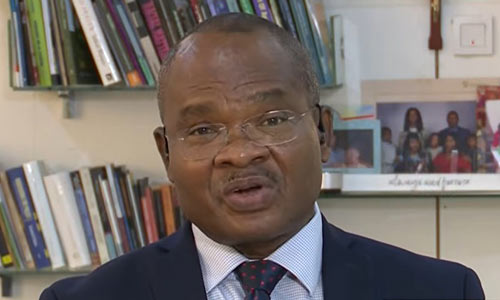
The Director of the Policy and Legal Advocacy Centre (PLAC), Clement Nwankwo, has raised concerns over the credibility of Nigeria’s voter register ahead of the 2027 general elections, alleging that artificial intelligence-generated information and photographs have found their way into the register maintained by the Independent National Electoral Commission (INEC).

Nwankwo warned that irregularities in the register, inadequate communication with political parties and gaps in the commission’s preparations could undermine public confidence in the electoral process and create opportunities for manipulation.
Speaking during an interview with ARISE NEWS on Thursday, he questioned the increase in the number of registered voters from over 90 million to approximately 103 million, expressing doubts about whether the figure accurately reflected the number of eligible voters in Nigeria.
According to him, technological developments have made it easier to identify questionable entries in the register, including photographs and information suspected to have been generated using artificial intelligence.
“Technology has of course come forward, and now what we see is what is now referred to as AI-generated information and photographs that have been inserted into the voter register,” he said.
Nwankwo explained that civil society organisations and concerned individuals had deployed technological tools, including artificial intelligence, to examine the voter register and identify possible irregularities.
“And the verdict you see, of course, is that using AI, you can tell quite clearly that the voter register has very serious problems,” he stated.
He expressed particular concern about the increase in registered voters, questioning how the figure rose to 103 million and whether all the names represented genuine eligible voters.
“We did see voter register that jumped from 90-something million to 103 million. And questions are arising as to how that jump happened and who is on that voter register, I think that we do not have 103 million persons who are eligible to vote in this country,” he said.
The PLAC director maintained that Nigeria needed to undertake a comprehensive review of its voter registration system to address longstanding concerns about the integrity of the electoral database.
However, he acknowledged that preparing an entirely new voter register before the 2027 general elections might no longer be feasible.
“It means that we must go back to the drawing board. And I think it’s too late, though, for 2027 that you talk of a new voter register. But this country must come to terms with the fact that its current voter register has no credibility,” Nwankwo declared.
Beyond the register itself, Nwankwo questioned INEC’s level of preparedness and transparency, particularly its engagement with political parties concerning preparations for the elections.
He argued that the commission had a responsibility to regularly brief political parties on its activities, operational arrangements and measures being taken to ensure credible elections.
“You must brief the political parties. You must call them in and say, these are what you are doing. But is INEC doing so? No. The parties don’t know what is going on, and it should be that the parties should know what INEC is doing,” he stated.
“So I don’t see that communication going on. I don’t see INEC putting out information on its preparedness.”
Nwankwo further expressed concern that existing gaps in electoral preparations might become increasingly difficult to address as the election date approaches.
“And as we speak right now, looking at the threshold document, it is clear that there are lapses and gaps that may be difficult to rectify as we speak,” he said.
He also warned that shortcomings in the process of transferring voters between polling units could result in widespread disenfranchisement during the 2027 elections.
According to him, INEC had not done enough to ensure that Nigerians who relocated from their previous places of residence could conveniently transfer their voter registration details to polling units closer to their new locations.
“I think you will see an even larger number of people disenfranchised in the 2027 election, because INEC has not done what it should do to ensure that people can move and have their voting unit migrate to where they have recently moved to,” he warned.
The PLAC director also questioned whether INEC had adequately informed citizens about the procedures for challenging incorrect entries or submitting objections to names appearing in the voter register.
He noted that displaying the register without clearly communicating the procedures for claims and objections could limit public participation in identifying and correcting irregularities.
“I have no evidence as we speak right now that INEC has followed up from displaying the voter register to including information on how citizens can make those objections and claims,” he said.
Nwankwo suggested that some questionable entries might have originated during previous continuous voter registration exercises, when politicians and political parties mobilised residents in their constituencies to register.
He recalled that such mobilisation exercises had previously raised concerns about the authenticity of some entries.
“If a lot of us remember, when INEC opened the window for continuous voter registration, a lot of the political parties and politicians went to their constituencies and said they were mobilising registration of voters. And that’s when this window opened, and you had all sorts of names generated,” he stated.
Drawing comparisons with earlier registration exercises, Nwankwo recalled instances in which fictitious names and questionable biometric information were allegedly entered into Nigeria’s voter database.
“I think we need to look at the previous exercises prior to 2010, when all sorts of names were entered into the register. Michael Jackson, Muhammad Ali, and all of that number of names. And people were using palm panels to put in fingerprints and so on,” he said.
He maintained that the recurrence of concerns about questionable voter records demonstrated the need for stronger safeguards and a more reliable registration system.
Addressing the legal requirements for displaying and reviewing the voter register, Nwankwo explained that the Electoral Act provides for public inspection and the submission of claims and objections before the final register is prepared.
“The Electoral Act requires that INEC displays the voter’s register within a certain period. I think it’s 90 days before the elections. And it’s supposed to receive claims and objections, which means that once it displays it, it’s supposed to be on display for at least seven days,” he stated.
“And it takes claims and objections and then goes and finalises a voter register that should be ready for elections at least 60 days before the elections.”
He argued that modern technology should make it easier for Nigerians to inspect the register and identify irregularities without incurring unnecessary expenses.
According to him, access to the register should be facilitated through INEC’s digital platforms to encourage public scrutiny and strengthen confidence in the electoral process.
“And everyone, everyone who can pay for it is entitled to access to the voter register. And in these days, when you have technology, it means that you really shouldn’t be paying too much other than access this on INEC’s portal,” he said.
Nwankwo also clarified that the Electoral Act does not expressly require INEC to deploy artificial intelligence in conducting elections.
He stressed the need to distinguish between the use of AI tools to examine electoral records and any suggestion that the law mandates the commission to use artificial intelligence in its operations.
“I must say very, very clearly that there is nothing in the Electoral Act that says that INEC should use AI. And that means that we even have to define what AI is,” he stated.
Asked whether the 2027 general elections should be postponed to allow INEC more time to address the identified concerns, Nwankwo declined to support such a proposal.
He argued that postponement would not necessarily guarantee better preparations and could further undermine confidence in the electoral process.
The PLAC director recalled earlier discussions about conducting the elections in November 2026, explaining that constitutional provisions governing the timing of elections had influenced the eventual selection of January 16, 2027.
“I am not going to go into conversation about a postponement of election, because I do know that there was a push to even have these elections conducted in November this year,” he said.
“And it was only when references were made and some of us said, look, you can’t have an election in November because the constitution gives you a 30-day to 150-day window to conduct elections, and November doesn’t fall into that.”
He explained that the eventual election timetable had already affected political parties, particularly their primary elections and preparations for the general polls.
“That’s when the next available date after November was fixed for January 16th. And INEC prosecuted all the options, and this affected political parties tremendously in terms of how they should conduct primaries, the timelines and so on,” he added.
Nwankwo maintained that the commission should focus on addressing existing deficiencies rather than relying on a possible postponement.
“So I would never be one to say postpone elections, because even if you were to postpone elections, will INEC be ready? And I make the point quite clearly that I do not think that we’re all ready for these elections,” he stated.
He warned that any last-minute attempt to postpone the elections could have serious consequences for national security and public confidence in democratic institutions.
“And I think it would be a shame if this country were to come close to January 16th to hear anybody talk about postponement of elections,” he said.
“I think it would be a serious, serious breach of national security and indeed national confidence if this were to happen.”
The PLAC director concluded by warning that weaknesses in voter registration, inadequate electoral preparations and insufficient transparency could create opportunities for manipulation during the 2027 elections.
He urged greater attention to the credibility of the voter register and the commission’s readiness to conduct transparent and credible polls.
“I think that given our electoral environment and given recent electoral operations, it is quite clear that you do have a lot of lapses that could be used to manipulate the elections. But I must say again, we don’t have a credible voter register going into 2027,” Nwankwo declared.
[A MUST HAVE] Evidence Act Demystified With Recent And Contemporary Cases And Materials

Available now for NGN 40,000 at ASC Publications, 10, Boyle Street, Onikan, Lagos. Beside High Court, TBS. Email publications@ayindesanni.com or WhatsApp +2347056667384. Purchase Link: https://paystack.com/buy/evidence-act-complete-annotation
______________________________________________________________________ “Enhance Legal Practice With Authoritative Reports” — Alexander Payne Offers Comprehensive Law Reports, Spanning Over A Century Of Nigerian Jurisprudence Interested buyers are encouraged to place their orders and enquiries via:
0704 444 4777, 0704 444 4999, 0818 199 9888
Website: www.alexandernigeria.com