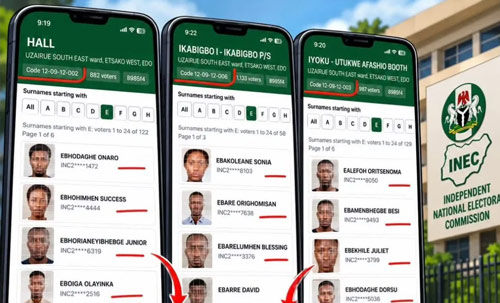
The Independent National Electoral Commission (INEC) has commenced an investigation into suspicious photographs, including images suspected to have been generated using Artificial Intelligence (AI), found in the preliminary voters’ register published online ahead of the 2027 general elections.

The commission confirmed that it had identified and flagged several questionable registration records during the physical display of the preliminary register nationwide and had begun reviewing the affected entries to determine the nature of the irregularities and take appropriate corrective action.
The development followed widespread criticism from Nigerians after INEC published the preliminary register on its website on Monday, October 26, 2026, with social media users raising concerns over photographs, questionable names and other suspected inconsistencies in voter records.
In a statement issued on Tuesday, October 27, INEC National Commissioner and Chairman of the Information and Voter Education Committee, Mohammed Haruna, explained that the commission was already examining the disputed records before the controversy gained wider public attention.
“During the physical display, a number of questionable registration records were identified and flagged for further examination,” Haruna stated.
“The commission commenced the process of reviewing these records and taking appropriate corrective action in accordance with established procedures.”
According to him, the preliminary register published online was the same document displayed physically at Registration Areas across the country between October 9 and 15, 2026, during the Display, Claims and Objections exercise.
He clarified that the online version represented the original preliminary register and did not incorporate all the corrections and data-cleanup activities currently being undertaken by the commission.
“The online publication represents the original preliminary register and does not reflect all ongoing data-cleanup activities,” he explained.
Haruna emphasised that the preliminary register should not be mistaken for the final certified list of eligible voters, stressing that the display exercise was specifically designed to allow Nigerians to identify errors, challenge questionable entries and submit objections before certification.
“It is important to emphasize that the preliminary register is not the final certified register. The display, claims and objections exercise is specifically intended to facilitate public scrutiny, identify inaccuracies and irregularities, and enable appropriate corrections before certification,” he said.
Addressing concerns about the suspected AI-generated photographs, INEC disclosed that it was investigating how the questionable images entered the registration records, including whether technical failures or procedural lapses contributed to the irregularities.
“The commission is also examining the circumstances surrounding the suspicious photographs, including possible technical or procedural lapses, and will take appropriate action based on verified findings,” the statement added.
The commission’s response followed complaints from Nigerians who shared screenshots of voter registration records containing photographs they suspected had been artificially generated.
Particular attention was drawn to entries from polling units in Ward 11, Etsako West Local Government Area of Edo State, where some social media users questioned the authenticity of photographs attached to registered voters.
Similar concerns were raised about entries said to originate from Esan Central Local Government Area of the state.
One X user, identified as Decosule, using the handle @SuleDeco, publicly challenged INEC to explain the circumstances surrounding the photographs.
“Dear @inecnigeria, can you explain why you have AI-generated images on the INEC Register in polling units in Ward 11, Etsako West LG, Edo State? We want an explanation,” he wrote.
“Who infused AI-generated images in the register? Who did the capturing? Who collected their PVCs, if they have been collected? We want answers!!!!!”
Another user, Mayor of Etsako, @bryma_007, questioned the names attached to some of the disputed records.
“And the names are not even proper Edo names, not to talk of being Etsako. Omo!!!” he wrote.
The complaints intensified public scrutiny of the preliminary register, with some Nigerians questioning the integrity of the voter registration process and demanding explanations from the electoral commission.
Other concerns raised online included allegations of duplicate registrations and entries bearing the names of deceased persons.
However, the claim that the disputed photographs were generated using Artificial Intelligence has not been independently established, and INEC has not confirmed that the images were AI-generated.
The commission has also not publicly identified those responsible for the questionable entries or established whether they resulted from deliberate manipulation, technical errors or other procedural irregularities.
INEC’s latest statement represents its first substantive response to the controversy surrounding the photographs since the preliminary register became available online.
The commission explained that publishing the register was intended to promote transparency and encourage Nigerians to participate in identifying inaccuracies before the final list of voters is produced.
The online publication followed public demands for broader access to the register after its earlier physical display at registration centres nationwide.
INEC said the exercise was conducted in accordance with Section 19 of the Electoral Act 2026, which provides for public scrutiny of voter registration records.
Haruna commended Nigerians and other stakeholders who drew attention to the suspected irregularities, describing their participation as an important contribution to strengthening the accuracy and credibility of the register.
He assured the public that all verified irregularities would be addressed through established procedures and that further information would be provided as the review progressed.
“INEC remains committed to completing the necessary verification, adjudication, and data-cleanup processes ahead of the scheduled certification of the final register of voters on 15th December 2026,” he stated.
The commission maintained that the preliminary register remains subject to verification, corrections and adjudication before the final certified register is released.
The controversy comes as preparations intensify for the 2027 general elections, with the accuracy of voter records remaining a central concern among political stakeholders and members of the public.
While INEC has acknowledged the existence of questionable registration records and commenced investigations, the circumstances surrounding the suspicious photographs and the identities of those responsible, if wrongdoing is established, remain unresolved.
[A MUST HAVE] Evidence Act Demystified With Recent And Contemporary Cases And Materials

Available now for NGN 40,000 at ASC Publications, 10, Boyle Street, Onikan, Lagos. Beside High Court, TBS. Email publications@ayindesanni.com or WhatsApp +2347056667384. Purchase Link: https://paystack.com/buy/evidence-act-complete-annotation
______________________________________________________________________ “Enhance Legal Practice With Authoritative Reports” — Alexander Payne Offers Comprehensive Law Reports, Spanning Over A Century Of Nigerian Jurisprudence Interested buyers are encouraged to place their orders and enquiries via:
0704 444 4777, 0704 444 4999, 0818 199 9888
Website: www.alexandernigeria.com