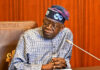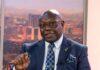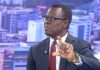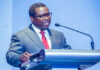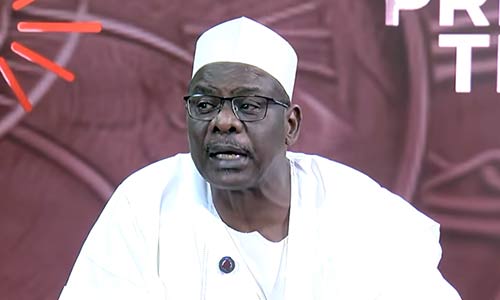
Senator Ali Ndume, the All Progressives Congress lawmaker representing Borno South, has raised concerns over what he described as hypocrisy and deep internal contradictions within the ruling party, alleging that some APC members publicly display loyalty to President Bola Tinubu while privately acting against him.

Ndume made the remarks during a television interview in which he was asked about tensions within the APC and Vice-President Kashim Shettima’s warning that the party’s internal problems posed a greater threat than the opposition ahead of the 2027 general election.
Pointing to the President’s emblematic cap worn by some party members, Ndume said he deliberately avoided wearing it because, in his view, loyalty should not be reduced to public display.
“You have to fake the liking of somebody. You wear that cap in the afternoon and you trample on it, step on it in the night,” he said.
“Many of them are doing that. You don’t have to show that you like somebody. It’s within you.” Ndume, however, did not name any APC member he was accusing of such conduct.
He agreed with Shettima that the APC’s major problems were coming from within rather than from opposition parties.
“I think the Vice President was just blunt… because that’s the truth. We have more problems within than without,” Ndume said.
While acknowledging that opposition parties remained “resilient, tough and talking big,” he argued that Nigeria’s political problem went beyond party labels, saying politicians were largely coming from the same background and merely using different platforms in their struggle for power.
He criticised what he described as personality-driven politics, saying political debate should focus more on ideas, policies and programmes than on individual personalities.
Ndume said he was particularly worried that politicians were taking Nigerians for granted.
“What I see… is a lot of hypocrisy,” he said, adding that those responsible for promoting the ruling party’s record were, in his view, more concerned about themselves than effectively defending the government’s programmes.
He also criticised the opposition for similarly focusing excessively on individuals.
“Tinubu is not the only APC. I’m APC too. What we are talking about is… ADC are not talking about ADC. They are talking about Atiku. The same thing.
“It’s a personality-driven politics, which is not supposed to be the case,” he said. Pasted markdown
Turning to the economy, Ndume identified the consequences of fuel subsidy removal as one of the biggest challenges facing Nigerians, alongside what he described as misplaced government priorities.
“The major problem that we have in the country today is the negative impact, or the side effect, of the removal of subsidy. That’s the major one. That’s a big issue,” he said.
Despite his criticism of the administration in some areas, Ndume gave President Tinubu credit for increased attention to security, particularly investment in equipment and improved remuneration for security personnel.
According to him, the measures have improved morale and produced noticeable security gains in his constituency.
“It’s improving, but it’s not done yet. But there’s a lot of improvement,” he said, noting that farmers had returned to areas they previously considered inaccessible.
Ndume also distanced himself from the recent move in the Senate suggesting support for Senate President Godswill Akpabio to retain the position in the next National Assembly.
He said he was absent when the motion was taken and dismissed the exercise as constitutionally untenable.
“I want to use this opportunity to say publicly that I am not in support of this. I’m not part of it. I was not there,” he said.
Ndume said he had gone to pray and returned after the motion had been taken.
“There’s nothing to agree with, because that is not possible. It’s unconstitutional,” he said, citing Sections 50 to 52 of the Constitution in support of his position.
He also questioned the procedure adopted, arguing that the matter was not listed on the Order Paper and that the composition of the next Senate could not be predetermined by the current chamber.
According to him, the episode amounted to “a joke taken too far” and was like “putting the cart before the horse.” Pasted markdown
Ndume further questioned Akpabio’s role in presiding over a discussion directly concerning his own political future.
“How can you sit down there and preside over something that affects you? A motion that affects you. And then you preside over it and you hit the gavel, as it were,” he said. Pasted markdown
He recalled that only 25 members of the 109-member Ninth Senate returned to the Tenth Senate, using the figure to stress that the electorate ultimately determines the composition of a succeeding National Assembly.
Ndume confirmed that he would again contest for the Senate and rejected suggestions that long service should automatically disqualify politicians from seeking another term.
Drawing comparisons with the United States Senate, he argued that legislative experience could be an advantage and maintained that the Senate was traditionally an institution where experienced public figures represented their constituents.
Defending his own record, Ndume listed projects and legislation he said he had facilitated, including the Federal College of Agriculture in Shani, the North East Development Commission, the Nigerian Army University and a Federal College of Education in his community.
He said he intended to continue pursuing projects for local governments in his constituency that had yet to benefit adequately from federal presence, including his proposal for a Federal Medical Centre in Kwaya Kusar.
Beyond constituency projects, Ndume said one of his broader objectives was to strengthen legislative oversight and accountability through an “Unexplained Wealth Act.”
He argued that existing anti-corruption mechanisms made it difficult to deal with public officials whose assets appeared disproportionate to their legitimate earnings because prosecutors often had to establish the unlawful source of the wealth.
“The most important thing I want to struggle for is the Unexplained Wealth Act, the law that will hold people responsible for wealth that they have and they cannot account for,” he said.
Ndume argued that such legislation should place a greater responsibility on persons possessing unexplained assets to account for how they acquired them.
“You find a director in the service whose salary is… yet he is owning a house that is worth billions. And you cannot do anything, because the law says you have to prove beyond reasonable doubt that he stole that money, which is near impossible,” he said.
“But if you make a law that puts the burden of proof on him that owns, or claims, those assets, then you have a reduction in this.”
He maintained that Nigeria needed stronger laws to tackle corruption while stressing that the proposal remained an idea he intended to pursue rather than an already enacted measure.
[A MUST HAVE] Evidence Act Demystified With Recent And Contemporary Cases And Materials

Available now for NGN 40,000 at ASC Publications, 10, Boyle Street, Onikan, Lagos. Beside High Court, TBS. Email publications@ayindesanni.com or WhatsApp +2347056667384. Purchase Link: https://paystack.com/buy/evidence-act-complete-annotation
______________________________________________________________________ “Enhance Legal Practice With Authoritative Reports” — Alexander Payne Offers Comprehensive Law Reports, Spanning Over A Century Of Nigerian Jurisprudence Interested buyers are encouraged to place their orders and enquiries via:
0704 444 4777, 0704 444 4999, 0818 199 9888
Website: www.alexandernigeria.com