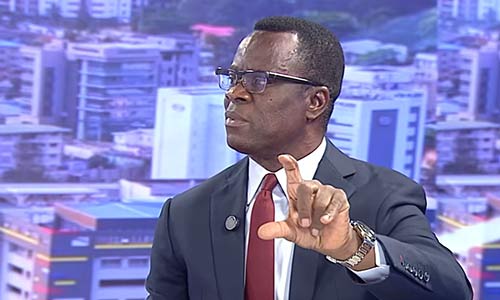
Mr. Mike Igini, a former Resident Electoral Commissioner of the Independent National Electoral Commission, has told a television audience that Nigerians are watching the wrong people ahead of the 2027 general elections, and that the officials who will actually conduct the poll are young men and women currently serving in the National Youth Service Corps, whose list, he says, politicians have historically infiltrated.

“Democracy dies and lives with a ballot. And in a democracy, if votes do not count, election becomes a mere ritual without actually choosing.”
“Effective power to govern in a democracy lies with legitimate authority.”
“The outcome of elections has implications for national security, stability and sustainability of democracy.”
He began with a warning about the pre-election period.
“I want to call [the] attention of stakeholders to the threats that [are] going on. People are working too hard to put the light of democracy out of Nigeria.”
“Our fight for democracy, for which some of us fought, [for which we] were deprived of our freedom, were detained, was that we needed to have a government where the people had a say. Because under the military there was a judiciary, there was [an] executive. What was left? There were no parliament. There [was] no people[‘s] representation.”
“The current threat across Nigeria shows that we are already in a state of anomie.”
“The greatest promise of democracy is periodic election for peaceful transfer of power.”
“Today, where we are supposed to be under the rule of law, we are now under the rule of men.”
He then asked for two provisions to be displayed on screen.
“I want your producer to put out section 95 of the Electoral Act 2026, so that Nigeria can read and see it itself, to the fact that in the entire Federal Republic of Nigeria it is the duty of the Nigerian Commissioner of Police in [each] state to ensure that candidates, political parties [and] aspirants are not prevented from campaigning, from carrying out procession across the country. But what we have today, they are putting out the light of democracy in our country.”
“Particularly subsection 97. Look at section 97. They were very clear that there should be no threat of violence against any Nigerian citizens in terms of the choices they wish to make in an election.”
“And so I call on the [Inspector-]General of Police, one of the finest [Inspectors-General] it [has] been a privilege to have, to preside over the security of the 2027 election, to call on the [Commissioners of Police] across the country. Look at section 97: that a candidate shall not be compelled in any form [by] anybody to support or [refrain from] supporting a political party or candidate. The law is there, but today…”
“We are now in a state of anomie. The laws are no longer enforced. That is my greatest worry about this election.”
“Because if we cannot fix the politics, we can never fix our economy, because issues of development are embedded in politics and political processes. The crisis of Nigeria is [the] leadership recruitment process. If we [are] able to deal with this process, the speed with which Nigeria will attain greatness will be at the speed of a rocket.”
“When you want to look [at] the success of any organisation or a nation, you look at your recruitment policy.”
Asked what he would say to the Chairman of the Commission, Professor Joash Amupitan, he answered:
“First and foremost, the call for openness and transparency can never be answered by secrecy. And that is why the core values, the guiding core value when we came to the Commission, [were] transparency, integrity, openness.”
“Nigeria cannot be in [autarky] of best practice around the world.”
“Democracy gets strengthened when the people of this country get more informed and they are less marginalised in terms of information to empower them.”
He then set out the structure he says the public misunderstands.
“You look at that pyramid, you will find that the apex, that’s the Chairman[‘s] office, headquarters in Abuja. Second is the INEC state offices. Third is the office of the electoral officers. These three categories of persons are not involved on election day.”
“[The] Chairman, national commissioners, these directors we are talking about, [the electoral officers], they are not the one[s] that will conduct election on election day.”
“And so Nigeria need[s] to focus on the people that are going to conduct these elections, who are not the regular permanent staff of INEC, and that is from the position of supervising presiding officer down to the base.”
“There are people to be recruited from federal agencies.”
Asked whether the political exposure of a redeployed Director of Operations therefore did not matter, he said:
“A staff who is a director can be redeployed at any given point in time. But the challenge is the optics, having regard to the husband, who is [a] well-known individual. But that is not conclusive evidence of any wrongdoing, because in fact and indeed she will remain in Abuja.”
“I am not talking about… there’s [a] difference between theory and practice.”
“On election day, [the] staff of federal agencies [are] drawn from the universit[ies], all these bodies. What happen[s] is that politicians infiltrate those agencies. They infiltrate those agenc[ies] and create liability for the INEC itself as an institution.”
“Now, my message this morning is to the [NYSC]: that in 2027, it is your staff that will be used, [whom] they are going to compromise to manipulate elections.”
Asked whether the Commission should not be able to anticipate this, he agreed.
“Absolutely. The job of the [electoral management body] is to ensure supervision, because by my own experience I conducted the election in several state[s], over seven states of the Federal Republic of Nigeria, and I know the tricks. Whereas we are focusing on the leadership that may have actually compromised themselves, on election day they are not going to be there.”
“Now the most important staff that Niger[ians] should focus on will be the presiding officers. Who are the presiding officers? They are young men and women who are currently undergoing national youth service in Nigeria.”
“Now what we found by way of experience, in [the] place[s] [I] have worked, was that the [NYSC] [list] is usually infiltrated. And that’s why the recommendation ha[s] only been [that] the DG of [NYSC] must satisfy the integrity of the list of [NYSC], because what [politicians] do is that they will infiltrate the list, either at the state level. They would bring in people, [sew] NYSC uniform for them. So what you find at the polling unit are people actually submitted through compromise to our own staff to conduct election at the level of the polling unit.”
“And that was why we decided that we must bring some level of embrace of technology, because any organisation that fail[s] to embrace the benefit of technology will be overtaken by the chaos or decay and decline.”
“So at the level of [NYSC], that is where the danger is done.”
“But the good news to the Nigerian people, this is what you need to know: at the polling unit you have only four officials.”
“The power of the people at the polling unit is awesome. And that is that in every polling unit of the 176,846 polling unit[s] of the Federal Republic of Nigeria, voters will normally outnumber [the] poll officials at the polling unit. That’s where the power of [the] voter lie[s].”
He cited his own record.
“In 2014, August, I was the one who superintended the conduct of election in [Osun], that [Rauf Aregbesola] won, and we shut down all the tricks to rig election in that state.”
“And so [the] presiding officer is very key. And parents, we need to speak to parents now. [In] your [children’s hands] the future of democracy is going to be.”
“[NYSC], you must be ready to give integrity of the list you’re going to present, and you must [ensure] that you verify them.”
Put to him that most of the result images uploaded in the last election were uploaded through phones rather than the accreditation device, he turned to an account from Rivers State.
“A man called Dr. [name unresolved in transcript] said he was a lecturer at the Federal College of Education in Omoku. But this man was the person that came to read out election results from [Obio/Akpor] local government area that heavily swayed elections in favour of the APC.”
“Investigative journalists of the BBC went to the Federal College of Education in Omoku to verify his credentials and they said nobody like that existed on the payroll. [He is] not the staff of the school. Somebody not from the school was the one that read the result in [Obio/Akpor].”
“When confronted with the facts, [the] regional spokesperson for [INEC] in Port [Harcourt] blamed a gross shortage of time and personnel and admitted that the Commission [was] resorting to hiring ad hoc collation officer[s] on short notice without verifying identities.”
“It was an ad hoc unverified person that announced election result in [Obio/Akpor], that took a victory of Peter Obi, that he was winning in Rivers State, and gave it to APC. Till today, [INEC] has not come clean on who [that person is].”
“That’s how shambolic our election process ha[s] become, so somebody can come and impersonate tomorrow and just announce election results. This story happened in 2023. We’ve not sorted it out till date.”
“That is not an isolated case.”
He then gave a first-hand account from his own time in charge of Akwa Ibom State in 2019.
“That is the role of supervision. I was working with the [ASUU] team. The list that was brought was infiltrated. People from other universit[ies] found themselves [on it].”
“[At] the hall [on] the day of training nationwide, we discovered that mercenar[ies] were sent in on that list submitted from the head office in Abuja.”
“I place[d] a call to the Chairman that under my watch the training that is going on across the country will not go on, because we have found mercenaries who are not universit[y staff], including a market woman that I caught at the hall who said her name was included.”
“And that was why there was no training.”
“There were people [who] were flying from Abuja to come and take a per [diem]. And I declined. I cut all of them.”
“The source of recruitment: they have to make what [I] call full disclosure of all the agencies.”
“At the heart of this election is the polling unit. That [is] the key. [It] is a tragedy [in] our country that we are talking of requesting [that] candidates must have what you call [an] agent [everywhere], which they have to do by law.”
“[In each] of the 176,846 [polling units], INEC is going to deploy four for each polling unit. Now if you multiply, and one [presiding officer] will be paid 37,000, multiply 37,000 by 4 to give you 148,000 for every polling unit. [This] country, this Nigeria, is spending 148,000 for every polling unit.”
“If you multiply that [by] 176,846, that gives you a total [of] about 26 something billion.”
“These same people that we are paying, we are saying that they are not to protect the vote of [the] Nigerian people.”
“[And] the police [at] the polling unit, they [are] also paid. But we are saying that people should not come out and protect their vote. That [is] the failure of the state. The state ha[s] failed to protect the vote of [the] Nigerian people.”
“How can you pay 26 something billion [and] those people cannot be held accountable? Police cannot be held [accountable] at the polling unit?”
“We were the one[s] [who] develop[ed] system tools to address [the] historical challenge [of] election service delivery in the country.”
“[Instead of] the vote of the people [being] counted and determined at the [polling unit], at the moment now I conduct election and it is [the] court that declare[s] the winner.”
“In 2010, when we came on board, we went to conduct election in 2011. I granted an interview where I said that we need to build more prisons, because many of the characters you see today in public offices, they are some of the candidate[s] for prison.”
“[And] more important[ly], I made a point that of the then 120,000 polling unit[s], we [should] have what we call in [INEC] official video recorder of the opening of the poll as well as the most important stage of the counting of the vote, so that that official recorder will be [in] evidence whenever there’s [a] dispute.”
“Up to today they refused. However, you know what has happened: in 2010 we succeeded in ensuring… go to section 41 subsection 3 of the Act. Do you know where that happens right now at the polling unit? Agents of candidates, we have now inserted, and they have taken it, and [you] do video recording of the result of the Form EC8A, as well as auditing of election material.”
“Particularly go to section 41 subsection 3 and 4. Subsection four [deals with] the recording by video recording of the process.”
“In the current election, what you need to do is that at the end of the poll, don’t rely on the carbonated counterpart copies, because they will never be clear, and that’s why they are quick to tell you, ‘after all we gave [every] party [an] agent’. You will never see that.”
“And that’s why we had it there: video recording. You take your picture and snap the original [of] Form EC8A.”
He then addressed, directly, the question whether parties and candidates may publish results.
“Once you do that, [candidates] are free under the law to have their [own result tracking]. What they have is called [a] situation room.”
“They are free under the law to publicise, to report what INEC had officially [announced], under section 25, because section 25 is a creature of an office.”
“A distinction [is] to be made between publicising [the] declaration of a winner and [the] announcement of result. I repeat, there is a clear distinction between the declaration of a winner by a returning officer and [the] announcement of result under section 25, because section 25 created offices for that purpose[]: at the polling unit the presiding officer, at the ward the ward [returning] officer. Niger[ians] can go to section 25.”
Told that this is not the Chairman’s position, he replied:
“That is wrong. It is wrong.”
“Bring out Form EC60E. What we came in [to do] was to remove all the opacity around result management [and] result announcement and management. From [Form EC60E], it was our considered opinion that the Nigerian people that have voted at the polling unit, who may have gone home, they have a right to come back to have that result, see it there. That’s [Form] EC60E for the people.”
“Who now says that [a] result that ha[s] been legally [and] officially announced by the presiding officer, that the party agent[s] that are entitled to have that result cannot send it to their situation room? Who says that that is correct?”
“In any case, [the] attempt to intimidate media houses, intimidate citizens, that they cannot report, is a violation of section 39.”
“When [there is an] adult at home, the she-goat should not suffer the pain of parturition. And so I’m so delighted that, as always, our elder [Olisa Agbakoba], all of them who were in the trenches fighting for democracy, [has] reminded Nigeria of the subsisting judgment of the court as to the right of journalists who have received information to impart and communicate [it] to the [world].”
“All candidates in Nigeria, they ha[ve] [a] right to do so.”
“Every election is a test, but [this] election [is] more than a test.”
“The high court of history will sit in judgment over every one of us. [INEC] will be judged, and officials [of the] judicial[ry] will be judged. More importantly, politicians who are seeking political office, they will be judged.”
“Our current effort and those of our hero[es] past should not be in vain.”
He closed with two comparisons.
“Do you know that in Ghana, [in 2024], it is the situation room of the ruling party, before the commission makes [its] announcement, [that] called [it], [saying] ‘we have lost the election’. And I believe that happened in Botswana as well.”
[A MUST HAVE] Evidence Act Demystified With Recent And Contemporary Cases And Materials

Available now for NGN 40,000 at ASC Publications, 10, Boyle Street, Onikan, Lagos. Beside High Court, TBS. Email publications@ayindesanni.com or WhatsApp +2347056667384. Purchase Link: https://paystack.com/buy/evidence-act-complete-annotation
______________________________________________________________________ “Enhance Legal Practice With Authoritative Reports” — Alexander Payne Offers Comprehensive Law Reports, Spanning Over A Century Of Nigerian Jurisprudence Interested buyers are encouraged to place their orders and enquiries via:
0704 444 4777, 0704 444 4999, 0818 199 9888
Website: www.alexandernigeria.com