*Says “IReV Is Now Treated Like Going To A Gallery To Watch A Football Match”

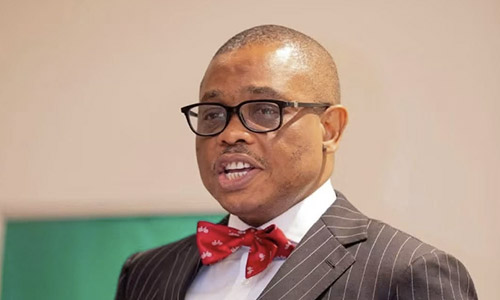
The immediate past President of the Nigerian Bar Association (NBA), Mazi Afam Osigwe, SAN, has said that Nigerian politicians now rely on election tribunals rather than voters to determine electoral victories, and that the courts have gradually assumed a role that properly belongs to the electorate.
He spoke on Thursday at the 22nd All Nigeria Editors Conference, organised by the Nigeria Guild of Editors at the International Conference Centre, Enugu, where he delivered a paper titled “Election Petition in the Digital Age: Independence, Evidence, BVAS.” The opening session of the conference carried the theme “The Ballot, the Media and the Task of Keeping Democracy Alive.”
“The Judicialisation Of The Electoral Process”
The senior advocate traced the phrase to a paper delivered by a judge.
“A judge, a very good friend of mine, once presented a paper and called it ‘The Judicialization of the Electoral Process.’ He argued that because of the difficulty of proving non-compliance with the Electoral Act, the courts have gradually and increasingly usurped the role of the voters in determining the representatives of the people. And I couldn’t have agreed with him more,” he said.
He said the consequence is visible in the volume of litigation. “I see that Nigeria is one of the countries with the highest number of election petitions, and all because the courts are very frequently involved in determining either the outcome or who won,” he said. “And all too often, the courts are merely called in to give direction on issues of procedure.”
He attributed the trend to the manner in which elections are conducted and to the difficulty of establishing electoral violations within the limited period allowed for petitions.
“Would Our Courts Have Had The Boldness To Decide Decisively?”
He contrasted the pace of Nigerian proceedings with a decision of the United States Supreme Court concerning an attempt by former President Donald Trump to alter United States Postal Service voting procedures, which was resolved within days.
“I don’t know how long such a process would have taken if it were Nigeria, or if our courts would have had the boldness to decide decisively,” he said.
“A Failure Of Leadership”
The senior advocate located the wider problem in leadership, citing Chinua Achebe.
“Chinua Achebe, in his book The Trouble with Nigeria, identifies leadership as the problem. He says, ‘The trouble with Nigeria is simply and squarely a failure of leadership.’ And this failure of leadership is found in our homes, in our organizations, and everywhere we work, not just in the presidency or governorships,” he said, extending the point to governors, local government chairmen, political parties and leaders of institutions.
A Word On His Own Profession
He acknowledged that the legal profession contributes to the difficulty, saying lawyers sometimes deploy complicated arguments and technicalities that make it hard for judges to follow their cases.
Answering a question on why judgments are no longer seen as justice, he said the perception is not the whole picture, noting that there have been excellent judgments from the courts which have strengthened the polity.
He also cautioned against “lawyers being used as tools in the hands of the clients,” saying it negates the course of justice and overburdens the courts.
On INEC’s Independence And Voter Turnout
Turning to the Independent National Electoral Commission, he said the process by which members of the commission are appointed remains a major concern for its autonomy, and questioned the use of ad hoc electoral officers, including academics, alleging that some recruited for election duties later faced criminal proceedings.
He linked declining participation directly to public disbelief in the process.
“If you check the voter turnout data, increasingly, fewer Nigerians are coming out to participate in elections. It’s because many Nigerians do not believe that whatever votes they cast matter or count,” he said.
He was particularly critical of collation conducted overnight. “They believe that between the polling units where they vote and the announcement of results at collation centres, especially if collation drags into the night, miracles are suspected to have happened before daybreak. So why vote?”
“Money, Salt, And Rice”
He said politicians exploit that distrust, and condemned voter suppression, ethnic profiling, vote buying and electoral violence.
“Politicians, knowing that the people don’t have confidence in them, prey on the people by giving them money, salt, and rice, while recruiting helpless young men as thugs to unleash violence,” he said.
On State Electoral Commissions
He questioned the independence of the state electoral bodies.
“Whenever people are appointed into the State Independent Electoral Commissions, the ruling party almost always wins 100%. Sometimes you’ll be waiting for ballot papers to arrive, and the results are already announced,” he said.
He said the credibility of elections would remain in doubt where the institutions conducting them are perceived to be politically influenced.
“Then Came The Shockers From The Courts”
The senior advocate devoted a substantial part of the address to whether the technology introduced to strengthen elections has achieved its purpose, given the judicial interpretations that followed.
“Because of the difficulty of proving allegations, we introduced smart cards in 2015, and then moved to BVAS and IReV. Everybody said ‘Hooray!’, but then came the shockers from the courts,” he said.
On the Bimodal Voter Accreditation System, he said: “The court held that the BVAS machine itself is the primary evidence, not the printout from it. So if you are challenging a state-wide election, you must physically carry the BVAS from every single polling unit to court within strict time limits. Yet technology was supposed to make it easier for us.”
He added: “So if you’re challenging a state-wide election, and an issue concerns BVAS from every polling unit, you must physically go and carry the BVAS from every polling unit. And yet the court is not a bit hesitant to set time limits.”
“Why Do We Call It A Subpoena?”
He was equally critical of the treatment of subpoenaed evidence in the presidential election petitions filed by Mr. Atiku Abubakar and Mr. Peter Obi.
“The court’s decision on subpoenas confuses me. When the court said anything a subpoenaed witness did not file within 21 days is inadmissible, it effectively rendered useless the concept of a subpoena,” he said.
“How do you expect an INEC official to willingly sign a witness statement on oath against INEC within 21 days without being suspended?”
He asked: “Why do we call it a subpoena? Why didn’t they say they are your witnesses?”
He said the interpretation weakened the usefulness of the process, particularly where petitioners need documents in the custody of the commission or other public institutions which they could not access before filing.
“Like Going To A Gallery To Watch A Football Match”
On the INEC Result Viewing Portal, he said it had been stripped of evidential value.
“IReV is now treated as a mere viewing portal, like going to a gallery to watch a football match,” he said.
He was careful about the remedy he proposed: “I’m not saying it should be the primary evidence, but first of all, some recognition should be given to it.”
On The Proposed Amendment
He expressed concern over a proposed provision that would prevent non-compliance with the commission’s regulations and guidelines from constituting a ground for challenging an election.
“In my administrative law class at the University of Nigeria in 1993, we were taught that subsidiary legislation made pursuant to a main law has the force of law. Yet now, non-compliance with INEC guidelines is treated as no violation at all,” he said.
He argued that where the commission is empowered to make regulations and guidelines for elections, compliance with them should have meaningful relevance to the credibility of the process, and warned that the provision could encourage politicians to focus only on securing a declaration regardless of whether the process leading to it complied with the law.
“Let That Idiot Go And Waste His Time”
The senior advocate said the weaknesses in the electoral dispute process have produced a culture in which politicians dismiss grievances with a single phrase.
“When a politician tells you to ‘go to court’ in Nigeria, his tone and body language suggest he knows you are going to meet a brick wall, or that he already knows what the outcome will be. It means: ‘Let that idiot go and waste his time.'”
He said the refrain has damaged public perception of the judiciary. “That ‘go to court’ refrain has brought poor perception to the judiciary. A number of judges who have been disciplined were caught collecting money from litigants for favors,” he said.
He also identified weak enforcement procedures as responsible for what he described as flagrant disobedience to court judgments.
On Allegations Of Bribery In Foreign Currency
He raised, while expressly declining to adopt as established fact, allegations of bribery in election tribunals.
“I am told most of these bribe payments to tribunals are made in US dollars, pushing down the value of the naira. Whether true or not, the fact that it is a commonplace saying among lawyers leaves a damaging perception on the judiciary’s ability to deliver justice,” he said.
“Pre-Election Matters Should Not Be Justiciable”
Reflecting on his tenure as President of the association, he restated a position he took in office.
“When I was NBA President, I supported the view that pre-election matters should not be justiciable. Political parties should be able to choose their representatives through internal processes without court interference, just like in the UK where party executives control nominations,” he said.
He rejected the argument that the country is not ready for such an arrangement. “People say we are not yet ripe for that process. But the last time I checked, we gained independence 65 years ago. We keep making excuses, and we only end up making many lawyers very wealthy and corrupt judges extremely wealthy.”
Signage, States And Local Governments
In a separate session at the same conference, the senior advocate accused some state governments of usurping functions constitutionally assigned to local governments, and alleged that the practice is being used to frustrate opposition parties ahead of the elections.
He cited the regulation of campaign billboards and other signage as an example, alleging that some state governments had taken over the function and imposed heavy fees and fines on opposition parties seeking to erect campaign billboards.
“It’s making it difficult for opposition parties to put up their signages. Then putting huge cost on it that is doubtful whether the members of the ruling party in those states are paying,” he said.
“So, in most states, you only see the billboards of the members of the ruling party in that particular state, and not the opposition ones,” he added, warning that the use of regulatory powers in that manner could undermine equal participation in the electoral process.
He urged editors and journalists to continue to scrutinise the commission, the courts and political actors, saying the media has a crucial role in ensuring that votes cast by Nigerians translate into legitimate mandates.
He concluded by warning that continued weaknesses in the handling of electoral disputes could further discourage participation and leave the courts, rather than voters, at the centre of determining who governs.
[A MUST HAVE] Evidence Act Demystified With Recent And Contemporary Cases And Materials

Available now for NGN 40,000 at ASC Publications, 10, Boyle Street, Onikan, Lagos. Beside High Court, TBS. Email publications@ayindesanni.com or WhatsApp +2347056667384. Purchase Link: https://paystack.com/buy/evidence-act-complete-annotation
______________________________________________________________________ “Enhance Legal Practice With Authoritative Reports” — Alexander Payne Offers Comprehensive Law Reports, Spanning Over A Century Of Nigerian Jurisprudence Interested buyers are encouraged to place their orders and enquiries via:
0704 444 4777, 0704 444 4999, 0818 199 9888
Website: www.alexandernigeria.com
Interested buyers are encouraged to place their orders and enquiries via:
0704 444 4777, 0704 444 4999, 0818 199 9888
Website: www.alexandernigeria.com