*Dasuki, Badeh, Alison-Madueke, Dambazau, The Obasanjo Family, Nnamani, Kalu, Ajimobi, Suswam, Ngige, Obiano, Oduah, Ewubare, Ojerinde And Maina: The Names In The Dirty Deeds Report
An investigation has identified 284 properties in the United States, valued at about 271 million dollars, linked to 61 current and former high-level Nigerian officials, their family members, close associates and affiliated companies.
Of those, 152 properties worth about 177 million dollars were acquired while the officials were in office.
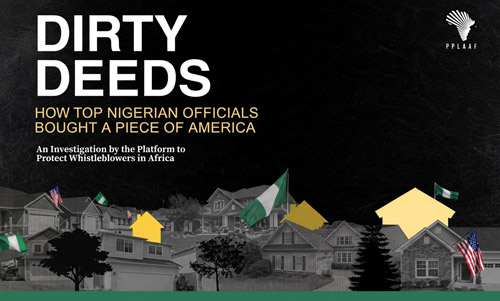
The findings are contained in a 60-page report titled “Dirty Deeds: How Top Nigerian Officials Bought a Piece of America,” launched in Abuja on Tuesday by the Platform to Protect Whistleblowers in Africa (PPLAAF) in partnership with the Anti-Corruption Data Collective (ACDC).
“Not A Verdict”
The report’s authors were careful to frame what the findings do and do not establish.
“This report is not a verdict. It is evidence placed in the public domain,” the Executive Director of PPLAAF, Mr. Jimmy Kande, said, adding that owning property abroad is not, by itself, evidence of corruption.
Presenting the findings, the organisation’s Director of Investigations, Ms. Sonia Rolley, said the investigation did not establish that the properties were bought with stolen public funds, but that ownership patterns, financing arrangements and links between officials and associates raised red flags requiring further scrutiny.
The properties were acquired between 1991 and 2026, although most were purchased after Nigeria’s return to democratic rule in 1999. The report states that 39 of the 61 individuals examined have been publicly accused, indicted or sentenced for corruption, and that those 39 are linked to 232 of the identified properties.
The Figures
According to the report, 230 of the 284 properties, representing about 81 per cent and worth a combined 232 million dollars, were purchased without apparent financing, meaning without a recorded mortgage or other source of finance.
A total of 147 properties worth approximately 111 million dollars were acquired by officials or their spouses in their own names or through legal entities registered in their names. A further 104 properties, valued at about 140 million dollars, were purchased through companies. In 12 cases, officials used United States incorporated entities that appeared to be affiliated with their Nigerian companies to purchase, hold or sell properties.
Of the 232 properties linked to publicly accused persons, 195 worth about 208 million dollars were acquired without apparent financing during or after the officials’ tenure, and 94 worth approximately 135 million dollars were acquired without an apparent source of financing while the officials were still in office.
The report further states that 79 properties worth approximately 73 million dollars remain connected, as at December 2025, to 27 individuals who have been publicly accused of corruption.
The Categories
The report examined officials across six categories. The figures for each are as follows:
| Category | PEPs | Properties | Value | Share of total |
|---|---|---|---|---|
| Security | 12 | 82 | $93m | 34.4% |
| Executive | 11 | 43 | $75m | 27.8% |
| Legislature | Senators and members of the House | 84 | $53m | 19.6% |
| State Government | 14 | 54 | $32m | 11.9% |
| State-Owned Enterprises | 2 | 15 | $14m | 5.2% |
| Other Officials | 3 | 6 | $2.56m | 1.1% |
Security, executive and legislative officials together accounted for properties valued at 222 million dollars, or 82 per cent of the total identified.
Within the security category, 68 per cent of the value is attributed to the former National Security Adviser and his close associates. Within the executive category, 17 properties worth a combined 10.36 million dollars are attributed to two Nigerian presidents, and 21 properties worth about 57 million dollars to seven ministers. In the legislature, senators account for 75 properties worth 49 million dollars, or 93 per cent of that category, with the House of Representatives accounting for nine properties worth 4 million dollars. At state level, 32 properties worth 25 million dollars are linked to current and former governors, and 22 properties worth 7 million dollars to two former members of the Lagos State House of Assembly.
The Names Profiled In The Report
The report sets out fifteen case studies. They are:
| Name | Position | Category |
|---|---|---|
| Sambo Dasuki | Former National Security Adviser | Security |
| Alex Badeh (late) | Former Chief of Defence Staff and Chief of Air Staff | Security |
| Diezani Alison-Madueke | Former Minister of Petroleum Resources | Executive |
| The Obasanjo family | Olusegun Obasanjo, former Head of State and President, and members of his immediate family | Executive |
| Abdulrahman Bello Dambazau | Former Chief of Army Staff and former Minister of Interior | Executive |
| Chimaroke Nnamani | Former Governor of Enugu State, later Senator | Legislature |
| Orji Uzor Kalu | Former Governor of Abia State, now Senator | Legislature |
| Abiola Ajimobi (late) | Former Senator for Oyo South and former Governor of Oyo State | State Government |
| Gabriel Torwua Suswam | Former Governor of Benue State | State Government |
| Chris Ngige | Former Governor of Anambra State, later Senator and Minister of Labour and Employment | State Government |
| Willie Obiano | Former Governor of Anambra State | State Government |
| Stella Oduah | Former Minister of Aviation | State-Owned Enterprises |
| Chris Osa Ogiemwonyi | Former Minister of State for Works, husband of Ms. Oduah | State-Owned Enterprises |
| Roland Onoriode Ewubare | Former head of the National Human Rights Commission and former Group Chief Operating Officer, NNPC | State-Owned Enterprises |
| Dibu Ojerinde | Former Registrar of JAMB and former head of NECO | Other Officials |
| Abdulrasheed Maina | Former Chairman, Presidential Task Force on Pension Reforms | Other Officials |
Others named in connection with the profiles include Mr. Robert Oshodin and Mrs. Mimie Oshodin, described as associates of the former National Security Adviser; Mrs. Farida Dasuki; Mr. Timothy Ijir, described by a judicial commission of inquiry as a close associate of the former Governor of Benue State; and members of the Badeh and Obasanjo families.
The Security Category
The report states that the former National Security Adviser, Mr. Sambo Dasuki, purchased a 127-acre horse farm in South Carolina in 2002 for nearly one million dollars in cash, while serving as head of the Nigerian Security Printing and Minting Company, and later transferred it to his wife for one dollar. It records that when she applied for a United States immigrant investor visa in 2007 on the basis of that purchase, she told officials the funds came from a lobbying contract; the application and a subsequent appeal were both rejected. The report says the family still owns the farm, which now operates as a short-let rental and wedding venue.
It further states that Mr. Robert Oshodin and Mrs. Mimie Oshodin, Nigerian-American business owners who served as legal guardians of the family’s children in the United States, bought 20 homes in Los Angeles and a suburb of Washington DC during his tenure for about 24 million dollars in cash, with some purchases occurring within days of wire transfers from his office. Mrs. Oshodin and her company were acquitted of money laundering charges by a Federal High Court in Abuja in April 2026. Her husband, the report says, has remained beyond the reach of Nigerian law enforcement.
On the late Chief of Defence Staff, Mr. Alex Badeh, the report records a Florida condominium bought in 2013 for 420,000 dollars, transferred to a corporate entity by quitclaim deed in February 2016 weeks before his arraignment, transferred back after his death and later sold. It records further Florida acquisitions by his children. He pleaded not guilty throughout and his trial was still ongoing when he was killed in December 2018, upon which the criminal case terminated, although his company later entered a plea bargain and its assets were ordered forfeited. His son told the investigators that one property was acquired from lawful earnings.
The Executive Category
On the former Minister of Petroleum Resources, Ms. Diezani Alison-Madueke, the report notes that she was charged with bribery-related offences by the United Kingdom’s Serious Fraud Office in 2023 and acquitted on all criminal charges by a London jury three years later, and that United States federal authorities pursued civil forfeiture actions. It states that six of the eleven properties identified had already featured in those proceedings.
On the Obasanjo family, the report states that no properties appear to be directly owned by the former President himself, and that eleven properties worth around nine million dollars were linked to members of his immediate family, including his son and two of his children. It notes that he was publicly accused by the EFCC but officially cleared. A further eight assets sharing the family surname could not be fully corroborated.
On the former Chief of Army Staff and Minister of Interior, Mr. Abdulrahman Bello Dambazau, the report states expressly that he was never formally implicated in the defence procurement controversies of the period, and that the absence of direct legal exposure did not end public debate about institutional responsibility within the military leadership.
Geography
Texas, North Carolina, California, Georgia and Maryland together account for approximately 71 per cent of all the identified properties.
The report cautions that concentration does not indicate many different officials investing in the same place. All 31 properties identified in Charlotte are linked to a single individual, Senator Orji Uzor Kalu. The metropolitan areas with the greatest diversity of owners are Houston, with properties linked to nine different politically exposed persons, followed by Atlanta with seven, Bowie with six and New York City with five.
“Could Amount To International Money Laundering”
Mr. Kande said the findings exposed both individual conduct and structural weakness.
“At an unprecedented scale, these findings expose the failings of individual officials and the structural gaps that allow stolen public wealth to cross borders and settle quietly into foreign real estate,” he said.
“The purchases, transfers, and sales documented here could amount to international money laundering and must be investigated as such. Nigerian and American authorities must work together to ensure these assets are returned to the people they were taken from.”
He urged Nigerian authorities to use existing mechanisms for mutual legal assistance where evidence of wrongdoing is established, called on financial institutions, real estate professionals and other gatekeepers to strengthen scrutiny of cross-border flows, and said similar reviews could be undertaken in the United Kingdom and the United Arab Emirates. He also called for stronger whistleblower protection, noting that Nigeria still lacks standalone whistleblower-protection legislation.
“Money can cross borders. Evidence can cross borders. Our cooperation must cross borders too,” he said.
The report’s conclusion states: “The findings in this report are not the result of exceptionally cunning or unusually sophisticated schemes. They are the predictable outcome of a system in which the incentives to move stolen wealth offshore are high, the tools to detect and recover are weak, and the political will to close the gap has been insufficient.”
It adds that the properties identified “represent schools not built, hospitals not staffed, and a power grid that cannot keep the lights on.”
Methodology
The Anti-Corruption Data Collective compiled a database of United States property records, credit-related address data and corporate ownership registries. The two organisations built a list of relevant individuals and entities from Nigerian government records, published lists, expert-generated rosters and summaries of indictments, using the annual compendium of major Nigerian corruption cases published by the Human and Environmental Development Agenda Resources Centre as a primary guide.
Names were cross-referenced against the property databases, and for each property the investigators obtained documents from the official registry of the relevant county or state.
Each property was assessed independently. Beyond a subject’s family name, a minimum of two independent corroborating links was required for inclusion, resting on distinct personal identifiers such as dates of birth, residential addresses or matching signatures appearing across deeds and registries. In one instance corroboration came from an official who listed a Nigerian home address on a signed power of attorney; in others, signatures on United States property documents were compared against documents signed by the same person in Nigeria.
Where properties were held through intermediaries, corroboration was sought through corporate registries, family identification and open-source intelligence including social media, geolocation data, travel records and professional backgrounds. Both incriminating and exculpatory evidence was considered, and a structured false-positive risk assessment was applied, accounting for name frequency, geographic consistency and regional naming conventions.
Properties were valued using appraised values from 2025 rather than historical purchase prices, to allow a standardised comparison.
The full 60-page report is available for download, but key findings are visualised in the sections below
[A MUST HAVE] Evidence Act Demystified With Recent And Contemporary Cases And Materials

Available now for NGN 40,000 at ASC Publications, 10, Boyle Street, Onikan, Lagos. Beside High Court, TBS. Email publications@ayindesanni.com or WhatsApp +2347056667384. Purchase Link: https://paystack.com/buy/evidence-act-complete-annotation
______________________________________________________________________ “Enhance Legal Practice With Authoritative Reports” — Alexander Payne Offers Comprehensive Law Reports, Spanning Over A Century Of Nigerian Jurisprudence Interested buyers are encouraged to place their orders and enquiries via:
0704 444 4777, 0704 444 4999, 0818 199 9888
Website: www.alexandernigeria.com
Interested buyers are encouraged to place their orders and enquiries via:
0704 444 4777, 0704 444 4999, 0818 199 9888
Website: www.alexandernigeria.com