*Says “If Tinubu Wants To Travel To The UN For Purposes Of UN Business, He Is Immune From The Kinds Of Suggestions People Are Making”


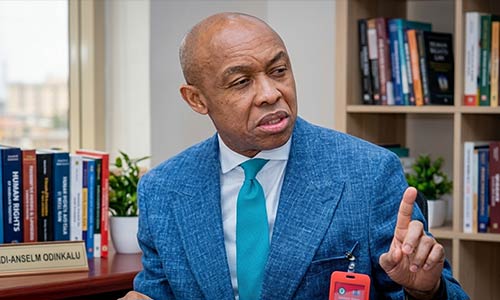
A former Chairman of the National Human Rights Commission, Professor Chidi Odinkalu, has said that President Bola Ahmed Tinubu cannot govern Nigeria indefinitely from abroad, warning that the country has effectively become an ungoverned territory as the President’s absence reached 24 days with the Vice President, Senator Kashim Shettima, also out of the country.
He spoke on Channels Television’s Politics Today, in a discussion of who is constitutionally exercising presidential authority. The President left Nigeria on 30 August on what the presidency described as a working vacation, travelling to London and later to Paris, and on 21 September the presidency announced that he had extended the trip and would return at the weekend. The Vice President left Abuja on 20 September for the United Nations General Assembly in New York.
Before turning to the constitutional question, Professor Odinkalu asked leave to address the education summit under way in New York.
“At least I know the secondary school I went to, I know the schools I went to, and both of my parents are teachers, and I’m a teacher, and education means a lot to me,” he said.
“As you probably know, there is a crisis with the unity schools in Nigeria over the concessioning of King’s College. There is no policy on concessioning of publicly owned schools, by the way. So this is just drawn out of the heart.”
He said the administration has no education policy at all. “The last policy on education was done by Adamu Adamu as Minister of Education in 2017, and I don’t even think this administration has read it. They’ve not bothered to update it. The numbers of out-of-school children are skyrocketing in the country. And we can’t even go to the United Nations and say, oh, this is our education policy. That’s how bad it is.”
He added: “Sadly, the President does not have a calling card on this, because he cannot name any teacher who taught him. He cannot name the schools he went to. Do you see the credibility crisis we are running, attending an education summit at the United Nations General Assembly?”
Turning to section 145, he entered a caveat. “Let me be quite clear, just as a citizen, not with any legal qualifications, because I lack any on this particular issue.”
How Section 145 Came About
He traced the provision to the final illness of the late President Umaru Musa Yar’Adua.
“The context is the events that took place in 2010, and preceding that, over the health of President Umaru Musa Yar’Adua, and the need to ensure that there is no vacancy unexplained in the running of the country in such a way as to make it impossible for the country to run.”
“At the point when President Yar’Adua was tragically in the final days of his life, he was outside the country. Vice President Jonathan, this was in the first two months of 2010, Vice President Jonathan was quite literally made to sit in Abuja twiddling his thumbs, unable to do anything. And in the end, the Senate had to manufacture the doctrine of necessity, if you recall, by which power was eventually transitioned to him in an acting capacity.”
“On the back of the lessons from that, section 145 was then produced in a way as to make it impossible for that kind of crippling vacancy to either exist or to subsist. But that requires a contingency in section 145 to be fulfilled, and the Senate, the National Assembly, this National Assembly as it is, is unwilling and unable to fulfil that contingency.”
“Running A Country Requires Common Sense”
Asked to apply the provision, Professor Odinkalu objected to treating the question as one of text alone.
“Running a country is not as mechanistic as just reading texts and trying to do everything you want to do,” he said, offering a domestic analogy. “I presume you’re married. I don’t imagine that whenever you wake up and you want to go to the other room with your wife, you look for a legal text that provides for going to the other room, and if you cannot find it, you cannot go. So running a country requires common sense.”
He said the present situation is without precedent in Nigeria.
“This is the first administration where the principals, the Vice President and the President, are making a habit of abandoning the country without leadership. It never happened before. As a rule, as a convention, pretty much a binding convention of government, no president allowed himself to be out of the country with the Vice President at the same time. It never happened. It was not permitted.”
“Under Buhari, whenever Buhari was going out of the country, Osinbajo was required to be back in the country. Under Obasanjo, Obasanjo would never contemplate it. Yar’Adua did not contemplate it. Jonathan did not allow it.”
“The question therefore you’ve got to pose is, do the current people running the country even think or understand what the obligations of running the country are, before we get into the constitutional text? Because if they don’t understand this, no matter how much you try to read the text, they will subvert it.”
“Conventions Are Part Of The Common Law Of The Constitution”
Told that he had offered a moral rather than a legal grounding, Professor Odinkalu rejected the characterisation.
“What I described was not a moral principle. Conventions are part of the norms of constitutional government. Indeed, the decision of the Privy Council in Adegbenro v Akintola in 1963 foregrounds the idea that conventions are part of the principles of constitutional government. That’s actually common law, which is a source of Nigerian law, as you well know.”
“Working Vacation Does Not Exist In That Text”
On the presidency’s description of the trip, he was blunt.
“No matter how you read the text of section 145, the idea of working and vacation does not exist in that text. What section 145 addresses is absence from the country for a duration which is set at 21 days. It is irrespective. If the President does not transmit a transfer of authority enabling the Vice President to act, then upon the onset of the 21st day, something should give.”
He said he would not have advanced the argument the presidency has chosen.
“If I were the counsel in the presidency, I will not be talking about this idea of working vacation or not working vacation. That sounds quite illiterate, with the greatest, most profound respect.”
The Better Argument He Would Make
He then set out what he described as the strongest available defence.
“If I were counsel in the presidency, what I would do to sound very overly legalistic about this is to use the Interpretation Act and say that 21 days means 21 working days, and at the moment that is not yet the case. You will be existing within the boundary of agreeable legal argumentation, but you cannot be talking about working or non-working vacation.”
He explained the arithmetic: “When you look at the Interpretation Act, 21 days would mean 21 working days. And 21 working days is effectively four calendar weeks, because you don’t count public holidays, you do not count weekends. Now, that is within the bounds of sensible legal argumentation.”
He immediately added the objection to his own argument: “But that leaves the country unmanned. And if I were legal counsel, this is what I’d be suggesting to them. We have to be intellectually honest. This is permissible and plausible legal argument.”
He observed wryly: “I’ve given you the best legal argument that can run. And they should actually be paying me for this.”
“Nigeria Effectively Has Become An Ungoverned Territory”
Beyond the legal argument, his assessment was severe.
“Every other thing about this is very squalid, and that’s putting it rather mildly,” he said. “My favourite country is across the border, Cameroon. Paul Biya visits Cameroon. He lives in Switzerland and visits Cameroon from Switzerland. He’s just left back to Switzerland. He hasn’t been in Cameroon for like four or five days, after nearly 80 days of being away.”
“Now, President Tinubu, as you rightly point out, has been away for 24 days. Increasingly, it’s beginning to look like Nigeria is his vacation spot and France is really where the Nigerian capital is and where he goes to do business. I don’t think really people should be telling us that our president is running the country.”
“Nigeria effectively has become an ungoverned territory. This is exactly what it is. Nigeria is ungoverned. We’ve been talking about our insecurity situation as a reflection of ungoverned territory. So here we are.”
He described the country’s principals as absent from their posts while other leaders were at the United Nations. “The people running the country have abdicated, gone to look after countries, to become basically house-sitters in countries whose presidents are in New York. The Prime Minister of the United Kingdom is in New York at the moment. Our president is looking after Europe. To go and clean houses for other people. That’s exactly what our president is doing. That’s terrible. There’s no way to make this sound good or look good, no matter how legalistic you want to be about it. It says something terribly squalid about the attitude that leaders of the highest levels bring to governance.”
On The Secretary To The Government
Asked whether an unelected appointee such as the Secretary to the Government of the Federation could be said to be in charge, he was categorical.
“That does not exist. That possibility of the SGF does not exist within the contemplation of section 145. So I think we can dispense with that quite quickly.”
He earlier described the suggestion as part of a wider casualisation. “To then casualize everything, they say the country is going to be run by the Secretary to the Government of the Federation, is frankly something I could be quite brutal in describing, but I don’t want to use the expression on set. I just think that we cannot take ourselves seriously if we are going down that route.”
“It Is Not Necessarily The Case That The President Has To Transmit A Letter”
Professor Odinkalu cautioned that section 145 is more complex than the debate allows, and warned against what the Privy Council has called “the austerity of tabulated legalism.”
“It’s important to zoom out to the responsibilities of leadership first, before you start getting into the black letter lawyering. But if you get into the black and white lawyering, it’s not as clear as people want to make out.”
“There isn’t necessarily, it’s not necessarily the case that the President has to transmit a letter. The President may actually be going out under conditions that do not enable him to transmit a letter. It could be a medical situation, anything like that. That’s why section 145(2) exists.”
He cited an American precedent for the better practice. “Under section 145, it is good practice to transmit a letter. So, for instance, when Ronald Reagan was going into surgery in, I believe, 81, following the shooting incident in DC, he transmitted a letter transmitting powers to Vice President George H. W. Bush. That was very clear, and it is good practice.”
“However, if the President fails to do that and you have a clear onset of the 21-day trigger, depending on how 21 days is interpreted, the obligation shifts from the presidency, the executive, to the legislature, who, by joint resolution adopted by a simple majority, should take responsibility to confer that authority to act on the Vice President.”
“So this is actually delicately structured. The design is not so that we just read off mechanistically. It assumes that the people exercising power understand that statecraft is a huge responsibility, in the management of which there should be no vacuum. If you do not have responsible people exercising statecraft, you cannot operate section 145 properly.”
“No President Is Required To Assume The Status Of A Prisoner”
Asked directly whether physical absence from Nigeria means the President has lost his powers, he answered plainly.
“The straightforward answer to that, of course, is no. No president is required by virtue of assuming office to also assume the status of a prisoner.”
“The biggest things the President does are two: national security and foreign policy. The third, of course, is the additional responsibilities of commander-in-chief, which are not delegable. And all of these three are mutually intertwined. Pretty much all of them require the President now and again to be out of the country.”
“But nobody realistically, because the presidency is such a tasking role, nobody realistically expects the President to just wander off and keep swanning around in foreign countries and territories until the day after eternity, which seems to be exactly what is happening.”
He went further: “The President has assumed residency of a foreign country. And if he has not assumed the residency of a foreign country, he could quite easily meet the thresholds for acquiring residency of a foreign country while serving as President of Nigeria. That’s what is at stake here.”
“The Legal Point Is Not A Winning Argument”
He faulted the opposition for the ground on which it has chosen to fight.
“My disappointment is that the politicians are making this a legal argument, which is not a winning argument for them. Let me be quite clear. The legal point is not a winning argument. The winning argument is the political point. When politicians leave their politics and become lawyers, particularly in the context of Nigeria, there’s a problem.”
“The big issue here is a political issue. The presidency has abdicated and rendered Nigeria into an ungoverned territory. Can they stick with that?”
“The President Is Not A Priestess”
Asked whether a president can therefore run the country remotely and digitally, he said he could not.
“No. The President is not a priestess. The President cannot stay somewhere and be inflicting spiritual attack on Nigeria, which is what you’re suggesting. There are constitutional parameters, again, requiring sensible people. At the moment, they are not in abundance in leadership in the country. Let’s be clear about that.”
“Twenty-one days is the outer limit within which the President can spiritually attack Nigeria from anywhere. After 21 days, then the National Assembly should exercise responsibility.”
He repeated the Interpretation Act point. “If you interpose the Interpretation Act, 21 days could mean working days. I’m not saying it necessarily means; I’m saying it could mean working days. If it is 21 working days, that effectively is one calendar month. That’s a different magnitude of the time stretch, the time horizon.”
“Like Paul Biya Runs Cameroon”
He then delivered the comparison that framed his conclusion.
“But no, the President cannot interminably run Nigeria like Paul Biya runs Cameroon. No. From a hotel or a sanatorium in Switzerland.”
He listed other precedents on the continent. “The late President of Côte d’Ivoire, Le Vieux, ran Côte d’Ivoire from a sanatorium in France until he died, for the last five years of his life, essentially. The late President of Gabon, Omar Bongo, ran the country from a sanatorium in Spain pretty much for the last two years of his life until he died. The late President of Angola, José Eduardo dos Santos, ran the country from a sanatorium in Spain for the last two years of his life until he died.”
“That’s not acceptable. That’s the point I’m making, that presidents should not take their countries for granted in this way, because they conduce to constitutional and institutional instability, and they casualize the constitutional arrangements which are essential for running the country. So if your interpretation of what I said is that the President can do that interminably, absolutely not, not under the Nigerian Constitution either.”
On Claims That Tinubu Cannot Enter The United States
Invited to address the suggestion by critics that the President may face an impediment to entering the United States on account of his history there, and the insinuation that he could be at risk if he travelled, Professor Odinkalu declined to speculate but gave a firm answer on the law.
“I’m only a poor citizen. I don’t venture into the realm of the dark arts. I’m not certificated in juju or clairvoyance, so I cannot venture down that route. So I will stick with what I can defend and justify.”
He then set out the position under the United Nations headquarters agreement.
“First of all, the United Nations is headquartered in New York, and the United Nations does have a headquarters agreement, a headquarters protocol, with the United States government. Under the headquarters protocol with the US government, all foreign sovereigns and their duly authorised representatives, and that would include therefore heads of government, not just sovereigns, but heads of government, foreign ministers, and ambassadors accredited to the United Nations, are required to be granted access to New York for purposes of conducting UN business and exit from New York.”
“So if Tinubu wants to travel to the UN for purposes of UN business, he is immune from the kinds of suggestions that people are making. Again, I insist we’ve got to be intellectually honest in these conversations. So let’s be very clear about that. Tinubu would not face any of those threats.”
He gave a comparison. “I mean, the President of Iran is at the United Nations. They’re at war with the US. The US is precluded from basically constraining access to and exit from the work of the UN.”

 Interested buyers are encouraged to place their orders and enquiries via:
0704 444 4777, 0704 444 4999, 0818 199 9888
Website: www.alexandernigeria.com
Interested buyers are encouraged to place their orders and enquiries via:
0704 444 4777, 0704 444 4999, 0818 199 9888
Website: www.alexandernigeria.com