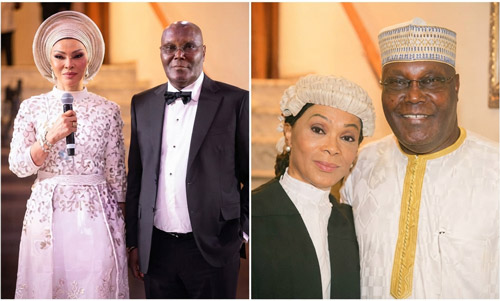
The final award issued on 17 September by an International Chamber of Commerce (ICC) arbitration tribunal in Paris, in the dispute over the Mambilla Hydroelectric Power Project, is the fifth international matter in which the presidential candidate of the African Democratic Congress (ADC), Mr. Atiku Abubakar, and his former wife, Mrs. Jennifer Douglas, have been named in connection with suspicious financial transactions or allegations of bribery, according to report by Abdulqudus Ogundapo of premiumtimesng.
Across more than two decades, the matters have involved a German engineering conglomerate, a convicted former United States congressman, a federal intervention fund, a United States Senate investigation and, most recently, an arbitration over Nigeria’s largest stalled power project.
In none of them has the former Vice President been charged or convicted of any offence, and he has consistently denied wrongdoing. His spokesman, Mr. Paul Ibe, did not respond to calls and messages seeking comment on the report on which this account is based.
Mr. Abubakar served in the Nigeria Customs Service for about 20 years, retiring in 1989 as a deputy director, spent roughly a decade in the private sector, and was Vice President to former President Olusegun Obasanjo from 1999 to May 2007. Frequently named among Nigeria’s wealthiest figures, he has attributed his fortune to “wise investments, hard work and sheer luck of being at the right place at the right time.”
One: The Mambilla Arbitration
The ICC tribunal found that the promoter of Sunrise Power and Transmission Company Limited, Mr. Leno Adesanya, made a payment of 500,000 dollars on 30 January 2003 from the Swiss bank account of his offshore company, China Castle Investments Limited, to a United States bank account belonging to Mrs. Douglas. The payment was made months before the contract at the centre of the dispute was said to have been awarded, at a time when Mr. Abubakar was Vice President.
Nigeria alleged in the arbitration that the transfer was connected to the disputed award. Mr. Adesanya and his company denied it, and he explained the payment as a foreign exchange transaction carried out for the former Vice President. The tribunal rejected that explanation, noting the absence of documents evidencing an underlying naira payment, an exchange rate, instructions, or any record of commercial purpose.
Two qualifications are essential to that finding. The former Vice President was not a party to the arbitration, did not give evidence and was not cross-examined; and the tribunal made no finding that he solicited or received a bribe. He has publicly challenged those citing the award against him to identify the paragraph in which any such finding appears, stating that there is none.
Two: The Siemens Bribery Scandal
The Siemens case concerned allegations that the German conglomerate paid bribes to Nigerian officials to secure telecommunications contracts during the Obasanjo administration. The matter became public after the late President Umaru Musa Yar’Adua took office, and in December 2007 his administration suspended further dealings with the company.
The United States Securities and Exchange Commission alleged that Siemens’ telecommunications subsidiary paid at least 4.5 million dollars in bribes in connection with four Nigerian contracts worth approximately 130 million dollars, channelled through fictitious consultancy agreements and intermediaries.
According to the commission’s documents, approximately 2.8 million dollars of those payments was routed through a bank account in Potomac, Maryland, held in the name of Mrs. Douglas, who was then married to the Vice President and living in the United States. She is said to have represented a business consultant who entered into consultancy agreements with the company for supply, installation and commissioning services, despite no work being performed.
Other alleged payments included the purchase of watches worth about 172,000 dollars for Nigerian officials recorded in the company’s internal records as “P.” and “V.P.”, designations believed to refer to the President and Vice President. Those are the company’s internal notations, and no tribunal has determined the identity of the persons behind them.
In November 2008, Siemens agreed to pay approximately 1.6 billion dollars in penalties to United States and German authorities for violations of the Foreign Corrupt Practices Act. Nigeria’s Economic and Financial Crimes Commission filed charges against Siemens entities and individuals in October 2010, but the following month the Federal Government reached an out-of-court settlement under which the company reportedly paid about 46 million dollars in damages, and the charges were withdrawn.
Three: The William Jefferson Affair
The scandal involving the former United States congressman for Louisiana, Mr. William Jefferson, concerned an American technology company, iGate, and a Nigerian telecommunications company, Netlink Digital Television.
The company’s then chief executive, Mr. Vernon Jackson, approached the congressman for assistance in using his political position to advance iGate’s interests in Nigeria. In 2006 Mr. Jackson pleaded guilty to bribery-related offences, admitting that the company paid the congressman more than 400,000 dollars.
According to court records, the congressman arranged a meeting between iGate representatives, the Vice President and associates including the businessman Mr. Oyewole Fasawe, urging support for the company’s entry into Nigeria and proposing a revenue-sharing partnership with the Nigerian firm.
The records state that the congressman discussed paying the Vice President 100,000 dollars in cash to influence the partnership, and claimed to have delivered the money. A subsequent search of his home by the Federal Bureau of Investigation recovered 90,000 dollars in marked cash, wrapped in aluminium foil and concealed in a freezer. The claim that the money reached the Vice President was the congressman’s own account; it was not the subject of any finding against the former Vice President, who was never charged in the matter.
In June 2006 the United States Department of Justice and the FBI wrote to Nigerian authorities seeking documents concerning the Vice President and others connected to the congressman’s business activities, prompting President Obasanjo to direct the EFCC to investigate.
The commission reported that the Vice President personally made an initial payment of 30 million naira towards securing the Nigerian company’s headquarters in Abuja, through an account associated with Marine Float Limited, an entity linked to him.
The congressman pleaded guilty to corruption-related charges and was sentenced to 13 years’ imprisonment in 2009, later reduced to 12 years on appeal. He was released in 2017 after serving about five years.
Four: The Petroleum Technology Development Fund
In 2006 an audit and forensic report by the EFCC into the management of the Petroleum Technology Development Fund indicted the then Vice President, finding that he approved the release of 20 million dollars from the treasury and its placement in Trans International Bank without appropriation or the approval of the Federal Executive Council. The report described the action as improper and as amounting to abuse of office.
The investigation examined the approval of 125 million dollars for the fund’s purposes, the placement of substantial portions of it with Equatorial Trust Bank and Trans International Bank, and a subsequent 20 million dollar transaction, together with transactions involving the Nigerian telecommunications company, a former executive secretary of the fund, and other persons.
The investigators found that the fund operated without formal annual budgets and without stated goals for each department. “Therefore, the Fund operated without adequate planning and control,” they wrote, identifying that as a likely reason for its general mismanagement through placement in fixed deposits with banks of unsound financial standing.
Questioning why 30 million dollars was placed in 2003 with a bank already experiencing cash flow problems, they concluded that the “long-standing relationship between the VP and Otunba Fasawe could be the reason that informed the VP’s choice of TIB for the deposit,” noting that he was a prime and influential customer of the bank.
They added: “The immediate transfer of the additional funds to TIB, with its not-too-spectacular rating in the banking industry, is likely to justify the allegation of the US Congressman, William J. Jefferson, that NDTV delayed the payment of a contract sum to iGate because they were expecting funds allegedly related to PTDF.”
The report stated that despite its liquidity problems the bank granted over 1.5 billion naira net of interest to companies related to Mr. Fasawe, and a further 300 million naira to a company owned by a director of the telecommunications firm. It listed payments from one of those accounts between July 2003 and July 2004, including over 104 million naira to a personal assistant to the Vice President, 100 million naira to the national headquarters of the Peoples Democratic Party, and sums to other recipients. It said the Vice President benefited from the account to the tune of 61 million naira, and that Marine Float received 250 million naira.
What Followed
President Obasanjo constituted an administrative panel headed by the then Attorney-General of the Federation, Mr. Bayo Ojo, to examine the report. The panel found that the Vice President approved the placement of the funds in banks rather than their immediate application to the approved projects, and recommended that he be held accountable for the 20 million dollar transaction.
Because a sitting Vice President enjoys immunity under section 308 of the Constitution, prosecution was not possible, and the panel recommended referral to the Code of Conduct Bureau.
The Vice President, then the presidential candidate of the defunct Action Congress, described the investigation as selective and said the two reports were a premeditated political action intended to halt his presidential ambition. His campaign organisation alleged that the Federal Government may itself have breached the law, contending that of 700 million dollars realised in the 2002/2003 bidding rounds, only 145 million dollars was remitted to the fund’s account, contrary to the statute requiring such proceeds to be paid into it.
On 22 September 2006 the Federal Government filed an 18-count charge before the Code of Conduct Tribunal. The Vice President challenged the proceedings at the Federal High Court in Abuja on the ground of immunity, and the court upheld his position in December that year. In April 2007 the Court of Appeal affirmed that the tribunal’s proceedings were criminal in nature and could not be sustained against a sitting Vice President.
A Senate ad hoc committee headed by Senator Victor Ndoma-Egba, SAN, separately examined the transactions and reported that there was no direct evidence of personal enrichment, pointing instead to procedural and administrative lapses.
Five: The United States Senate Investigation And Banking Scrutiny
A report of the United States Senate Permanent Subcommittee on Investigations, released on 4 February 2010, examined the movement of funds into the United States between 2000 and 2008.
It found that a network of accounts at American financial institutions was used to move more than 40 million dollars in suspect funds into the country through wire transfers from offshore corporations based in Germany, Nigeria, Panama, the British Virgin Islands and Switzerland.
Nearly 25 million dollars was transferred into more than 30 accounts opened in the names of Mrs. Douglas, the Jennifer Douglas Abubakar Family Trust, the Gede Foundation and the American University of Nigeria. She opened 18 of the accounts at Citibank, four at Chevy Chase Bank, six at Wachovia Bank and three at Eagle Bank in Maryland, among others.
The report found that the banks in many cases opened accounts without knowing that she was a politically exposed person, some relying on third-party vendors with incomplete databases or operating inadequate due diligence procedures. It recorded that she repeatedly told banks that her husband transferred millions of dollars to her accounts through offshore companies, while listing her occupation variously as “student”, “homemaker” or “unemployed”. It also noted that she lived in a luxury home in Potomac, Maryland.
As institutions began questioning the offshore companies transferring the funds, accounts were closed and new ones opened elsewhere, in some cases with the assistance of her United States lawyer, Mr. Edward Weidenfeld, who the report said received 3.4 million dollars from offshore entities to pay legal bills and to fund a university account he opened at SunTrust Bank. Over five years the university received 14 million dollars. In each instance, the report said, the recipient institution was told the funds originated from the former Vice President.
A 2020 investigation based on confidential Suspicious Activity Reports filed with the United States Financial Crimes Enforcement Network showed that transactions involving him, his family and companies linked to him were subject to heightened scrutiny within the international banking system.
Among the entities flagged was Guernsey Trust Company Nigeria Limited, which held a 16 per cent interest in Intels Nigeria Limited and was established in 2003 to manage assets under a blind trust created after he became Vice President. In March 2012 Habib Bank Limited New York flagged a series of transactions involving the company, including a transfer to a real estate brokerage in Dubai to purchase a property for one of his wives, and transfers from Swiss accounts to London covering the personal expenses of his first wife. The bank placed the individuals and entities into its internal system for real-time monitoring.
In 2017 Deutsche Bank Trust Company Americas filed a report concerning 27 transactions totalling 11.14 million dollars connected to Intels Nigeria Limited, referring to his connection with the company and citing prior negative information and investigations into allegations of fraud, corruption and money laundering.
The Move To Dubai
In March 2018 it was reported that the former Vice President and Mrs. Douglas sold their Potomac property for about 2.95 million dollars. The seven-bedroom house, measuring more than 7,000 square feet, had been acquired in December 1999 for 1.75 million dollars, before he became Vice President. It was listed at about 3.25 million dollars in January 2018 and sold through an online auction.
The property had attracted the attention of investigators: in 2005 the FBI searched it in the course of the Jefferson investigation.
The sale came against the background of prolonged difficulty in obtaining a United States visa. In December 2017 he said his application remained under administrative processing, while denying that he was avoiding the country. The publication which examined the matter states that it has not independently established the precise reasons for the visa refusals.
His spokesman previously denied that the sale was connected to any investigation or legal pressure, saying the property was no longer serving its intended purpose and that the proceeds would be reinvested in businesses owned by the former Vice President.
The couple married in 2003 and divorced in June 2021.
 Interested buyers are encouraged to place their orders and enquiries via:
0704 444 4777, 0704 444 4999, 0818 199 9888
Website: www.alexandernigeria.com
Interested buyers are encouraged to place their orders and enquiries via:
0704 444 4777, 0704 444 4999, 0818 199 9888
Website: www.alexandernigeria.com