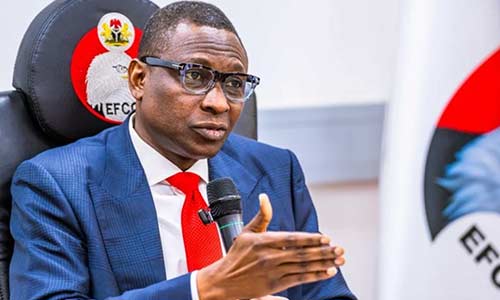
The Chairman of the Economic and Financial Crimes Commission (EFCC), Ola Olukoyede, has warned religious leaders against diverting tithes, offerings, zakat and other funds belonging to churches, mosques and faith-based organisations into their personal businesses, describing such conduct as potentially criminal.
Olukoyede said religious leaders who operate legitimate private businesses must maintain a clear separation between their personal finances and money entrusted to religious organisations, stressing that funds contributed by worshippers should be used for the purposes for which they were received.
The EFCC chairman spoke at the 2026 Second Council Meeting of the Nigeria Inter-Religious Council (NIREC), held under the theme, “Shared Sacred Flourishing in Nigeria.”
According to him, religious organisations generally operate as not-for-profit bodies and should put appropriate financial and regulatory compliance systems in place to ensure that money belonging to the organisation is not mixed with the personal funds of founders, clerics or other officials.
Olukoyede said there was nothing wrong with a religious leader engaging in another lawful vocation, including farming, trading or other businesses, but maintained that organisational funds must not be diverted to finance those private ventures.
“You are not supposed to mingle it. There’s nothing that says you can’t do another vocation. You sell cars, you have a farm and all of that,” he said.
“Don’t mix the money from the purse of your organisation with that of your own personal money. Don’t do that. When money is paid to your organisation, don’t divert it to your business.
“That is criminal.”
He urged churches, mosques and other religious bodies to establish financial controls and compliance mechanisms that clearly identify which funds belong to the organisation and which belong personally to their leaders.
“Go and develop regulatory compliance templates for your religious organisation so that you know where you don’t have to cross the line. You know where the boundary is drawn. You know the money that belongs to you and the money that does not belong to you,” he said.
The EFCC chairman stressed that tithes, offerings, zakat and other contributions made to religious organisations were entrusted to those institutions for religious and charitable purposes and should not be treated as personal income merely because a particular individual heads the organisation.
Olukoyede also used the occasion to recall previous EFCC investigations into bodies responsible for the sponsorship and administration of religious pilgrimages, saying investigators encountered what he described as disturbing financial irregularities.
He said that during his earlier service at the commission, including periods when he served as Chief of Staff and Secretary to the EFCC, investigations were conducted into both Christian and Muslim pilgrimage boards.
“Some of the discoveries we made were mind-boggling,” he said.
According to Olukoyede, investigators found in one instance that almost 75 per cent of government funds released for the sponsorship of pilgrims had allegedly been stolen by officials connected with the programme.
He did not, in the remarks reported from the NIREC meeting, identify the particular pilgrimage body involved, the period of the alleged diversion or the officials concerned. The allegation should therefore be understood as an account of investigative findings cited by the EFCC chairman rather than a fresh judicial determination against any named person or institution.
Olukoyede said such experiences demonstrated why stronger financial accountability was necessary not only in government institutions but also within religious organisations and government-funded religious programmes.
He urged faith leaders to understand that accountability for money entrusted to them should form part of their moral and institutional responsibilities.
Beyond financial compliance, the EFCC chairman called on religious leaders to play a stronger preventive role in Nigeria’s fight against corruption.
According to him, law enforcement agencies such as the EFCC largely intervene after suspected financial crimes have occurred, whereas churches, mosques and other faith communities are capable of shaping the values and character that influence whether individuals engage in corrupt practices in the first place.
“The EFCC can investigate a person’s conduct. Faith communities can influence that person’s character,” Olukoyede said.
“We can prosecute fraud. Religious teachings can cultivate honesty. We can confiscate illicit wealth.
“Churches and mosques can challenge the values that make society worship wealth without questioning its source.”
He said religious institutions could therefore make a significant contribution to the anti-corruption campaign by promoting the dignity of honest work and discouraging an excessive celebration of unexplained wealth.
Olukoyede maintained that one of the societal problems confronting Nigeria was the tendency to admire wealth without sufficiently questioning how it was acquired.
He urged religious leaders to challenge that culture and teach their followers that the source of wealth matters as much as its possession.
The EFCC chairman said faith communities occupy a particularly influential position because millions of Nigerians listen regularly to religious leaders and often model their behaviour on what those leaders say and do.
He therefore argued that clerics must lead by example if religious institutions are to play a meaningful role in changing attitudes towards corruption.
According to him, preventing corrupt conduct before it occurs should receive as much attention as investigating and punishing offenders after funds have already been stolen or diverted.
“It is important to state here that one of the most consequential contributions religious leaders can make to shared sacred flourishing is to restore the moral dignity of honest living,” he said.
 Interested buyers are encouraged to place their orders and enquiries via:
0704 444 4777, 0704 444 4999, 0818 199 9888
Website: www.alexandernigeria.com
Interested buyers are encouraged to place their orders and enquiries via:
0704 444 4777, 0704 444 4999, 0818 199 9888
Website: www.alexandernigeria.com