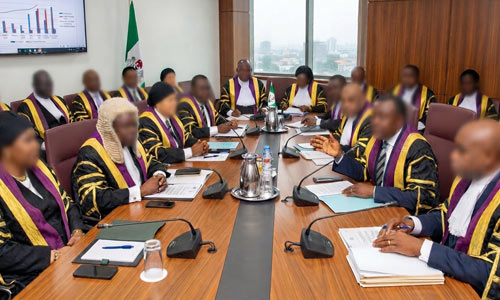
The Body of Benchers has rejected a fresh request by the National Open University of Nigeria (NOUN) for its outstanding law graduates to be admitted into the Nigerian Law School, insisting that its earlier approval covered only 1,883 graduates and was intended as a one-off arrangement.

In a letter dated 15 September 2026 and addressed to the Vice-Chancellor of the university, Professor Uduma Oji Uduma, the Body said it had considered the request and resolved to stand by the decision it took in 2020.
That decision, according to the letter signed by the Secretary of the Body of Benchers, Mr. Daniel M. Tela, approved the admission of 1,883 NOUN law graduates to the Nigerian Law School.
“This letter represents the final position of the Body of Benchers on this matter,” Mr. Tela wrote.
The Body said the list of 1,883 graduates submitted by the university had been considered and approved by the relevant stakeholders as a one-off exercise, and that the university was told not to admit further students into its Faculty of Law.
It said that position remains unchanged.
The letter makes a further point that is likely to shape the dispute as it proceeds.
The Body of Benchers stated that its statutory responsibilities are to call aspirants to the Bar and to discipline erring lawyers, and that matters concerning admission into the Nigerian Law School fall within the exclusive purview of the Council of Legal Education.
The Nigerian Law School was established under the Legal Education Act 1962, now the Legal Education (Consolidation, etc.) Act, while the Council of Legal Education is responsible for the professional legal education of persons seeking to enter the legal profession.
The letter therefore does not amount to an admission decision in respect of every outstanding NOUN graduate. It is a statement of the Body’s position on the request made to it, and it offers no new pathway for the graduates concerned.
According to the university’s account submitted to the House of Representatives, it suspended fresh admissions into its Bachelor of Laws programme in 2015, after the Council of Legal Education declined to admit its law graduates into the Nigerian Law School.
The university said it subsequently engaged the Council and other stakeholders and, in 2019, submitted a list of 1,883 graduates for consideration. It later discovered that 90 names had been omitted, bringing the number represented by that submission to 1,973.
In 2020, the Body of Benchers approved a special remedial programme for those graduates, rather than direct admission into Bar Part II, the route ordinarily followed by graduates of Nigerian universities.
The first group eventually progressed through the process. The university reported in 2025 that 203 of its law graduates were among those called to the Nigerian Bar that year.
The university’s later graduates, however, were not covered by that arrangement.
The university said it submitted a further batch of 2,226 graduates on 13 May 2022, maintaining that those graduates had been admitted into the programme before the 2015 suspension but completed their studies afterwards.
According to its account before the House committee, the Council of Legal Education rejected that submission, among other reasons on the basis of its position that the university continued to admit students after 2015. The university disputes that allegation.
The result has been a growing backlog of graduates holding university law degrees but without access to the professional training required to practise.
The dispute has now reached the National Assembly, with more than 5,000 affected graduates petitioning the House of Representatives over their inability to proceed to the Nigerian Law School and qualify for Call to Bar.
The House Committee on Public Petitions invited the university and the Nigerian Law School to explain the circumstances of the impasse. Neither institution appeared at the scheduled hearing on 16 September, although both submitted written explanations and requested another date.
The graduates have argued that they should not bear the consequences of disagreements between institutions over the history and regulation of the university’s law programme. Their campaign has already moved from petitions to protests: in July, members of the group demonstrated at the National Assembly and at the office of the Attorney-General of the Federation, demanding intervention.
 Interested buyers are encouraged to place their orders and enquiries via:
0704 444 4777, 0704 444 4999, 0818 199 9888
Website: www.alexandernigeria.com
Interested buyers are encouraged to place their orders and enquiries via:
0704 444 4777, 0704 444 4999, 0818 199 9888
Website: www.alexandernigeria.com