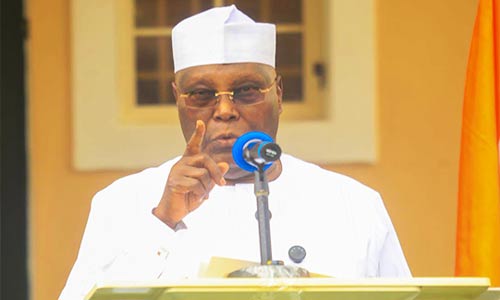
Former Vice-President and African Democratic Congress (ADC) presidential candidate, Atiku Abubakar, has rejected calls by the All Progressives Congress (APC) Presidential Campaign Council for him to withdraw from the 2027 presidential race, challenging the ruling party to identify any part of the International Chamber of Commerce (ICC) tribunal’s final award that found him guilty of receiving a bribe, abusing his office or corruptly influencing the award of the Mambilla Hydroelectric Power Project contract.
Atiku’s response followed an APC campaign council statement which linked him to controversy surrounding a $500,000 payment made in January 2003 by Leno Adesanya, promoter of Sunrise Power and Transmission Company Limited, to Jennifer Douglas, who was then married to Atiku. The APC said the circumstances examined in the Paris arbitration raised questions about Atiku’s role in the Mambilla project and consequently asked him to withdraw from the presidential contest.
In a statement issued by his Senior Special Assistant on Public Communication, Phrank Shaibu, Atiku accused the APC of presenting allegations considered by the tribunal as though they constituted a corruption verdict against him.
At the centre of the dispute is the $500,000 transferred on January 30, 2003, through China Castle Investments Limited, an offshore company controlled by Adesanya, into Douglas’ Citibank account in the United States. The transfer occurred less than four months before Sunrise was purportedly awarded the Mambilla build-operate-transfer contract. The ICC tribunal examined the payment and rejected Adesanya’s explanation that it represented a foreign-exchange transaction because he produced no contemporaneous documentary evidence supporting that account.
The APC campaign council alleged that the payment was connected with the subsequent award of the Mambilla contract and accused Atiku and then Minister of Power, Olu Agunloye, of facilitating the transaction despite objections surrounding the project. It also cited what the tribunal described as the close timing between the January 2003 payment and the purported contract award in May of that year.
The APC further criticised Atiku for not giving evidence before the arbitral tribunal, noting that former Presidents Olusegun Obasanjo and Muhammadu Buhari testified in Nigeria’s defence. It also sought to link him to the prolonged difficulties surrounding the Mambilla project and the financial claims subsequently brought against Nigeria. Those assertions remain the APC campaign council’s political and legal interpretation of the record.
Atiku, however, said the argument rested on what he described as the incorrect assumption that because he served as Vice-President under Obasanjo, every decision taken by the administration could automatically be attributed to him.
He cited his opposition to the proposed third-term agenda during the same administration as an example of why individual officials should not automatically be treated as personally responsible for every government decision.
“Serving in an administration does not make every office holder personally responsible for every policy, scheme or decision associated with that government,” his statement said.
Turning specifically to the Mambilla contract, Atiku said he neither participated in the technical evaluation of the competing proposals nor sat on the procurement panel that recommended Sunrise.
“I was not a member of the technical process that evaluated the competing proposals and recommended Sunrise. I did not sit on the procurement panel. I did not award the contract,” he said.
He consequently challenged those alleging that he manipulated the process to identify the instruction or intervention he made and the portion of the arbitral award establishing corrupt influence on his part.
Atiku specifically asked the APC to produce any paragraph in which the tribunal found that he received a $500,000 bribe, instructed Agunloye to award the project to Sunrise, abused his office or participated in a corrupt conspiracy to procure the contract.
“There is no such finding,” he said.
“What the APC has done is intellectually dishonest. It has converted suspicion into guilt, an unexplained transaction into a proven bribe, and an allegation canvassed before arbitrators into a verdict the arbitrators themselves never delivered,” Atiku said, describing the APC’s interpretation as “political fabrication.”
Published accounts of the award support an important distinction in that argument: while the tribunal rejected Adesanya’s explanation for the $500,000 transaction and expressed concern about the lack of supporting evidence, it did not make a finding that Atiku himself received a bribe.
Atiku acknowledged that the tribunal examined the transfer from Adesanya’s China Castle Investments to Jennifer Douglas and rejected the explanation that it represented a foreign-exchange transaction.
But he argued that rejecting Adesanya’s explanation was legally different from finding that he personally received a bribe or used his office corruptly to secure the Sunrise contract.
“An unsuccessful explanation by Leno Adesanya does not automatically become a corruption verdict against Atiku Abubakar,” the statement said.
The tribunal record shows that Adesanya acknowledged making the transfer and said the money represented dollars purchased for Atiku in exchange for naira. However, the tribunal found that he did not produce records showing the underlying naira payment, the applicable exchange rate, instructions from Atiku or his aides, or other contemporary documentation establishing the commercial purpose of the transaction. Neither Atiku nor Douglas gave evidence in the arbitration to corroborate Adesanya’s explanation.
Atiku nevertheless insisted that the evidential weakness in Adesanya’s account could not be converted into a finding against a person who was not a party to the proceedings.
“If the tribunal wanted to find that the $500,000 was a bribe paid to Atiku, it could have said so plainly. If it wanted to find that Atiku abused his office to procure the contract for Sunrise, it could have said so plainly,” he said.
The former Vice-President also addressed the APC’s criticism of his failure to testify before the tribunal.
He said he was not a party to the arbitration and argued that the reported record did not establish that the tribunal itself had summoned him, directed him to testify or found that he disobeyed an order to appear.
“For the avoidance of doubt, I was not a party to the arbitration and I did not testify before the tribunal. The reported contents of the award do not establish that the tribunal summoned me, ordered me to testify or found that I disobeyed any directive to appear,” he said.
Atiku argued that a party to litigation attempting to obtain a person’s testimony was different from the tribunal formally compelling that person to appear.
“There is a world of difference between a party to an arbitration attempting to secure somebody’s testimony and the tribunal itself summoning that person to appear,” he said.
He acknowledged that Obasanjo and Buhari gave evidence for Nigeria and that former ministers Babatunde Fashola, SAN, and Suleiman Adamu were among those involved in the Federal Government’s defence, but maintained that their participation could not establish that he had been ordered to testify and refused.
Atiku further stressed that the parties to the arbitral proceedings were Sunrise Power and Transmission Company Limited, Leno Adesanya and the Federal Republic of Nigeria, rather than himself.
He said the central issue should therefore remain whether the tribunal actually made the findings now attributed to it by the APC.
“The question is not whether the $500,000 transaction deserved scrutiny. It did, and it was scrutinised,” Atiku said.
“The question is whether the tribunal took the further step the APC now attributes to it and found that Atiku Abubakar received a bribe and corruptly influenced the award of the Mambilla project.”
He then directly challenged the ruling party to publish the portions of the award supporting its allegations.
“Let the APC produce that finding. Let it identify the paragraph where the tribunal found that Atiku solicited a bribe. Let it identify the paragraph where the tribunal found that Atiku received $500,000 in exchange for influencing the Mambilla contract. Let it identify the paragraph where the tribunal found that Atiku instructed Olu Agunloye to award the contract to Sunrise. And let it identify the paragraph where the tribunal found Atiku culpable of corruption in relation to the project,” he said.
“These are not questions of political opinion. They are questions of record. They have factual answers. If the APC has those paragraphs, it should publish them in full and allow Nigerians to read the words of the tribunal themselves.”
The controversy follows the conclusion of the long-running arbitration between Sunrise, Adesanya and Nigeria over the Mambilla project.
The ICC tribunal ultimately rejected Sunrise’s claims against Nigeria and ordered the company and Adesanya to reimburse the Federal Government for 75 per cent of its legal fees and expenses.
The tribunal’s examination of the $500,000 payment concluded that Adesanya failed to substantiate his foreign-exchange explanation with documentary evidence. But available reports of the final award state that the tribunal did not separately find that Atiku personally received the money as a bribe, personally directed its transfer or was adjudged culpable of corruption in connection with it.
Atiku has denied wrongdoing and is now demanding that the APC base its allegations on the precise language of the arbitral award rather than, in his account, drawing conclusions that the tribunal itself did not make.
[A MUST HAVE] Evidence Act Demystified With Recent And Contemporary Cases And Materials

Available now for NGN 40,000 at ASC Publications, 10, Boyle Street, Onikan, Lagos. Beside High Court, TBS. Email publications@ayindesanni.com or WhatsApp +2347056667384. Purchase Link: https://paystack.com/buy/evidence-act-complete-annotation
______________________________________________________________________ “Enhance Legal Practice With Authoritative Reports” — Alexander Payne Offers Comprehensive Law Reports, Spanning Over A Century Of Nigerian Jurisprudence Interested buyers are encouraged to place their orders and enquiries via:
0704 444 4777, 0704 444 4999, 0818 199 9888
Website: www.alexandernigeria.com
Interested buyers are encouraged to place their orders and enquiries via:
0704 444 4777, 0704 444 4999, 0818 199 9888
Website: www.alexandernigeria.com
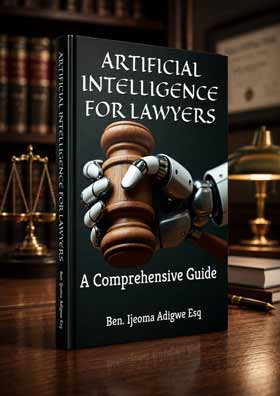 The book also examines Nigeria's legal ecosystem, focusing on the LPELR and NBA AI Guidelines. As a bonus, every purchase comes with a FREE eBook titled: How to Use the AI Features in LegalPedia and LawPavilion.
Ohio Books Ltd praises the publication, stating:
"....this is the only Nigerian book I know of on the topic."
How to Order:
📞 Call, Text, or WhatsApp: 08034917063 | 07055285878
📧 Email: benadigwe1@gmail.com
🌎 Website: www.benadigwe.com
Ebook Version: Access it directly online at https://selar.com/prv626
Authored by Ben Ijeoma Adigwe Esq., ACIarb (UK), LL.M, Dip. in Artificial Intelligence, Director at the Delta State Ministry of Justice, Asaba, Nigeria.
______________________________________________________________________
The book also examines Nigeria's legal ecosystem, focusing on the LPELR and NBA AI Guidelines. As a bonus, every purchase comes with a FREE eBook titled: How to Use the AI Features in LegalPedia and LawPavilion.
Ohio Books Ltd praises the publication, stating:
"....this is the only Nigerian book I know of on the topic."
How to Order:
📞 Call, Text, or WhatsApp: 08034917063 | 07055285878
📧 Email: benadigwe1@gmail.com
🌎 Website: www.benadigwe.com
Ebook Version: Access it directly online at https://selar.com/prv626
Authored by Ben Ijeoma Adigwe Esq., ACIarb (UK), LL.M, Dip. in Artificial Intelligence, Director at the Delta State Ministry of Justice, Asaba, Nigeria.
______________________________________________________________________