By Otuosorochi Junior Omoha, Esq.

In a trending statement made by an officer of the Economic and Financial Crimes Commission (EFCC), the Acting Zonal Director of the EFCC Lagos Zonal Directorate erroneously warned that legal practitioners who charge their clients in foreign currencies may face prosecution.
The warning was issued during a meeting with members of the Nigerian Bar Association (NBA) Lagos Task Force on Illegal Practice of Law.
We strongly object to the warning and state that it was unnecessary, as the Commission should focus on legal practitioners refusing Naira as payment for their professional fees, not lawyers charging their clients in foreign currencies for payment of their professional fees. What happens when a lawyer charges in dollars or any other foreign currency and, at the end of the day, the lawyer is paid the Naira equivalent of the dollar amount charged? It appears that the Acting Zonal Director’s reasoning was clouded by the prevailing situation in the country, particularly the increasing circulation of dollars, but even at that, he should have been mindful of his statement.
It would be pertinent to note at this point that no statute in the country criminalises the acceptance of foreign currencies, and Section 20(1) of the CBN Act, 2007, does not forbid the acceptance of foreign currencies; instead, it clearly provides that the Naira is legal tender, while Section 20(5) of the same Act criminalises the refusal to accept Naira as a means of payment. However, the law does not criminalise transactions in foreign currency.
The relevant provisions of the CBN Act, 2007, read:
“Section 20(1) – The currency notes issued by the Bank shall be legal tender in Nigeria at their face value for the payment of any amount.
Section 20(5) – A person who refuses to accept the Naira as a means of payment is guilty of an offence and liable on conviction to a fine of N50,000 or 6 months imprisonment.”
Flowing from the above, it can be deduced that the CBN Act does not criminalise the acceptance of foreign currencies in a transaction, and there is no other law that prohibits citizens from charging in foreign currencies. The law is settled that when the provisions of a statute are plain and unambiguous, the literal interpretation must be used. In the instant section, the law clearly criminalises the refusal of Naira as a means of payment but does not criminalise the acceptance of foreign currencies.
The Constitution also makes it clear that for a person to be charged and prosecuted in court, the offence must be defined and the penalty prescribed. See Section 36(12) of the Constitution of the Federal Republic of Nigeria, which provides thus: “Subject as otherwise provided by this Constitution, a person shall not be convicted of a criminal offence unless that offence is defined and the penalty therefor is prescribed in a written law, and in this subsection, a written law refers to an Act of the National Assembly or a Law of a State, any subsidiary legislation or instrument under the provisions of a law.” Deductively, the EFCC cannot prosecute lawyers under a non-existent law. The CBN Act does not criminalise lawyers or other persons for charging in foreign currencies; instead, the law criminalises the refusal of Naira as a means of payment. This entails that you may charge your professional fees in dollars and also accept the Naira equivalent in payment.
We must also note that we keenly understand the government’s policies aimed at ensuring that our Naira gains more value in the country, and we also understand that all government agencies are contributing their quotas towards achieving this end, but that will not make government policies take the place of law.
We respectfully refer to the case of STATOIL (NIG.) LTD. V. INDUCON (NIG.) LTD. (2021) 1 NWLR (PT. 1774) 1, where the apex court held quite unequivocally: “A government policy is not law and cannot override the autonomy and freedom of contract. The freedom and autonomy of contract is the fundamental principle of contract law. Parties to a contract have the freedom to determine the terms of their contract. No other person, not even the court, can determine the terms of the contract between the parties thereto.” This clearly settles the point that government policies cannot take the place of law, and lawyers will not be penalised or prosecuted under a non-existent law merely because government policies support that notion.
In a plethora of cases, the apex court has also decided that judgments of the court can be fulfilled in foreign currency. We respectfully refer to the case of SAEBY JERNSTOBERI M.F. A/S V. OLAOGUN KNT (1999) 14 NWLR (PT. 637) 128, (PP. 145-146, PARAS. H-B) SC, where the apex court held thus: “Courts in Nigeria can assume jurisdiction to entertain and determine cases where sums in foreign currencies are claimed. The old rule to the contrary is judge made which has no relevance in the light of present-day circumstances of extensive international commercial relationships. Where an award is made in foreign currency, the judgment will be for the payment of the amount in foreign currency, or its naira equivalent converted for the purposes of the enforcement of the judgment at the time of the judgment.”
Having carefully addressed the statement of the Acting Zonal Director of the EFCC in the preceding paragraphs, we emphatically and unequivocally submit that lawyers, just like members of other professions, have the right to charge in foreign currencies, and there is no law in the country as of today that criminalises the acceptance of foreign currencies. By virtue of the provisions of the Constitution, lawyers who charge in foreign currencies cannot be prosecuted under a non-existent law.
Before concluding, we must also reference the case of F.R.N. V. ICE BY CW & ANIOGOR GODSWILL OBIAJULU, where the EFCC charged the Defendants on a two-count charge, the first count being based on the allegation that the Defendants refused to accept Naira merely because they accepted the sum of $10,000 as payment for one diamond Clover bracelet. We respectfully submit that the facts of this case are not fully covered by the provisions of Section 20 of the CBN Act. However, we sadly note that after the arraignment of the Defendants on the charge, the 2nd Defendant pleaded guilty to the offences, which means that the case cannot be cited with great authority, as the provisions of the law were not tested in line with our contested view.
The two counts of the charge read:
1. “That you, ICE BY CW and Aniogor Godswill Obiajulu, on the 10th day of December, 2024, in Lagos, within the jurisdiction of this Honourable Court, refused to accept Naira (Nigeria’s legal tender) by accepting the sum of $10,000 (Ten Thousand US Dollars) as a means of payment for the purchase of one diamond Clover bracelet and you thereby committed an offence contrary to and punishable under Section 20(1) of the Central Bank of Nigeria Act, 2007.”
(2.) “That you, ICE BY CW and Aniogor Godswill Obiajulu, on the 10th day of December, 2024, in Lagos, within the jurisdiction of this Honourable Court, directly retained the total sum of $10,000 (Ten Thousand US Dollars), which sum you reasonably ought to have known forms part of the proceeds of your unlawful activity to wit: pricing and accepting USD as a means of payment for goods and services and you thereby committed an offence contrary to Section 18(2)(d) of the Money Laundering (Prevention and Prohibition) Act, 2022, and punishable under Section 18(3) of the same Act.”
Written by Otuosorochi Junior Omoha, Esq.
You can contact me via my email address: omohaotuosorochi2@gmail.com or phone numbers: +2348135414889, +2347048710331.
[A MUST HAVE] Evidence Act Demystified With Recent And Contemporary Cases And Materials

Available now for NGN 40,000 at ASC Publications, 10, Boyle Street, Onikan, Lagos. Beside High Court, TBS. Email publications@ayindesanni.com or WhatsApp +2347056667384. Purchase Link: https://paystack.com/buy/evidence-act-complete-annotation
______________________________________________________________________ “Enhance Legal Practice With Authoritative Reports” — Alexander Payne Offers Comprehensive Law Reports, Spanning Over A Century Of Nigerian Jurisprudence Interested buyers are encouraged to place their orders and enquiries via:
0704 444 4777, 0704 444 4999, 0818 199 9888
Website: www.alexandernigeria.com
Interested buyers are encouraged to place their orders and enquiries via:
0704 444 4777, 0704 444 4999, 0818 199 9888
Website: www.alexandernigeria.com
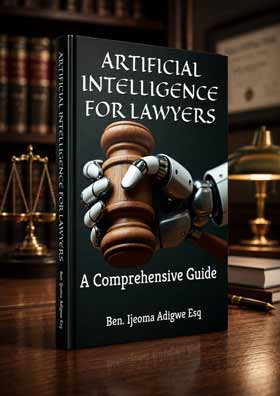 The book also examines Nigeria's legal ecosystem, focusing on the LPELR and NBA AI Guidelines. As a bonus, every purchase comes with a FREE eBook titled: How to Use the AI Features in LegalPedia and LawPavilion.
Ohio Books Ltd praises the publication, stating:
"....this is the only Nigerian book I know of on the topic."
How to Order:
📞 Call, Text, or WhatsApp: 08034917063 | 07055285878
📧 Email: benadigwe1@gmail.com
🌎 Website: www.benadigwe.com
Ebook Version: Access it directly online at https://selar.com/prv626
Authored by Ben Ijeoma Adigwe Esq., ACIarb (UK), LL.M, Dip. in Artificial Intelligence, Director at the Delta State Ministry of Justice, Asaba, Nigeria.
______________________________________________________________________
The book also examines Nigeria's legal ecosystem, focusing on the LPELR and NBA AI Guidelines. As a bonus, every purchase comes with a FREE eBook titled: How to Use the AI Features in LegalPedia and LawPavilion.
Ohio Books Ltd praises the publication, stating:
"....this is the only Nigerian book I know of on the topic."
How to Order:
📞 Call, Text, or WhatsApp: 08034917063 | 07055285878
📧 Email: benadigwe1@gmail.com
🌎 Website: www.benadigwe.com
Ebook Version: Access it directly online at https://selar.com/prv626
Authored by Ben Ijeoma Adigwe Esq., ACIarb (UK), LL.M, Dip. in Artificial Intelligence, Director at the Delta State Ministry of Justice, Asaba, Nigeria.
______________________________________________________________________