The Court of Appeal, Owerri Judicial Division, has held that the corroboration required by law for the unsworn evidence of a child witness need not take the form of another eyewitness account, and may be supplied by circumstantial evidence, a medical report or the defendant’s own confessional statement, provided the material is intrinsically connected to the child’s testimony.

The court reached the decision on 3 August 2026 in Nduka Eguzouwa v. The State, Appeal No. CA/OW/8C/2025, in a panel comprising Hon. Justice P. A. Mahmoud, Presiding, Hon. Justice Ntong F. Ntong and Hon. Justice Abdulazeez M. Anka, who delivered the lead judgment.
The Facts
The appellant was arraigned before the High Court of Abia State, coram L. Abai, J., on a charge of murder contrary to section 319(1) of the Criminal Code, Cap. 80, Vol. 3, Laws of Abia State 2005, for the killing of his wife. He pleaded not guilty.
The prosecution called four witnesses. The appellant testified for himself and called no other witness, denying that he killed his wife. On 20 June 2013, the trial court convicted him and sentenced him to death by hanging.
The third prosecution witness was the appellant’s nine-year-old son, who gave unsworn evidence as an eyewitness. The appellant, having applied out of time, was granted leave to appeal with a fresh notice.
The Sole Issue
The appellant framed one question: whether the uncorroborated and unsworn evidence of a child, on which the trial court relied in holding the charge proved, was sufficient to ground a conviction.
Counsel for the appellant, C. E. Okoroafor, argued that the burden of proof lies squarely on the prosecution under section 135(1) of the Evidence Act 2011, and that a conviction resting exclusively on the uncorroborated unsworn testimony of a child of tender age occasioned a miscarriage of justice.
He relied on section 209(1) of the Evidence Act, under which a child who has not attained the age of 14 shall not be sworn and shall give evidence otherwise than on oath, if in the opinion of the court he possesses sufficient intelligence to justify the reception of his evidence and understands the duty of speaking the truth. He relied further on section 209(3), which provides that a person shall not be liable to be convicted on testimony admitted under subsection (1) and given on behalf of the prosecution unless it is corroborated by some other material evidence implicating the defendant.
Counsel submitted that the prosecution had no direct and independent evidence pointing to the appellant as the killer, and that the confessional statements admitted as Exhibits A and B, together with the medical certificate admitted as Exhibit D, were neither independent nor direct on the question of who caused the death. He added that the appellant denied making Exhibits A and B, saying they were recorded on his behalf and did not reflect what he said.
He cited Idris v. State (2010) LPELR 50959 (CA), Ibrahim v. State (2022) LPELR 57193 (CA), Boniface v. State (2015) 2 NWLR (Pt. 1458) 237 and A.G. v. Kano State (2018) LPELR 44201 (CA) for the proposition that the unsworn evidence of a child requires corroboration, and Augustine v. State (2021) LPELR 52893 (CA) and Okabichi & Ors v. The State (1975) 1 All NLR 17 for the rationale behind the high standard, namely that children are easily swayed by emotion and external influence, which can lead to inaccurate accounts and wrongful conviction.
The Respondent’s Case
For the State, Charles Oti, Principal State Counsel, Ministry of Justice, Abia State, framed the issue as whether the trial court was right to convict under section 319(1), and submitted that the essential ingredients had been established: that the deceased died, that her death resulted from the act of the accused, and that the act was intentional with knowledge that death or grievous bodily harm was its probable consequence. He relied on Uguru v. The State (2002) 9 NWLR (Pt. 771) 90 and Giya v. The State (1996) 4 NWLR (Pt. 443) 375.
Counsel submitted that the prosecution relied heavily on the admitted statements of the appellant, and that admitted or circumstantial evidence can support a conviction, citing Achabua v. The State (1976) 12 SC for the proposition that the secrecy with which crime is committed often deprives the prosecution of eyewitnesses, so that a confession alone, even without corroboration, can support a conviction where the court is satisfied of its truth. He also relied on section 28 of the Evidence Act 2011, Hassan v. The State, Yabanja v. The State, Dada v. The State (2017) LPELR 43468 (SC) and Saminu v. The State (2020).
He submitted that there was nothing before the trial court to show that the appellant was tortured or induced or that the statement was made under duress, that the appellant did not plead insanity, and that retraction or denial does not extinguish admissibility or the weight of the evidence.
The Preliminary Examination Of The Child
The Court of Appeal set out the exchange in which the trial court satisfied itself of the child’s competence, in which he gave his name and school, said he knew why he was in court, said he was there to tell the truth rather than what he had been told, and answered that it is not good to tell lies.
On that basis the trial court held that the child, aged nine, possessed sufficient intelligence to justify the reception of his evidence and understood the duty of speaking the truth, and could therefore testify.
The Court of Appeal held that this accorded with the preliminaries the Evidence Act requires before the testimony of a child witness is received, and that the trial court duly complied.
The Evidence Relied On
The child gave evidence that his father attacked his mother in the family house in his presence, that his father silenced him, drew the deceased inside and locked the room, and that his mother asked him for water which he could not bring because the room was locked. Under cross-examination his account was, in the court’s view, unshaken and undiscredited.
The first prosecution witness testified that the appellant telephoned him and told him that he had killed the deceased, that he had decided to put an end to the relationship, and that he intended to take his own life. Under cross-examination he confirmed a history of problems between the couple, that the deceased had once left the house, that he had intervened several times, and that he had seen marks on the deceased’s body before the incident.
The second prosecution witness, a sister of the deceased, testified that the deceased had been living with her because of threats to her life from the appellant, that she had advised the deceased not to go to the appellant’s house, and described the condition in which she found the body.
The fourth prosecution witness, the investigating police officer, tendered Exhibits A and B, the statements of the appellant, along with photographs, the coroner’s inquest and the weapons said to have been used.
The Objection To The Confession
The court examined what the appellant actually said when the statements were tendered. He said he did not make any statement, that he was prevented from making one because he was not normal, and, when asked what he meant, that his head was not correct. Defence counsel then submitted that he had not been properly recorded by the investigating officer.
The Court of Appeal held that this did not amount to a challenge to voluntariness.
Stating that a defendant did not make a statement, the court held, does not metamorphose into an objection on grounds of duress, torture or inducement such as to preclude admission or require a trial within trial.
It applied Nsofor v. State (2005) All FWLR 19401, that where the objection to the admissibility of an accused person’s statement is merely that it was not read over to him or that he did not make it, and not that it was not voluntarily made or that he was coerced or induced, the statement is taken to have been voluntarily made and is admissible. It also cited Obidiozo v. State (1987) 12 SC 74.
The trial court, it held, rightly admitted the statements, there being no objection on the ground of voluntariness. It further held, agreeing with the respondent, that retraction or denial of a confessional statement does not extinguish its admissibility, citing Dada v. The State.
The Defence Of Insanity
The appellant’s account was that while in the bedroom with his children he found himself, as though in a dream, on a farm cultivating yams, and returned home to find his son and the deceased on the ground.
The court described the defence as unconvincing. It held that the appellant did not plead insanity before the trial court, that nothing to that effect appears on the record, and that the defence is therefore inapplicable. Had there been any mental incapacity, the court observed, the defence ought to have been raised at the time of investigation, and the burden of demonstrating the extent of mental capacity would lie on the defence.
The Confession Itself
The court found the confessional statement to be direct and unequivocal. In it the appellant described an altercation, said he was provoked to anger, took the machete and began cutting the deceased, and stated that he decided to kill her and to kill himself.
The court held that this confirmed the evidence of the first prosecution witness, who said the appellant had telephoned to say he intended to take his own life after killing his wife.
It applied Saminu v. The State, in which the apex court held that where a confessional statement begins with family, educational and work background and gives a detailed account of the events of the day of the offence and its aftermath, of a kind that could only be recounted by an active participant, it is enough evidence on which to convict, and any contrary story told in court does not free the defendant from the charge.
The Holding
Delivering the lead judgment, Anka, JCA, held that corroboration of a child’s unsworn testimony does not necessarily require another eyewitness account, and may be circumstantial, or supplied through a medical report or the defendant’s own confessional statement, provided they are intrinsically connected.
He held that the testimonies of the first, second and fourth prosecution witnesses and the exhibits tendered all corroborated the unsworn evidence of the child, and that sufficient corroboration existed even without the confessional statement.
The court held that all the ingredients of murder under section 319(1) had been established and proved beyond reasonable doubt, that the conviction and sentence were unassailable, and dismissed the appeal.
The Concurring Judgment
Ntong, JCA, agreeing, restated that the burden of proof in criminal proceedings is static and never shifts to the accused, though a defendant may in certain circumstances lead evidence to discredit the prosecution case and raise reasonable doubt, citing sections 135 and 137 of the Evidence Act, Oseni v. State (2017) LPELR-42546(CA) and Anyasodor v. State (2018) LPELR-43720(SC).
Guilt, he held, may be established by eyewitness evidence, circumstantial evidence or confession, but whichever route is taken the evidence must cogently establish the essential ingredients and show with a high degree of certainty that the accused and no other person committed the offence, citing Jackson v. State (2026) 4 NWLR (Pt. 2035) 407.
He set out the three ingredients of murder and held that they must be proved conjunctively, failure on any one being fatal, relying on State v. Daniel (2025) 19 NWLR (Pt. 2020) 341 (SC), Igboji v. State (2025) 13 NWLR (Pt. 2003) 439 (SC) and Omokaro v. State (2026) 2 NWLR (Pt. 2027) 125 (SC).
On the child’s evidence, he held that by virtue of section 209(3) a court cannot convict solely on the unsworn testimony of a child unless there is other material evidence supporting or corroborating it, citing Abubakar v. State (2026) 8 NWLR (Pt. 2044) 161. In this case, he held, the trial court was careful not to convict on that testimony alone but sought corroboration outside it and found it.
On the retracted confession, he held that the fact that a defendant seeks to resile from his statement neither renders it inadmissible nor precludes the court from relying on it, since a court may properly convict on a retracted confession provided it is satisfied that the statement was made in circumstances giving credibility to its contents, citing Friday v. State (2024) 14 NWLR (Pt. 1957) 121 (SC).
Mahmoud, JCA, also concurred, dismissing the appeal and affirming the conviction and sentence.
C. E. Okoroafor appeared for the appellant. Charles Oti, Principal State Counsel, Ministry of Justice, Abia State, appeared for the respondent.
Three propositions of practical value come out of this judgment, and the first is the most significant.
Section 209(3) requires corroboration of a child’s unsworn evidence, but it does not say what corroboration must look like. This judgment answers that question directly: it need not be a second eyewitness. Circumstantial evidence, a medical or coroner’s report, and the defendant’s own confession will each serve, provided the material is intrinsically connected to the child’s account. That matters because the offences children most often witness domestic killings, sexual offences, violence within a household are precisely the offences committed where no second adult is present. A rule demanding eyewitness corroboration would make the child’s evidence useless in exactly the cases where it is the only evidence there is.
The safeguard, importantly, survives intact. The concurring judgment is careful to restate that a court cannot convict on the child’s unsworn evidence alone, and both judgments stress that the trial court looked for corroboration outside the testimony rather than reasoning backwards from it. The lead judgment goes further and finds that corroboration existed even setting the confession aside. That is the correct order of analysis, and defence counsel in future cases should test whether it was followed rather than arguing that corroboration must take a particular form.
The second proposition is a warning to defence practitioners. The appellant’s objection to his statements was that he did not make them and that his head was not correct. The court held that this is not an objection to voluntariness, and therefore triggered no trial within trial. The distinction is old law but it is repeatedly lost in practice: an assertion that a statement is not yours goes to weight and is a matter for cross-examination and final address, whereas an assertion that it was extracted by duress, torture or inducement goes to admissibility and must be resolved in a trial within trial. Counsel who intends the second must say the second, on the record, at the point of tender.
The third concerns mental capacity, and it is the aspect of this case that will trouble some readers. The appellant said in the dock that he was not normal and that his head was not correct, and his account of the events described a dissociative experience. Insanity was never pleaded, and the court held that the defence was unavailable, that it ought to have been raised at investigation, and that the burden of establishing it lies on the defence. That is a correct statement of the law under sections 27 and 28 of the Criminal Code and the presumption of sanity. It also means that in a capital case a defence that may have been available was lost through the way it was conducted, and that the appellate court will not supply it. Where a defendant makes statements of that kind, the obligation on counsel to raise fitness and insanity properly, and to seek a psychiatric evaluation, is not a matter of tactics.
There is a final observation the judgment invites rather than makes. The prosecution’s case rested in part on the eyewitness account of a nine-year-old child describing the killing of his mother by his father, given at trial and tested under cross-examination. Nothing on the record suggests that any provision was made for how that evidence was taken. Nigeria has no general statutory scheme of special measures for vulnerable witnesses of the kind found in comparable jurisdictions, and the Administration of Criminal Justice Act’s protections are limited. This case is a clear argument for one.
[A MUST HAVE] Evidence Act Demystified With Recent And Contemporary Cases And Materials

Available now for NGN 40,000 at ASC Publications, 10, Boyle Street, Onikan, Lagos. Beside High Court, TBS. Email publications@ayindesanni.com or WhatsApp +2347056667384. Purchase Link: https://paystack.com/buy/evidence-act-complete-annotation
______________________________________________________________________ “Enhance Legal Practice With Authoritative Reports” — Alexander Payne Offers Comprehensive Law Reports, Spanning Over A Century Of Nigerian Jurisprudence Interested buyers are encouraged to place their orders and enquiries via:
0704 444 4777, 0704 444 4999, 0818 199 9888
Website: www.alexandernigeria.com
Interested buyers are encouraged to place their orders and enquiries via:
0704 444 4777, 0704 444 4999, 0818 199 9888
Website: www.alexandernigeria.com
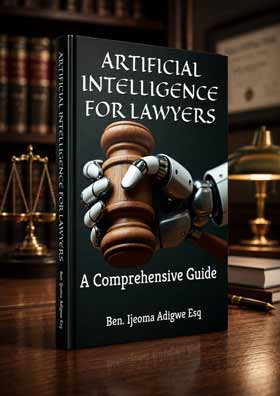 The book also examines Nigeria's legal ecosystem, focusing on the LPELR and NBA AI Guidelines. As a bonus, every purchase comes with a FREE eBook titled: How to Use the AI Features in LegalPedia and LawPavilion.
Ohio Books Ltd praises the publication, stating:
"....this is the only Nigerian book I know of on the topic."
How to Order:
📞 Call, Text, or WhatsApp: 08034917063 | 07055285878
📧 Email: benadigwe1@gmail.com
🌎 Website: www.benadigwe.com
Ebook Version: Access it directly online at https://selar.com/prv626
Authored by Ben Ijeoma Adigwe Esq., ACIarb (UK), LL.M, Dip. in Artificial Intelligence, Director at the Delta State Ministry of Justice, Asaba, Nigeria.
______________________________________________________________________
The book also examines Nigeria's legal ecosystem, focusing on the LPELR and NBA AI Guidelines. As a bonus, every purchase comes with a FREE eBook titled: How to Use the AI Features in LegalPedia and LawPavilion.
Ohio Books Ltd praises the publication, stating:
"....this is the only Nigerian book I know of on the topic."
How to Order:
📞 Call, Text, or WhatsApp: 08034917063 | 07055285878
📧 Email: benadigwe1@gmail.com
🌎 Website: www.benadigwe.com
Ebook Version: Access it directly online at https://selar.com/prv626
Authored by Ben Ijeoma Adigwe Esq., ACIarb (UK), LL.M, Dip. in Artificial Intelligence, Director at the Delta State Ministry of Justice, Asaba, Nigeria.
______________________________________________________________________