The Minister of Solid Minerals Development, Dele Alake, has defended President Bola Tinubu’s decision to remove the petrol subsidy, saying the President chose Nigeria’s long-term economic interests over short-term political considerations despite knowing that the policy would impose immediate hardship and attract public backlash.

Alake said successive administrations had recognised the distortions created by the subsidy regime and knew the difficult reforms required to address them, but repeatedly postponed decisive action because of concerns about elections and the political consequences of removing the subsidy.
He spoke on Wednesday during an interactive session with members of the All Progressives Congress Press Corps in Abuja, where he reviewed the Tinubu administration’s economic reforms and argued that there was no painless route to restructuring the economy.
Alake, who was recently announced as the APC Presidential Campaign Director of Strategic Communications for the 2027 election, said the major difference between the Tinubu administration and previous governments was what he described as the courage to implement reforms that had long been identified as necessary.
“There is no shortcut to genuine reforms. I do not need to elaborate on the fact that we knew what the Nigerian economy was before 2023.
“And I do not need to inform you that all the reforms and the policies that were and are necessary to correct these distortions and contradictions in the Nigerian society were there and identifiable by those previous governments.
“The only thing lacking was the courage to take those decisions,” he said.
Using the analogy of a person trapped in a hole, the minister said the solution was to stop digging rather than continue policies that had become unsustainable.
“Our elders say, when you are in a hole, what do you do? You stop digging. Because the more you dig, the deeper you sink,” he said.
Alake alleged that previous governments continued postponing difficult reforms for what he called “short-term political expedience,” largely because they feared the electoral consequences of unpopular decisions.
“But because those previous governments lacked the courage to stop digging, for short-term political expedience, they were afraid of elections; they were afraid of bringing them back to office and all that. So they shifted those decisions, the hard decisions they ought to have taken,” he said.
He recalled earlier attempts to remove petrol subsidy, noting that previous governments had faced mass protests and, in some instances, reversed or softened their decisions as elections approached.
According to him, Tinubu took a different course by proceeding with the removal despite the political risks and immediate consequences.
“And so people swallowed the bitter pill. But somebody came and decided to swallow the bitter pill, to take the bullets on behalf of Nigerians,” Alake said.
The minister said the President deserved commendation for implementing a policy capable of damaging his own political fortunes because, in his view, the country required an economic reset.
“I think we should, in all sense of fairness and objectivity, give a commendation to whom it is due. If a man, who is a politician himself, who should be very sensitive to elections, decided to take the bullets, regardless of the consequences on his own political career, on behalf of the nation, because the nation had to be reset. I think it’s just very, very important for us to appreciate that,” he said.
Alake argued that Nigeria must remain consistent with the reforms already introduced, saying difficult economic decisions inevitably come with challenges and adjustment pains.
He maintained that no public policy anywhere in the world could be completely without shortcomings, particularly because policies ultimately depend on human behaviour and implementation.
According to him, responsible governments and statesmen must seek policies that provide the greatest benefit to the largest number of people, even when certain individuals or groups benefit from the system being changed.
Turning specifically to the former petrol subsidy regime, Alake argued that its primary beneficiaries were wealthy Nigerians, fuel marketers and what he described as oil cartels rather than ordinary citizens.
He questioned the practical benefit of subsidy to the general population, noting that Nigerians still complained about high transport costs even when petrol was subsidised.
The minister alleged that some operators purchased subsidised fuel cheaply in Nigeria, smuggled it across the border and resold it for substantial profits.
“So the beneficiaries of the fuel subsidy were the oil cartels. They would buy the fuel at a lower price, cross the border, and immediately, they make humongous profits. And they come back to Nigeria to oppress the rest of us,” Alake said.
He argued that interests that benefited from the old arrangement should not be expected to accept its removal without resistance.
“So when fuel subsidy was removed, did you think that they would fold their arms and be looking? No! They will fight back. They will push back. And they are fighting back, and they are pushing back,” he said.
Alake further linked the old subsidy regime to the fiscal difficulties previously experienced by federal and state governments.
He recalled a period when several states struggled to pay workers’ salaries and claimed that even the Federal Government had resorted to borrowing to meet salary obligations.
“Now, at that time when there was a fuel subsidy, you recall how many states couldn’t pay salaries. In fact, the Federal Government itself was borrowing to pay salaries. And at some point, I recall, more than 18 states, if not more, could not meet wages. It was a tough situation,” he said.
Alake said resources that could have been channelled into infrastructure and productive sectors of the economy were instead consumed by subsidy payments.
“Money that should have been freed, you know, and put into use, into infrastructure and all that, constructing the regenerative sections of the economy, could not get the funds,” he added.
The minister acknowledged that the removal of subsidy and other economic reforms had caused pain and required a period of adjustment, but insisted that difficult measures could not produce their intended benefits immediately.
He said public policies require planning, mobilisation of resources, implementation and monitoring before their effects become fully visible.
According to Alake, the Tinubu administration’s reforms were already producing what he described as the desired results, notwithstanding the hardship associated with their implementation.
Tinubu announced the removal of petrol subsidy during his inauguration on May 29, 2023, declaring that the subsidy regime had ended. The policy was followed by sharp increases in transport costs and the prices of goods and services, although the Federal Government has repeatedly argued that the reform was necessary to stabilise public finances and free resources for other sectors.
The subsidy question has also become an issue ahead of the 2027 presidential election.
According to the report, former Vice-President Atiku Abubakar, who had also advocated subsidy removal during the 2023 election campaign, has said he would restore it if elected in 2027, citing the hardship facing Nigerians.
The report further stated that the Nigeria Democratic Congress presidential candidate, Peter Obi, and the Allied Peoples Movement candidate and Oyo State Governor, Seyi Makinde, have said they would retain subsidy removal while pursuing better management of the petroleum sector and measures aimed at making fuel more affordable.
Alake, however, maintained that reversing difficult reforms for political convenience would repeat what he described as the mistakes of previous administrations, insisting that Nigeria needed consistency and the political will to sustain policies intended to restructure the economy.
[A MUST HAVE] Evidence Act Demystified With Recent And Contemporary Cases And Materials

Available now for NGN 40,000 at ASC Publications, 10, Boyle Street, Onikan, Lagos. Beside High Court, TBS. Email publications@ayindesanni.com or WhatsApp +2347056667384. Purchase Link: https://paystack.com/buy/evidence-act-complete-annotation
______________________________________________________________________ “Enhance Legal Practice With Authoritative Reports” — Alexander Payne Offers Comprehensive Law Reports, Spanning Over A Century Of Nigerian Jurisprudence Interested buyers are encouraged to place their orders and enquiries via:
0704 444 4777, 0704 444 4999, 0818 199 9888
Website: www.alexandernigeria.com
Interested buyers are encouraged to place their orders and enquiries via:
0704 444 4777, 0704 444 4999, 0818 199 9888
Website: www.alexandernigeria.com
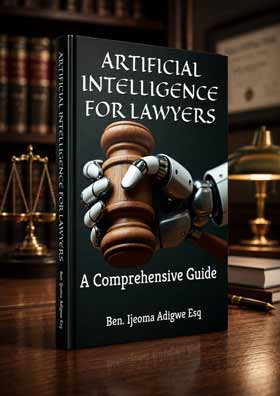 The book also examines Nigeria's legal ecosystem, focusing on the LPELR and NBA AI Guidelines. As a bonus, every purchase comes with a FREE eBook titled: How to Use the AI Features in LegalPedia and LawPavilion.
Ohio Books Ltd praises the publication, stating:
"....this is the only Nigerian book I know of on the topic."
How to Order:
📞 Call, Text, or WhatsApp: 08034917063 | 07055285878
📧 Email: benadigwe1@gmail.com
🌎 Website: www.benadigwe.com
Ebook Version: Access it directly online at https://selar.com/prv626
Authored by Ben Ijeoma Adigwe Esq., ACIarb (UK), LL.M, Dip. in Artificial Intelligence, Director at the Delta State Ministry of Justice, Asaba, Nigeria.
______________________________________________________________________
The book also examines Nigeria's legal ecosystem, focusing on the LPELR and NBA AI Guidelines. As a bonus, every purchase comes with a FREE eBook titled: How to Use the AI Features in LegalPedia and LawPavilion.
Ohio Books Ltd praises the publication, stating:
"....this is the only Nigerian book I know of on the topic."
How to Order:
📞 Call, Text, or WhatsApp: 08034917063 | 07055285878
📧 Email: benadigwe1@gmail.com
🌎 Website: www.benadigwe.com
Ebook Version: Access it directly online at https://selar.com/prv626
Authored by Ben Ijeoma Adigwe Esq., ACIarb (UK), LL.M, Dip. in Artificial Intelligence, Director at the Delta State Ministry of Justice, Asaba, Nigeria.
______________________________________________________________________