Two high-stakes election cases have been publicly disowned by the political parties in whose names they were filed, raising questions about the integrity of Nigeria’s electoral dispute resolution process.

A document displayed on the notice board of the Osun State Governorship Election Petition Tribunal in Osogbo listed Bola Oyebamiji and the All Progressives Congress as petitioners against Governor Ademola Adeleke, the Accord Party and the Independent National Electoral Commission. A second petition was attributed to a factional candidate of the Peoples Democratic Party.
Both the APC legal team and the named PDP figure swiftly denied any involvement.
A Senior Advocate of Nigeria and leading member of the APC legal team, Kunle Adegoke, said neither the party nor its candidate authorised the filing.
The episode closely resembles an earlier incident involving the Youth Party.
In May, a Federal High Court in Abuja nullified parts of INEC’s revised timetable for the 2027 general elections in a suit filed in the Youth Party’s name.
The party disowned it. “For us as a party, we never initiated it,” a representative said. “So if the identity of Youth Party is used to acquire a judgment, then where is it coming from? That’s a question. Where is it coming from? It begs a question that should be asked.”
The Nigerian Bar Association has frowned at the development, and practitioners have pointed to the point in the process where authority most often goes unrecorded.
“In trainings, lawyers are advised and warned not to use their law clerks or secretary or lawyers in their firm to depose to affidavit,” one practitioner said. “One of the easiest ways of showing a nexus between your legal representation and the party you claim to represent is that party signing the affidavit.”
It is the failure to obtain that signature, the practitioner said, that makes later denials possible. “It is sometimes the failure of lawyers in getting them to sign this that makes it possible for some clients, knowing that there may have been no written instruction, to deny instructions.”
He added that the pressure of election timelines contributes. “Sometimes, some lawyers, because of the cost of dealing with clients, are simply instructed on the phone and given facts and proceed to file actions, especially in periods of urgency.”
Governor Adeleke won re-election on the Accord Party platform with 511,067 votes against Oyebamiji’s 444,815.
For the governor, the denials offer a measure of relief. As one political analyst put it, when parties begin to disown the very lawsuits filed in their names, democracy itself starts to look like a theatre of the absurd.
Two explanations fit these facts, and the profession has an interest in knowing which one is true, because they call for entirely different responses.
The first is that these are genuine phantom filings, processes commenced by persons with no authority from the party or candidate named. If so, the offence is grave. A petition filed without instructions is not merely irregular; it is an abuse of the court’s process, and the practitioner who signs it has held himself out as having a retainer he does not hold. That is professional misconduct of the first order under the Rules of Professional Conduct, and it is capable of amounting to contempt. It also carries a practical danger nobody has yet raised. Election petitions must be filed within twenty-one days of the declaration of results under section 285(5) of the Constitution. If a party’s slot is consumed by a petition it did not authorise, and that petition is struck out for want of authority after the twenty-one days have run, the party’s right to challenge the election is extinguished by a document it never signed.
The second explanation is less dramatic and, on the practitioners’ own account, more likely in some cases: that instructions were given informally, by telephone and under time pressure, without a written retainer or a client-sworn affidavit, and that the client later found it convenient to deny them. That is not a conspiracy. It is a documentation failure, and it produces the same chaos.
The remedy for both is the same, and it is unglamorous. A registry that will not accept an election petition without an affidavit sworn by the petitioner personally, or a written authority to sue exhibited on filing, would close this gap almost entirely. The rule against counsel, clerks and firm staff deposing to affidavits in contentious matters already exists in practice; what is missing is enforcement at the counter. Where a filing is later disowned, the tribunal has the tools to establish the truth: summon the counsel who signed the process, require production of the retainer, and refer the matter to the Legal Practitioners Disciplinary Committee if none exists.
The Abuja case is the more serious of the two, and it should not be allowed to slip behind the Osun story. A court did not merely receive that suit; it granted relief on it, and parts of INEC’s 2027 timetable were nullified. If the plaintiff never authorised the action, the judgment was obtained in the name of a party that was not before the court, and it now governs the preparations of the electoral commission for a general election. Whether that judgment stands, and who moves to set it aside, is a question that concerns every party contesting in 2027, not just the Youth Party.
There is a final point the Bar should not step around. Every one of these processes was signed by a legal practitioner whose name is on it. Unlike most complaints about electoral litigation, this one does not require an investigation to identify the person responsible. The name is on the face of the document.
[A MUST HAVE] Evidence Act Demystified With Recent And Contemporary Cases And Materials

Available now for NGN 40,000 at ASC Publications, 10, Boyle Street, Onikan, Lagos. Beside High Court, TBS. Email publications@ayindesanni.com or WhatsApp +2347056667384. Purchase Link: https://paystack.com/buy/evidence-act-complete-annotation
______________________________________________________________________ “Enhance Legal Practice With Authoritative Reports” — Alexander Payne Offers Comprehensive Law Reports, Spanning Over A Century Of Nigerian Jurisprudence Interested buyers are encouraged to place their orders and enquiries via:
0704 444 4777, 0704 444 4999, 0818 199 9888
Website: www.alexandernigeria.com
Interested buyers are encouraged to place their orders and enquiries via:
0704 444 4777, 0704 444 4999, 0818 199 9888
Website: www.alexandernigeria.com
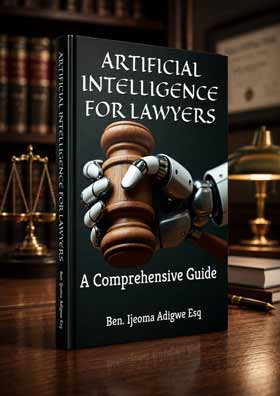 The book also examines Nigeria's legal ecosystem, focusing on the LPELR and NBA AI Guidelines. As a bonus, every purchase comes with a FREE eBook titled: How to Use the AI Features in LegalPedia and LawPavilion.
Ohio Books Ltd praises the publication, stating:
"....this is the only Nigerian book I know of on the topic."
How to Order:
📞 Call, Text, or WhatsApp: 08034917063 | 07055285878
📧 Email: benadigwe1@gmail.com
🌎 Website: www.benadigwe.com
Ebook Version: Access it directly online at https://selar.com/prv626
Authored by Ben Ijeoma Adigwe Esq., ACIarb (UK), LL.M, Dip. in Artificial Intelligence, Director at the Delta State Ministry of Justice, Asaba, Nigeria.
______________________________________________________________________
The book also examines Nigeria's legal ecosystem, focusing on the LPELR and NBA AI Guidelines. As a bonus, every purchase comes with a FREE eBook titled: How to Use the AI Features in LegalPedia and LawPavilion.
Ohio Books Ltd praises the publication, stating:
"....this is the only Nigerian book I know of on the topic."
How to Order:
📞 Call, Text, or WhatsApp: 08034917063 | 07055285878
📧 Email: benadigwe1@gmail.com
🌎 Website: www.benadigwe.com
Ebook Version: Access it directly online at https://selar.com/prv626
Authored by Ben Ijeoma Adigwe Esq., ACIarb (UK), LL.M, Dip. in Artificial Intelligence, Director at the Delta State Ministry of Justice, Asaba, Nigeria.
______________________________________________________________________