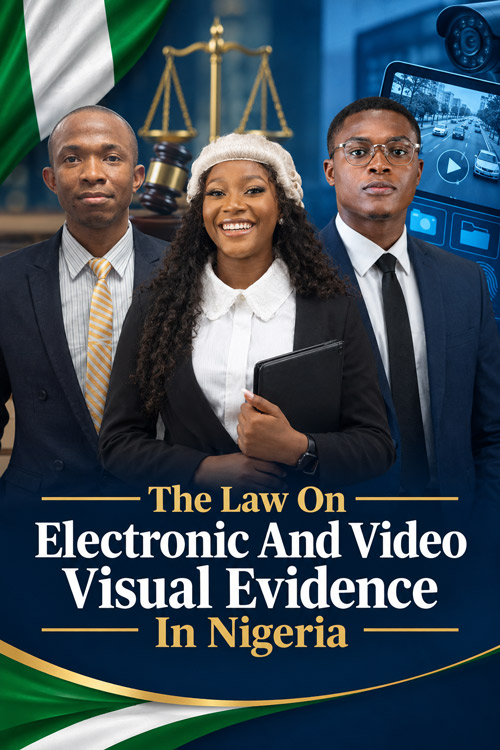
By C.K. ANYANWU, LL.M. O.M. ALADE, ESQ. B.J. JOSHUA (MISS)

INTRODUCTION
The increasing use of technology in everyday life has naturally affected the way evidence is produced and presented in Nigerian courts. Documents, videos, audio recordings, DVDs and other forms of electronically generated evidence are now commonly relied upon by parties in judicial proceedings. However, the fact that a piece of electronic evidence is relevant to a case does not, by itself, settle the question of how it should be admitted, demonstrated and ultimately relied upon by the court.
The Evidence Act 2011 provides the main statutory framework for the admissibility of computer-generated evidence. In particular, Section 84 sets out the conditions that must be satisfied before a statement contained in a computer-generated document can be admitted in evidence.
Nigerian courts have also had to deal with a related but equally important question: after electronic evidence has been admitted, can a judge privately examine or play the evidence in chambers, or must it be demonstrated in open court in the presence of the parties?
The decisions of the courts show an important distinction between the production and admissibility of electronic evidence and its demonstration or playback during trial. The cases also emphasise the fundamental requirement that judicial proceedings must remain adversarial and that parties should have an opportunity to see, hear, test and challenge evidence relied upon against them.
This article examines these principles through decided cases to show the conditions for the admissibility of video/audio recordings in court, the need to lay a proper foundation and the effect of failing to play an admitted audio recording in court.
RELEVANCE AND AVAILABILITY OF THE DOCUMENT
The question of whether failure to make an electronic document available to the opposing party affects admissibility was considered in DOGBE v. STATE (2023) LPELR-60407(CA).
The complaint in that case concerned the admission of DVD cassettes containing the Appellant’s interview. It was argued that the documents had not been made available to the Appellant from the beginning of the trial and that Section 84 of the Evidence Act 2011 had not been complied with.
The Court rejected the argument that failure to make the document available necessarily affects admissibility. It stated:
“As earlier noted, failure to make a document available to the Appellant does not affect its admissibility. It is relevancy that determines the admissibility of a document in a judicial proceeding.” Per GABRIEL OMONIYI KOLAWOLE, JCA (Pp. 44–45, Paras. F–B).
This decision is important because it distinguishes the question of admissibility from other procedural complaints that may arise concerning the handling of evidence. The fact that a document was not previously made available does not, by itself, determine whether the evidence is admissible.
AUDIO RECORDINGS AND THE NEED TO LAY PROPER FOUNDATIONS
The issue of electronic evidence is not limited to videos and DVDs. Nigerian courts have also considered the admissibility of audio recordings.
In MADUEKWE v. OKOROAFOR & ORS. (1992) LPELR-12795(CA), the Court considered the admissibility of audio cassettes or tape recordings.
The Court held:
“There are elaborate conditions to be satisfied for a tape-recorded speech to be accepted in evidence, such as that of the Governor of Abia State said to have been made during the campaign for the election in question. Besides, a foundation has to be properly laid in other directions before the reception of it as evidence. The source of the recorded speech and how it was obtained must be explained.”
This decision shows that a party seeking to rely on a tape recording cannot simply produce the recording and expect it to be accepted without a proper foundation. The circumstances in which the recording was made and obtained must be explained to the court.
The Court of Appeal went further in FEDERAL POLYTECHNIC, EDE & ORS. v. OYEBANJI (2012) LPELR-19696(CA) to list exactly what this foundation looks like:
“…In the case of a tape recording, as in other types of documentary evidence, it must be tendered by the maker, subject to the usual exceptions… He must lead evidence to show that the tape recording is authentic in the sense that it is the original; that the voice in the recording is indeed that of [the person]; that the tape was in his custody all the time and that there was no opportunity for anyone to tamper with it. None of these conditions was satisfied… in the absence of the person whose voice was said to have been recorded, the evidence is hearsay.” Per CHINWE EUGENIA IYIZOBA, JCA (Pp. 45–46, Paras. A–B).
Furthermore, Section 84 of the Evidence Act 2011 requires a “certificate of compliance” for computer-generated evidence. But does this mean you need a certificate for the projector or laptop you use to play a video in court? The Supreme Court says no. The certificate is only for the computer that produced the file, not the device used to play it.
In DICKSON v. SYLVA & ORS. (2016) LPELR-41257(SC); (2017) 8 NWLR (Pt. 1567) 167 S.C., the Supreme Court clarified:
“…it is only with respect to the computer that ‘produces’ the document, in this case, the DVD (Exhibit P42B), that ought to be certified… Authentication or quality control is essentially warranted at the production level and not the point of consumption… I am of the firm opinion that since Section 84 of the Evidence Act 2011 has limited its application to ‘production’ of computer evidence and not ‘playing’ or demonstrating it in open Court, the literal rule of interpretation ought to be invoked by the Trial Tribunal to permit Exhibit P42B to be played before it.” Per SULEIMAN GALADIMA, JSC (Pp. 42–48, Paras. D–B; p. 216, Paras. G–H).
FAILURE TO PLAY AN ADMITTED AUDIO RECORDING
Getting your DVD or audio tape admitted into evidence is only half the battle. Once it is admitted, it must be played in open court.
The landmark Supreme Court decision in DICKSON v. SYLVA (2017) 8 NWLR (Pt. 1567) 167 S.C. laid down the decisive rule on why electronic documents must be demonstrated in court:
“An electronically-generated document which has been admitted in evidence upon fulfilling all pre-conditions, and which is not taken as read by consent, ought to be demonstrated or played to prove the facts alleged; otherwise, it remains a closed or ‘sleeping’ document, which is unusable and which need not have been brought before the trial court or tribunal in the first place, as it would merely amount to clutter.” Per GALADIMA, J.S.C. (P. 205, Paras. E–G).
If a lawyer simply submits a video and the judge takes it into chambers to watch it privately, the entire process is flawed. Why? Because the opposing party cannot cross-examine on a video they have not watched in court. A judge investigating evidence in private is conducting “cloistered justice,” which the law strictly forbids.
This principle was strongly re-emphasised in OBIAJULU v. STATE (2024) LPELR-62782(CA):
“An electronically-generated document which has been admitted in evidence upon fulfilling all pre-conditions… ought to be demonstrated or played to prove the facts alleged; otherwise, it remains a closed or ‘sleeping’ document, which is unusable… The learned trial Judge at page 147 of the record said, ‘Furthermore, this Court examined the video recording…’ and proceeded to analyse… This means that only the learned trial Judge saw and viewed it in private; this amounts to cloister justice and examining evidence in the secrecy of the private chambers of the trial Court… Having not demonstrated same in the open Court, it means that the offence has not been proved beyond reasonable doubt, and the video exhibit was merely dumped on the trial.”
Similarly, in APC v. ZAILANI & ORS. (2023) LPELR-59510(CA), the Court condemned a judge for privately watching a video to determine whether an election used a secret or open ballot system:
“Watching of video (Exhibit 8) privately by the learned trial Judge when same was not played in open Court amounted to embarking on an investigation under the adversary system of adjudication… This amounts to investigation and not evaluation of cogent and verified evidence. This finding of the trial Court on Exhibit 8 is perverse.”
More importantly, an audio tape or video that is not played in open court has no probative value, meaning it carries no weight in deciding the case.
As firmly stated in NWAFOR v. ECOBANK (NIG) LTD & ANOR. (2024) LPELR-61814(CA):
“The trial Court did not attach probative value to Exhibit H even though same had been admitted in evidence because it was not played in open Court to the hearing of the parties and the Judge… Without such procedure being adopted, tendering the audio cassette in evidence without objection is as good as not tendering the audio cassette at all because the trial Judge is ignorant of the contents of the audio cassette and will accordingly not make use of it… I agree with the trial Court that it was absurd to retire to chambers and begin to watch or listen to what was not played or viewed in the open Court.” Per OKON EFRETI ABANG, JCA (Pp. 48–50, Paras. B–A).
CONCLUSION
Electronic and audio-visual evidence can be the most compelling tools in a lawyer’s case, but they come with strict procedural demands. It is not enough simply to have a recorded tape or a burned DVD admitted in evidence.
To win cases based on electronic evidence, you must first prove its authenticity, show a clear chain of custody and provide the necessary Section 84 certification for the device that produced it. More importantly, you must insist on playing the recording in open court. If the evidence is not seen and heard by everyone in the courtroom, it remains a “sleeping document,” and a sleeping document cannot win a case.
 Interested buyers are encouraged to place their orders and enquiries via:
0704 444 4777, 0704 444 4999, 0818 199 9888
Website: www.alexandernigeria.com
Interested buyers are encouraged to place their orders and enquiries via:
0704 444 4777, 0704 444 4999, 0818 199 9888
Website: www.alexandernigeria.com

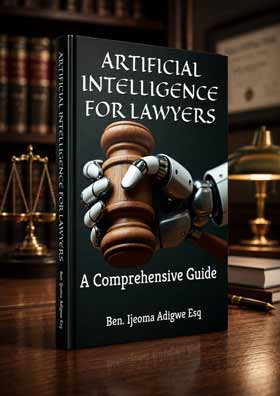 The book also examines Nigeria's legal ecosystem, focusing on the LPELR and NBA AI Guidelines. As a bonus, every purchase comes with a FREE eBook titled: How to Use the AI Features in LegalPedia and LawPavilion.
Ohio Books Ltd praises the publication, stating:
"....this is the only Nigerian book I know of on the topic."
How to Order:
📞 Call, Text, or WhatsApp: 08034917063 | 07055285878
📧 Email: benadigwe1@gmail.com
🌎 Website: www.benadigwe.com
Ebook Version: Access it directly online at https://selar.com/prv626
Authored by Ben Ijeoma Adigwe Esq., ACIarb (UK), LL.M, Dip. in Artificial Intelligence, Director at the Delta State Ministry of Justice, Asaba, Nigeria.
_______________________________________________________________________
The book also examines Nigeria's legal ecosystem, focusing on the LPELR and NBA AI Guidelines. As a bonus, every purchase comes with a FREE eBook titled: How to Use the AI Features in LegalPedia and LawPavilion.
Ohio Books Ltd praises the publication, stating:
"....this is the only Nigerian book I know of on the topic."
How to Order:
📞 Call, Text, or WhatsApp: 08034917063 | 07055285878
📧 Email: benadigwe1@gmail.com
🌎 Website: www.benadigwe.com
Ebook Version: Access it directly online at https://selar.com/prv626
Authored by Ben Ijeoma Adigwe Esq., ACIarb (UK), LL.M, Dip. in Artificial Intelligence, Director at the Delta State Ministry of Justice, Asaba, Nigeria.
_______________________________________________________________________