(When “Shutting Down” Does Not Mean “Winding Up”)

By John Ajose
On 2 September 2026, Uber Technologies ceased its ride-hailing operations in Nigeria, ending a twelve-year presence that began when the platform launched in Lagos in July 2014.[1] News headlines announced this as Uber had “exited Nigeria,” “shut down,” “pulled out,” and “closed its operations.” Whereas, in Uber’s own words, the company had taken “the difficult decision to wind down operations in Nigeria.”[2]
These phrases; exiting, shutting down, winding down, closing operations, are often used by journalists and even companies themselves as though they all mean the same thing. But to lawyers, creditors, shareholders, regulators and business counterparties, the differences between them can be wide apart. In particular, there is a legal distinction between winding up a company and winding down its operations. From the outside, the two may look alike, but they carry very different consequences.
Winding Up Under Nigerian Company Law
Winding up is a formal, statutory process through which a company’s existence is brought to an end. It is the liquidation of the company’s assets, the settlement of its debts, the distribution of any surplus to shareholders, and the dissolution of the company, after which the company ceases to exist as a legal entity. In Nigeria, winding up is governed in Nigeria, by the Companies and Allied Matters Act 2020 (CAMA 2020).[3]
Section 564(1) of CAMA 2020 provides for three modes of winding up: i. winding up by the court (compulsory winding up), ii. voluntary winding up, and iii. winding up subject to the supervision of the court.[4] Each of these has legal procedures with defined steps and regulatory consequences.
Compulsory winding up is initiated by petition to the Federal High Court.[5] Under section 571 of CAMA 2020, a company may be wound up by the court on several grounds, including the company’s inability to pay its debts, a reduction in membership below the statutory minimum, failure to hold statutory meetings, or where the court is of the opinion that it is just and equitable to do so.[6] A creditor, the company itself, a contributory, a receiver, or the Corporate Affairs Commission may present the petition.[7]
Voluntary winding up is initiated by the company’s own shareholders, typically through a special resolution.[8] Section 620 of CAMA 2020 sets out the circumstances in which a company may be wound up voluntarily: either upon the expiry of a fixed duration specified in its articles, or by special resolution of the company in general meeting.[9] Voluntary winding up may be either a members’ voluntary winding up, where the directors make a statutory declaration of solvency, or a creditors’ voluntary winding up, where no such declaration is made.[10]
In all cases, a liquidator is appointed whose primary function is to realise the company’s assets, pay its creditors according to their legal priority, and distribute any remainder to the members.[11] Once the liquidator has completed the process and filed the final accounts and returns with the CAC, the company is deemed dissolved three months after the registration of those documents.[12]
The consequence of winding up is dissolution, that is, the company’s separate legal personality, which it acquired upon incorporation,[13] comes to an end. The company ceases to exist. It can no longer sue or be sued, own property, enter contracts, or carry on any activity. Winding up is, thusly, the process of “burying” a company that has outlived its usefulness.
What Does It Mean to “Wind Down”?
Meanwhile, winding down is not a term manufactured by CAMA 2020. It does not appear as a statutory procedure. It is, rather, an operational expression used to describe the process by which a company reduces or ceases its business activities without necessarily undergoing the process of winding up.
For any number of reasons, a company may choose to wind down its operations. The market may have become unprofitable; the company may be restructuring its global operations; it may be transferring its business to another entity; or it may simply be redirecting its investments to other jurisdictions. When this happens, the company’s services, employees, offices and customer-facing presence in Nigeria may disappear entirely. To the public, it may look as though the company has ceased to exist.
But the legal position may be quite different. The corporate entity may continue to exist on the register of the CAC, retain its separate legal personality, and remain subject to its statutory obligations, including the filing of annual returns.[14] The company’s directors and shareholders do not change just because it has stopped trading. Its creditors’ rights are not extinguished. Its contractual obligations may survive.
Uber Nigeria: A Case Study in Corporate Exit
Uber’s recent departure from the Nigerian market provides a timely illustration of these principles.
The Facts
On 2 September 2026, Uber announced that it had “taken the difficult decision to wind down operations in Nigeria,” effective the same day.[15] The decision was part of a broader global restructuring that included the exit from Uganda on the same date, the earlier withdrawal from Ivory Coast in 2025 and Tanzania in early 2026, and the elimination of approximately 3,300 jobs worldwide.[16] Uber said that the decision was “limited strictly to these two markets” and that it remained “deeply committed to Sub-Saharan Africa,” where it continues to operate in Egypt, Ghana, Kenya and South Africa.[17]
Uber’s help centre was to remain open until 23 September 2026 to assist drivers and customers with account queries.[18] The company offered drivers a one-time goodwill payment, the terms of which were kept confidential.[19]
What Actually Happened — Legally?
The company did not say that it was winding up. It said it was winding down its operations. Based on publicly available information, observations can be made on this.
The first is that Uber Technologies Inc., the parent company, continues to exist and operate globally. It remains listed on the NYSE, reported gross bookings of approximately $58 billion for the quarter ended 30 June 2026, and continues to operate its ride-hailing and delivery platforms across dozens of countries.[20] The cessation of its Nigerian operations has no effect on its corporate existence or its operations elsewhere.
Moreover, the nature of Uber’s Nigerian operations must be carefully considered. Technology platform companies like Uber do not always operate through a locally incorporated subsidiary in each market. In many jurisdictions, Uber’s model has involved the use of a technology platform owned and operated by a foreign entity, with local operations conducted through contractual arrangements with drivers and service providers. Whether Uber operated in Nigeria through a company incorporated with the CAC, or through some other contractual structure, determines what (if anything) there is to “wind up” in the statutory sense.
Thirdly, what Uber did was to cease its commercial operations in Nigeria: it stopped providing its ride-hailing service, discontinued its platform in the market, and ended its relationships with local drivers and customers. This is a winding down of business activity, not a winding up of a company. It is an operational and commercial decision, not a statutory liquidation process.
Lastly, Uber itself noted the exit as specific to two markets and emphasised its continuing commitment to the African continent.[21] This is what a “winding down of operations” is known to be.
Whether any Nigerian-registered entity connected to Uber’s operations will subsequently be wound up or maintained on the CAC register is a separate question that depends on the corporate arrangements in place. There is, at the time of writing, no publicly available evidence that a formal winding-up procedure under CAMA 2020 has been commenced in respect of any Uber-related Nigerian entity.
Other Real-World Examples
Uber is not the only company to withdraw from the Nigerian market in recent years. Several others illustrate the distinction.
GlaxoSmithKline Consumer Nigeria Plc announced in 2023 that it would exit Nigeria after over fifty years of operations. The company pursued a Scheme of Arrangement sanctioned by the Federal High Court, under which minority shareholders received a cash payment of ₦17.42 per share. Its shares were delisted from the NGX on 5 February 2024.[22] This exit involved a specific corporate mechanism, a restructuring and exit from the exchange, not a straightforward dissolution of the company.
RAK Unity Petroleum Company Plc underwent a textbook members’ voluntary winding up under CAMA 2020. At its Annual General Meeting on 4 June 2021, shareholders resolved to place the company into voluntary winding up.[23] A liquidator, Mrs Chinwe Chiwete of EPIC Legal, was duly appointed.[24] The company’s physical assets were disposed of, creditors were paid, and remaining funds were distributed to shareholders. This was a full statutory winding up.
What Businesses and Lawyers Should Take Away
The confusion between winding up and winding down has consequences for at least five categories of stakeholders.
Creditors need to know whether a company still exists as a legal entity against which they can enforce their claims. If a company has merely wound down its operations, its creditors can still pursue it. If it has been wound up and dissolved, their rights may be extinguished, subject to any application to restore the company to the register.
Shareholders need to know whether the formal procedures for distributing the company’s assets have been followed, and whether they are entitled to any surplus. In a winding down, there is no automatic distribution; in a winding up, there is a structured process of liquidation and distribution.
Regulators need to know whether a company continues to exist for the purpose of compliance obligations such as annual returns, tax filings and regulatory reporting. A company that has merely wound down its operations remains on the register and remains subject to these obligations unless and until it is formally wound up.
Business counterparties, including customers and suppliers, need to understand whether the company they dealt with still exists, and whether its contractual obligations survive its departure from the market.
Lawyers advising on any of these matters must be precise in their use of language. Telling a client that a company has “wound up” when it has only wound down its operations could lead to an erroneous assumption that the company no longer exists, and that its liabilities have been extinguished. That assumption could be costly.
Conclusion
When a company ceases to operate in a market, the instinct of many observers is to reach for language that implies finality: the company has “shut down,” or “wound up.” But as this article has sought to demonstrate, the cessation of business operations is not the same thing as the winding up of a company. The two concepts are legally distinct, and the distinction matters.
Uber’s exit from Nigeria is a case in point. The company wound down its Nigerian operations, withdrew from the market, and redirected its investments elsewhere. But Uber Technologies Inc. continues to exist as a global company. There is no publicly available evidence that a formal winding-up petition was presented, that a liquidator was appointed, or that any Nigerian-incorporated entity connected to Uber’s operations was dissolved under CAMA 2020. What happened, therefore, was a commercial withdrawal, not a statutory winding up.
Sources
[1] Adepoju, P. (2014, July 24). Uber launched in Lagos. HumanIPO. https://humanipo.com/news/46262/uber-launched-in-lagos/. See also Reuters. (2026, September 2). Uber exits Nigeria after 12 years of operations. CNBC Africa. https://www.cnbcafrica.com/2026/uber-exits-nigeria-after-12-years-of-operations
[2] Oduo, A. (2026, September 2). Uber exits Nigeria, Uganda, to focus investments elsewhere. Techpoint Africa https://techpoint.africa/news/uber-exits-nigeria-uganda/.
[3] Companies and Allied Matters Act 2020 (CAMA 2020), Chap. XX (Winding Up).
[4] CAMA 2020, § 564(1).
[5] CAMA 2020, § 570(1). See also Mercantile Bank of Nigeria Plc v. Nwobodo [2000] 3 NWLR (Pt. 648) 297 (Federal High Court jurisdiction in winding-up proceedings).
[6] CAMA 2020, § 571.
[7] CAMA 2020, § 573.
[8] CAMA 2020, § 620.
[9] CAMA 2020, § 620(a)–(b).
[10] CAMA 2020, § 625(1)–(4).
[11] CAMA 2020, § 627 (members’ voluntary winding up); §§ 635–636 (creditors’ voluntary winding up).
[12] CAMA 2020, § 631.
[13] CAMA 2020, § 42. See also Marina Nominees Ltd v. Federal Board of Inland Revenue (Supreme Court of Nigeria) (confirming that a company upon incorporation acquires a separate legal personality distinct from its members).
[14] CAMA 2020, § 417 (annual returns of companies).
[15] Oduo, A. (2026, September 2). Uber exits Nigeria, Uganda, to focus investments elsewhere. Techpoint Africa. https://techpoint.africa/news/uber-exits-nigeria-uganda/
[16] Al Jazeera Staff. (2026, September 2). Uber lays off 3,300 employees, ceases operations in Nigeria and Uganda. Al Jazeera. https://www.aljazeera.com/economy/2026/9/2/uber-lays-off-3300-employees-in-largest-cuts-since-the-pandemic. See also Issa, K. (2026, September 2). Uber exits Nigeria and Uganda, trims African footprint to four markets. Khusoko. https://khusoko.com/2026/09/02/uber-exits-nigeria-uganda-africa-restructuring/
[17] Fakoyejo, O. (2026, September 2). Uber shuts down operations in Nigeria, Uganda. TheCable. https://www.thecable.ng/uber-shuts-down-operations-in-nigeria-uganda/.
[18] Osundiji, S. (2026, September 2). ‘We apologise for the inconvenience’, Uber exits Nigeria after 12 years of operations. Vanguard News. https://www.vanguardngr.com/2026/09/uber-to-exit-nigeria-after-12-years-of-operations/.
[19] Omoruyi, O. (2026, September 3). How Uber rewired Nigeria’s transport before leaving a heavy debt. Condia. https://thecondia.com/uber-exits-lagos-transportation-legacy/
[20] Uber Technologies Inc., SEC Filing (Form 8-K), FY2025 earnings. See also Issa, K. (2026, September 2). Uber exits Nigeria and Uganda, trims African footprint to four markets. Khusoko. https://khusoko.com/2026/09/02/uber-exits-nigeria-uganda-africa-restructuring/ (reporting gross bookings of $58 billion for Q2 2026).
[21] Fakoyejo, O. (2026, September 2). Uber shuts down operations in Nigeria, Uganda. TheCable. https://www.thecable.ng/uber-shuts-down-operations-in-nigeria-uganda/.
[22] Ugwu, C. (2024, February 10). NGX delists GlaxoSmithKline Consumer Nigeria Plc from daily official list. Nairametrics. https://nairametrics.com/2024/02/10/ngx-delists-glaxosmithkline-consumer-nigeria-plc-from-daily-official-list/. See also Tokede, K. (2025, January 1). How GSK Nigeria, Union Homes, 14 others were delisted from NGX in 2024. THISDAY. https://www.thisdaylive.com/2025/01/01/how-gsk-nigeria-union-homes-14-others-were-delisted-from-ngx-in-2024/
[23] Ugwu, C. (2023, May 26). Liquidation: Rak Unity Petroleum Company begins distribution of final payments to shareholders. Nairametrics. https://nairametrics.com/2023/05/26/liquidation-rak-unity-petroleum-company-begins-distribution-of-final-payments-to-shareholders/.
[24] Ibid.
John is a law graduate from the Ekiti State University and a Legal Research Assistant at BBO Solicitors. He writes from Ogba, Lagos.
 Interested buyers are encouraged to place their orders and enquiries via:
0704 444 4777, 0704 444 4999, 0818 199 9888
Website: www.alexandernigeria.com
Interested buyers are encouraged to place their orders and enquiries via:
0704 444 4777, 0704 444 4999, 0818 199 9888
Website: www.alexandernigeria.com

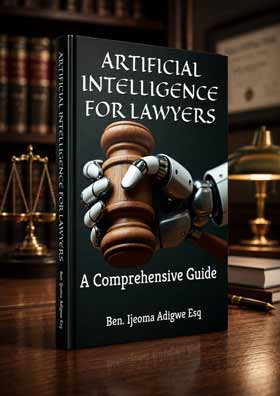 The book also examines Nigeria's legal ecosystem, focusing on the LPELR and NBA AI Guidelines. As a bonus, every purchase comes with a FREE eBook titled: How to Use the AI Features in LegalPedia and LawPavilion.
Ohio Books Ltd praises the publication, stating:
"....this is the only Nigerian book I know of on the topic."
How to Order:
📞 Call, Text, or WhatsApp: 08034917063 | 07055285878
📧 Email: benadigwe1@gmail.com
🌎 Website: www.benadigwe.com
Ebook Version: Access it directly online at https://selar.com/prv626
Authored by Ben Ijeoma Adigwe Esq., ACIarb (UK), LL.M, Dip. in Artificial Intelligence, Director at the Delta State Ministry of Justice, Asaba, Nigeria.
_______________________________________________________________________
The book also examines Nigeria's legal ecosystem, focusing on the LPELR and NBA AI Guidelines. As a bonus, every purchase comes with a FREE eBook titled: How to Use the AI Features in LegalPedia and LawPavilion.
Ohio Books Ltd praises the publication, stating:
"....this is the only Nigerian book I know of on the topic."
How to Order:
📞 Call, Text, or WhatsApp: 08034917063 | 07055285878
📧 Email: benadigwe1@gmail.com
🌎 Website: www.benadigwe.com
Ebook Version: Access it directly online at https://selar.com/prv626
Authored by Ben Ijeoma Adigwe Esq., ACIarb (UK), LL.M, Dip. in Artificial Intelligence, Director at the Delta State Ministry of Justice, Asaba, Nigeria.
_______________________________________________________________________