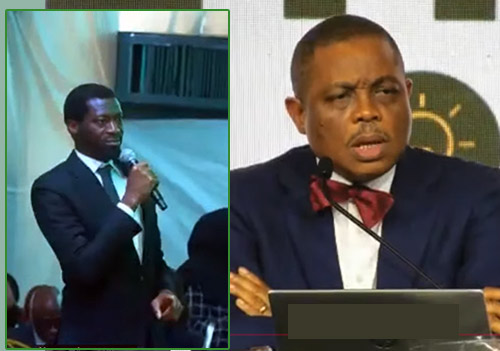
A young lawyer who attended the Annual General Meeting of the Nigerian Bar Association at the 66th Annual General Conference in Port Harcourt has published a personal account of the proceedings, alleging that a motion for electoral reform moved by a Senior Advocate was shut down without a seconder, without debate and without a vote, and that the incoming President established the very committee the motion sought within twenty-four hours.


The account is written by F.T. Tyoor, Esq., under the title “The Motion That Was Shut Down And The Inaugural Speech That Proved It Right: A Young Lawyer’s Account Of What Happened At The NBA AGM In Port Harcourt.”
“I attended the AGC in Port Harcourt and decided to attend the AGM, to observe. What I observed deserves to be recorded accurately,” he wrote.
According to Tyoor, the motion was moved during Any Other Business by Mr Lateef Omoyemi Akangbe, SAN, first runner-up in the July presidential election.
He states that after a brief background referencing what he describes as the well-documented failures of the 18 July election, the proposal was straightforward: to establish a committee to review the electoral provisions in the NBA Constitution so that what happened in July would not recur.
“A COMMITTEE, he proposed,” Tyoor wrote. “He was not asking the AGM to amend the Constitution on the spot.”
The account states that the immediate past President, Mazi Afam Osigwe, SAN, interjected while Akangbe was still speaking.
“The tone was adversarial and could easily have degenerated into a public row. It did not, because Mr Akangbe, SAN chose restraint. He absorbed the interruption, steadied himself, and completed his motion,” Tyoor wrote.
He alleges that what followed was worse. Rather than calling for a seconder and putting the motion to a vote as procedure requires, the outgoing President responded personally with two claims.
The first, according to the account, was that the Constitution cannot be amended by a motion at an AGM.
Tyoor describes that response as technically correct and entirely beside the point. “Every constitutional reform process in the history of the NBA has started with a committee. That is all Mr Akangbe was asking for,” he wrote.
He states that Osigwe then said the incoming President should not have her hands tied, and concluded: “This matter remains closed.”
“Interestingly, one would have thought that the outgone President would have been interested in institutional reform, as his legacy, but it turned out otherwise,” Tyoor wrote. “Thus, a motion moved by a Senior Advocate, on a matter of urgent institutional importance, was shut down without being seconded, without debate, and without a vote.”
The second and, in Tyoor’s words, more troubling claim was that the candidates’ insistence on SMS-based one-time passwords caused the flaws in the election.
Against that, he sets out what he says actually went wrong.
“The platform collapsed within ten minutes of going live. A new, untested portal was allegedly built within four hours and voting was migrated to it without following the constitutional safeguards. Multiple conflicting voting links were circulated on different NBA WhatsApp groups for the same election. Only one candidate’s photograph appeared on the presidential ballot when voting commenced initially,” he wrote.
“None of these failures had anything to do with how OTPs were delivered.”
He further states that the shift from email to SMS was the Electoral Committee of the Nigerian Bar Association’s own decision, citing its Revised Guidelines of 16 July 2026, in which the ECNBA said the change was made “to address perceptions, observed in previous NBA elections, that email-based OTP delivery was susceptible to manipulation.”
“The candidates asked for better security. The ECNBA agreed,” Tyoor wrote. “For the outgone President to now blame the candidates for a decision the ECNBA took on its own published reasoning, is to rewrite history at the very meeting where history was being made.”
The account puts figures against the argument.
“Turnout was 58.61 per cent in 2022 and 56.4 per cent in 2024. In this election, with 82,164 accredited voters, only 26,106 managed to vote. Barely a third of the profession. From nearly 60 per cent to 32 per cent in four years,” he wrote.
“The causes are structural, technical, and administrative. They sit with the system and those who built it.”
Tyoor states that the day after the motion was shut down, Mrs Oyinkansola Badejo-Okusanya, SAN, was inaugurated as the 33rd President of the NBA.
In her inaugural address, he writes, she acknowledged that the election “generated controversy, and that technological difficulties prevented a number of eligible members from exercising their franchise,” and announced the establishment of an Electoral Reform Committee chaired by Dr Babatunde Ajibade, SAN, to undertake a comprehensive examination of the NBA’s electoral architecture.
“The incoming President, on her first day in office, established exactly the committee that Mr Akangbe, SAN had moved a motion to create the day before,” he wrote. “The motion that was shut down without a vote. The motion the outgone President declared closed. It was vindicated within twenty-four hours by the very person he said should not have her hands tied.”
The account closes with a statement of standing.
“I am a young member of this Association. I do not have the seniority to lecture anyone. But I was in the room, and I felt a duty to set the record straight,” Tyoor wrote.
The value of this account is that it is procedural rather than personal, and the procedural complaint is the one the Association will have to answer.
Stripped of tone, the allegation is narrow: a motion was moved by a member entitled to move it, and the chair disposed of it by argument rather than by process. If that is what happened, the objection stands independently of whether the motion had merit. A presiding officer may hold a strong view on a motion; the remedy is to call for a seconder and let the meeting decide. “This matter remains closed,” if said, is a ruling the AGM never made for itself.
The OTP point is the sharper of the two, because it is documentary. The account does not merely dispute the outgoing President’s explanation; it puts the ECNBA’s own Revised Guidelines of 16 July against it. If the Committee published its reason for moving to SMS delivery, then attributing the resulting failures to candidate pressure is checkable rather than arguable, and it is checkable by anyone with the guidelines in hand.
The turnout figures give the whole account its weight. A fall from roughly 58 per cent to 32 per cent in four years is not a technical footnote; it is a legitimacy problem for whoever emerges from such a poll, and it explains why the reform question could not stay closed for a day.
Which brings the matter to its own resolution. Whatever view one takes of the AGM exchange, the incoming President’s first act settled the substantive question in favour of reform. That is the most useful outcome available, and it removes the need for anyone to relitigate the AGM itself. The Ajibade Committee now has the mandate. What the profession is entitled to is that it reports publicly, that the ECNBA’s conduct in July falls within its terms of reference, and that its recommendations reach the Constitution rather than the archive.
There is a further point the account raises without stating it. A young lawyer felt it necessary to publish an eyewitness record because he did not trust the proceedings to speak for themselves. An association that keeps and publishes proper minutes of its AGM does not leave that gap.
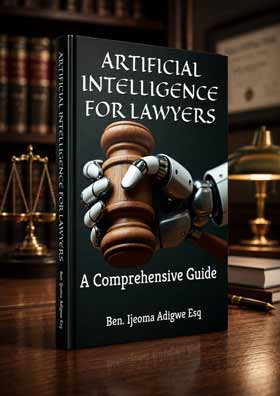 The book also examines Nigeria's legal ecosystem, focusing on the LPELR and NBA AI Guidelines. As a bonus, every purchase comes with a FREE eBook titled: How to Use the AI Features in LegalPedia and LawPavilion.
Ohio Books Ltd praises the publication, stating:
"....this is the only Nigerian book I know of on the topic."
How to Order:
📞 Call, Text, or WhatsApp: 08034917063 | 07055285878
📧 Email: benadigwe1@gmail.com
🌎 Website: www.benadigwe.com
Ebook Version: Access it directly online at https://selar.com/prv626
Authored by Ben Ijeoma Adigwe Esq., ACIarb (UK), LL.M, Dip. in Artificial Intelligence, Director at the Delta State Ministry of Justice, Asaba, Nigeria.
_______________________________________________________________________
“Enhance Legal Practice With Authoritative Reports” — Alexander Payne Offers Comprehensive Law Reports, Spanning Over A Century Of Nigerian Jurisprudence
The book also examines Nigeria's legal ecosystem, focusing on the LPELR and NBA AI Guidelines. As a bonus, every purchase comes with a FREE eBook titled: How to Use the AI Features in LegalPedia and LawPavilion.
Ohio Books Ltd praises the publication, stating:
"....this is the only Nigerian book I know of on the topic."
How to Order:
📞 Call, Text, or WhatsApp: 08034917063 | 07055285878
📧 Email: benadigwe1@gmail.com
🌎 Website: www.benadigwe.com
Ebook Version: Access it directly online at https://selar.com/prv626
Authored by Ben Ijeoma Adigwe Esq., ACIarb (UK), LL.M, Dip. in Artificial Intelligence, Director at the Delta State Ministry of Justice, Asaba, Nigeria.
_______________________________________________________________________
“Enhance Legal Practice With Authoritative Reports” — Alexander Payne Offers Comprehensive Law Reports, Spanning Over A Century Of Nigerian Jurisprudence
 Interested buyers are encouraged to place their orders and enquiries via:
0704 444 4777, 0704 444 4999, 0818 199 9888
Website: www.alexandernigeria.com
Interested buyers are encouraged to place their orders and enquiries via:
0704 444 4777, 0704 444 4999, 0818 199 9888
Website: www.alexandernigeria.com