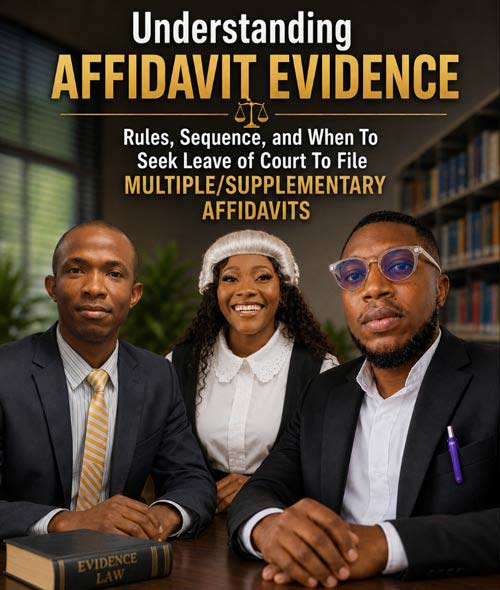
By C.K. Anyanwu, Ll.M. Kelechi Onyekwere, Esq. C.K. Ezeaku, Esq. J.B. Joshua (Miss)

INTRODUCTION
Under Nigerian law, matters like originating motions, originating summonses, applications, and fundamental rights enforcement proceedings are fought and won based on affidavit evidence. If you are involved in a case fought on affidavit evidence, understanding how to file affidavits, when to reply, and when you need the judge’s permission can make or break your case. This is because these sworn documents take the place of a living witness, and courts enforce strict rules regarding what can be included in them, how they must be challenged, and when extra affidavits require the judge’s permission. Knowing how to properly navigate affidavit evidence, from understanding its main purpose and statutory requirements to recognising when a process requires leave of court, is essential for any litigant or practitioner looking to protect their record. Therefore, this piece illuminates what is involved in affidavit evidence and when leave is required to file multiple affidavits.
WHAT IS AN AFFIDAVIT AND ITS FUNCTION
Basically, an affidavit is a written statement of facts made under oath or affirmation before an authorised officer, such as a Commissioner for Oaths. What gives an affidavit its legal weight is that solemn oath.
In PAT-OGHEONEMU v. OCEANIC INSURANCE CO. LTD & ANOR (2017) LPELR-50056(CA), the Court of Appeal highlighted this basic definition as follows:
‘Affidavit is defined as a statement of fact or declaration made either on oath or affirmation before an authorized person… The life of an affidavit is the declaration on oath.’ Per YARGATA BYENCHIT NIMPAR, JCA (Pp 22–23 Paras D–D)
Functionally, the affidavit serves as the actual evidence upon which a court relies to decide an application. Judges do not make findings based on speculation; they rely on the facts deposed to in the affidavit.
As held by the Court of Appeal in ADA v. ADA (2025) LPELR-81899(CA):
‘Affidavit in support forms the evidence to be relied on by the Court in making findings. The Court will find in favour of a party based on credible, consistent and logical depositions.’
Per MOHAMMED DANJUMA, JCA (Pp 21–21 Paras C–D)
Interestingly, because an affidavit constitutes sworn evidence, you cannot defeat it with mere oral arguments in court. If the opposing party deposes to facts you dispute, oral submissions will not displace those facts. You must file a counter-affidavit to controvert them.
The court in AHMED v. GOVT OF GOMBE STATE & ORS (2021) LPELR-53367(CA), emphasised this principle, stating:
‘The law is settled that when a party disbelieves an assertion in an affidavit or counter-affidavit, the best way to dispute/challenge it is to file a further or better affidavit to counter same, rather than attempting to do so by oral argument in Court. This is obviously because arguments can not substitute evidence.’
Per UGOCHUKWU ANTHONY OGAKWU, JCA
WHAT ARE THE CONTENTS OF AN AFFIDAVIT?
Under Section 115 of the Evidence Act 2011 (formerly Section 87 of the 1990 Act), an affidavit must contain only statements of facts. It must not contain legal arguments, prayers, conclusions, or objections.
i) It Prohibits Legal Arguments and Offensive Paragraphs
When an affidavit strays into legal argument, the court will strike out the offending paragraphs.
In AG ANAMBRA STATE v. AG FEDERATION (2007) LPELR-24343(SC), the Supreme Court held:
‘A cardinal principle of law is that affidavit evidence i.e. depositions must not contain legal arguments, and where they do they offend the provision of Section 87 of the Evidence Act, Cap. 112, Laws of the Federation of Nigeria, 1990. In the event that such situation exists the paragraphs containing the offensive depositions will be struck out, and I so strike out paragraphs 3-7 of the supporting affidavit to the originating summons.’
Per ALOMA MARIAM MUKHTAR, JSC (Pp 20–20 Paras B–E)
ii) Discloses Sources of Information and Belief
Where a deponent deposes to facts outside their personal knowledge, Section 115(3) & (4) of the Evidence Act requires them to state the source of the information and the grounds of their belief.
In AG FEDERATION v. AG OF ABIA STATE & ORS (2024) LPELR-62576(SC), the Supreme Court addressed an objection seeking to strike out paragraphs of an affidavit for alleged non-compliance with Section 115 of the Evidence Act 2011:
‘Without much ado, the motion is misconceived as the Plaintiff’s Affidavit in support of the summons has substantially complied with the provisions of Section 115 of the Evidence Act since the Deponent had disclosed the source of the facts or information which he believes to be true, setting out the circumstance forming the grounds of his belief. Section 115 of the Evidence Act provides thus:-
‘(1) Every affidavit used in the Court shall contain only a statement of fact and circumstances to which the witness deposes, either of his own personal knowledge or from, information which he believes to be true.
‘(2) An affidavit shall not contain extraneous matter, by way of objection, prayer or legal argument or conclusion.
‘(3) When a person deposes to his belief in any matter of fact, and his belief is derived from any source other than his own personal knowledge, he shall set forth explicitly the facts and circumstances forming the ground of his belief.
‘(4) When such belief is derived from information received from another person the name of his informant shall be stated and reasonable particulars shall be given respecting the information and the time, place and circumstance of the information.’
The averments of facts in the Affidavit in support of the summons are amply supported by the documents annexed thereto and do not constitute arguments to offend the above provisions.’
Per MOHAMMED LAWAL GARBA, JSC (Pp 82–83 Paras A–E)
DOCUMENTS ATTACHED TO AN AFFIDAVIT
Documents attached to an affidavit as exhibits form an integral part of that affidavit.
As affirmed by the Supreme Court in EZECHUKWU & ANOR v. ONWUKA (2016) LPELR-26055(SC). In the instant case, the apex court held:
‘However, it is also trite that all documents attached to an affidavit such as Exhibit R form part of the affidavit in question and it is not possible to raise objection to its admissibility in the affidavit of the respondent without running counter to Section 87 of the Evidence Act 1990, I rely on C.R.P.D.I.C. Ltd v. Obongh (2001) FWLR (Pt.54) 353.’
Per MARY UKAEGO PETER-ODILI, JSC (Pp 37–37 Paras C–D)
EFFECTS OF AN UNCHALLENGED AFFIDAVIT
If an opposing party files an affidavit deposing to material facts and you fail to file a counter-affidavit responding to them, the court is bound by law to accept those uncontradicted facts as true.
The court in PAT-OGHEONEMU v. OCEANIC INSURANCE CO. LTD & ANOR (2017) LPELR-50056(CA) explained the grave consequence of staying silent:
‘Where an affidavit is filed deposing to certain facts, and the other party does not file a counter-affidavit denying the said facts expressly or by necessary implication, the said facts deposed to in the affidavit would be deemed unchallenged and un-disputed… It is also settled that those facts not controverted are deemed as admitted, true and correct.’
Per YARGATA BYENCHIT NIMPAR, JCA (Pp 22–23 Paras D–D)
THE NORMAL FLOW OF AN AFFIDAVIT
In standard applications and fundamental rights proceedings, paperwork follows a structured exchange:
a) The Applicant files a Supporting Affidavit setting out the core facts to initiate the application.
b) The Respondent files a Counter-Affidavit detailing their defence and opposing facts.
c) The Applicant may file a Further Affidavit to respond to new facts introduced in the counter-affidavit.
Once this standard exchange takes place, the sequence generally ends. As the court explained in UMEKWE & ANOR v. TASIE & ORS (2021) LPELR-55487(CA), an applicant only has an automatic right to file a further affidavit if the respondent’s counter-affidavit introduces brand-new facts. If no new facts are introduced, the exchange naturally closes at the counter-affidavit stage.
WHETHER THE COURT’S PERMISSION IS NEEDED TO FILE A FURTHER COUNTER-AFFIDAVIT
A common point of confusion, particularly in Fundamental Rights Enforcement Procedure Rules cases, is whether an applicant must seek ‘leave’ (i.e. formal permission) from the judge before filing a further affidavit.
If you are simply responding to new facts or allegations raised in the respondent’s counter-affidavit within the standard procedural sequence, no leave is required.
In IGP & ORS v. BELLO (2021) LPELR-56343(CA), the court clarified:
‘An applicant does not need leave of Court to file a reply and further affidavit under Order 2 Rule 7 of FREPR while an applicant who intends to amend his statement and file further affidavit upon the amendment needs the leave of the Court.’
Per MISITURA OMODERE BOLAJI-YUSUFF, JCA (Pp 27–28 Paras F–B)
The Court of Appeal reaffirmed this position in NIGERIAN AIR FORCE & ORS v. CHIA & ORS (2021) LPELR-53293(CA):
‘It is obvious from the quoted portion of the rules that an Applicant has the right of filing a further and better affidavit in response to the Respondents’ Counter affidavit and written address. Therefore, the right of filing a further affidavit exist and without leave of Court.’
Per YARGATA BYENCHIT NIMPAR, JCA (Pp 38–45 Paras D–D)
However, filing a further affidavit remains an option, not a mandatory requirement. The rules employ the word ‘may,’ giving the party full discretion. As noted in NNUBIA v. ILODUBA & ORS (2024) LPELR-61762(CA):
‘The use of the word ‘may’ instead of ‘shall’ in the relevant Provisions, grants discretion rather than imposing an obligation… Therefore, the filing of a Further Affidavit to the Counter-Affidavit of the Appellant is simply at the discretion of the 1st Respondent.’
Per ADEBUKUNOLA ADEOTI IBIRONKE BANJOKO, JCA (Pp 31–32 Paras C–B)
Additionally, the deponent of a further affidavit does not strictly have to be the applicant. Anyone with personal knowledge of the facts can depose to it, as held in IGP & ORS v. BELLO (2021) LPELR-56343(CA).
Similarly, Order 13 Rule 1 of the Fundamental Rights (Enforcement Procedure) Rules 2009 states that any person or body who desires to be heard in respect of any human rights application and who appears to the court to be a proper party to be heard may be heard whether or not the party has been served with any of the relevant processes, and whether or not the party has an interest in the matter. In this case, Mr. Akande and Mr. Alamoyo (the deponents of the two further affidavits) are proper persons to be heard in the application. (P. 305, paras C–E)
See: I.G.P. v. Bello (2023) 1 NWLR (Pt. 1865) 265 C.A.
WHEN DOES LEAVE BECOME MANDATORY?
While leave is unnecessary for a standard further affidavit responding to a counter-affidavit, seeking the court’s permission becomes strictly mandatory once a party steps outside the prescribed sequence.
If you file supplementary or multiple affidavits without first applying for and obtaining leave of court, those processes are incompetent and will be discountenanced. In NWANKWOALA v. OKOROH & ORS (2022) LPELR-59375(CA), the court held that where parties filed successive ‘further counter-affidavits’ and ‘better affidavits’ without permission, the Court of Appeal upheld the trial court’s decision to throw them out.
‘The appellant who intended to file and make use of other affidavits apart from the primary counter-affidavit had the duty to formally seek and obtain the permission of the lower Court to do so… There is no evidence that the appellant obtained necessary permission to rely on the processes discountenanced by the lower Court.’
Per OLABODE ABIMBOLA ADEGBEHINGBE, JCA (Pp 42–45 Paras B–D)
LEGAL STATUS OF A FURTHER COUNTER-AFFIDAVIT
A practical dilemma arises when an applicant files a further affidavit that introduces entirely new assertions. Can the respondent file a ‘Further Counter-Affidavit’ to refute them?
Although some rules of court do not explicitly mention a ‘further counter-affidavit,’ the appellate courts have held that filing one is entirely permissible, provided the respondent applies for and obtains leave of court first.
In AKIODE & ORS v. OBI & ORS (2021) LPELR-56005(CA), the court held:
‘Even though the Rules does not expressly provide for the filing of another affidavit after a Further Affidavit filed after a Counter-Affidavit, it does not also expressly prohibit the filing of a Further Counter-Affidavit… The Further Counter-Affidavit was filed with the leave of the Court first sought and obtained.”
Per UGOCHUKWU ANTHONY OGAKWU, JCA (Pp 54–56 Paras C–F)
Similarly, in AHMED v. GOVT OF GOMBE STATE & ORS (2021) LPELR-53367(CA), the court observed:
‘In other words, the filing of a further and better counter-affidavit is somewhat unusual. That is not, however, to say that it is illegal or not in consonance with any of the rules.’
Per UGOCHUKWU ANTHONY OGAKWU, JCA
CONCLUSION
Understanding affidavit evidence requires balancing procedural precision with the duty to present a complete factual record. While affidavits take the place of live testimony in many proceedings, courts will not allow legal arguments to stand in place of sworn facts, nor will they permit litigants to file endless rounds of affidavits without supervisory control.
The essential distinction, therefore, lies between a further affidavit filed as part of the normal procedural sequence and successive, supplementary or additional affidavits filed outside that sequence. Where an applicant merely responds to new matters raised in a counter-affidavit, the applicable Rules may permit a further affidavit without leave of court. However, where a party seeks to introduce another affidavit after the ordinary exchange has run its course, particularly a further counter-affidavit, supplementary affidavit, further and better affidavit or any other successive affidavit, the safer and procedurally proper course is to first seek and obtain the leave of court.
The requirement for leave is not a mere technical formality. It enables the court to control its proceedings, prevents litigation by instalments, protects the opposing party from surprise, and ensures that neither party obtains an unfair advantage by continually introducing fresh facts after seeing the case presented by the other side. It also preserves the orderly presentation of affidavit evidence and ultimately advances the fundamental requirement of fair hearing.
Accordingly, counsel must pay close attention not merely to the title given to an affidavit, but to its position in the procedural sequence, its purpose, its contents, and the applicable Rules of Court. Where there is genuine doubt as to whether a proposed additional affidavit falls within the ordinary sequence permitted as of right, prudence dictates that leave should first be sought. The consequence of failing to do so may be grave: an otherwise useful affidavit may be held incompetent and discountenanced, leaving the facts contained in it unavailable to the party who sought to rely upon them.
Therefore, in affidavit proceedings, substance must be supported by procedure. A party may possess compelling facts, but those facts must be properly placed before the court. Knowing what to depose to, when to controvert, when to reply, when the evidential exchange should ordinarily end, and when the court’s leave becomes necessary is therefore indispensable to effective advocacy in proceedings conducted on affidavit evidence.
[A MUST HAVE] Evidence Act Demystified With Recent And Contemporary Cases And Materials

Available now for NGN 40,000 at ASC Publications, 10, Boyle Street, Onikan, Lagos. Beside High Court, TBS. Email publications@ayindesanni.com or WhatsApp +2347056667384. Purchase Link: https://paystack.com/buy/evidence-act-complete-annotation
______________________________________________________________________ “Enhance Legal Practice With Authoritative Reports” — Alexander Payne Offers Comprehensive Law Reports, Spanning Over A Century Of Nigerian Jurisprudence Interested buyers are encouraged to place their orders and enquiries via:
0704 444 4777, 0704 444 4999, 0818 199 9888
Website: www.alexandernigeria.com
Interested buyers are encouraged to place their orders and enquiries via:
0704 444 4777, 0704 444 4999, 0818 199 9888
Website: www.alexandernigeria.com