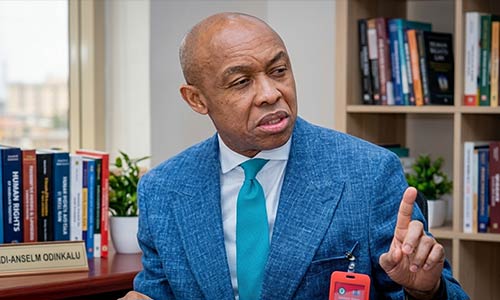
Professor of law and former Chairman of the National Human Rights Commission, Chidi Anselm Odinkalu, has recalled a 1997 memorandum in which all 18 judges of the High Court of Imo State unanimously urged that the most senior judge of that court should succeed to the office of Chief Judge, drawing a parallel with the succession dispute now running in the state.

Odinkalu set out the account in a series of posts on his X handle.
“Nearly 30 years ago, the High Court of Imo State was in the middle of a leadership transition. Chief Judge G.G.I. Ojiako was getting ready to retire. There was a question as to who to succeed him,” he wrote.
He traced the outgoing Chief Judge’s own path. “Justice Ojiako began his judicial career as a judge of the High Court. He was later appointed founding President of the Customary Court of Appeal of Imo State, before returning to the High Court to become Chief Judge.”
That path, he said, shaped the contest that followed. “To succeed him as President of the Customary Court of Appeal of Imo State, the government appointed Justice C.B.C. Uba. As Justice Ojiako approached retirement, C.B.C. Uba aspired to follow in his footsteps from the office of President of the Customary Court of Appeal to the office of Chief Judge.”
He named the contenders within the High Court itself. “In the High Court, Justices E.A. Ejiogu and S.O. Ekpe were the senior-most. There was serious contest for the office of the Chief Judge and it appeared to be boiling over.”
Odinkalu said the judges met to head off the dispute.
“To head that off, the judges of the High Court of Imo State arranged a collective huddle in June 1997. The result was a revealing memo to the Military Administrator dated 17 June 1997,” he wrote.
He quoted from it: “All of us are unanimous in the view that when the office of Chief Judge becomes vacant, whoever is the most senior among us the judges of the High Court of Imo State should be preferred to the vacant office. In that way, there will be no rancour or polarization. There will be peace and unity in Imo State judiciary.”
The former Commission chairman then connected the document to the present.
“Of the 18 judges who signed that memo, only 2 remain in service,” he wrote. “No. 17, Justice Nwosu-Iheme, is now a Justice of the Supreme Court. No. 14, Justice Agugua, is the current Acting Chief Judge whom the current governor of the state wants to supersede a third time for the substantive office of Chief Judge.”
He completed the account. “To complete the original story, Justice Ejiogu eventually became Chief Judge of Imo State. He was followed in that office by Justice Ekpe. C.B.C. Uba eventually achieved his ambition in succession to Ekpe.”
The document Odinkalu refers to was addressed to the Military Administrator of Imo State through the Chief Judge, and is headed “Memorandum submitted by the judges of the High Court of Imo State on the succession to the office of the Chief Judge of Imo State.”
The judges explained their timing, noting that their annual vacation would begin at the end of July with resumption in mid-September, and that the Chief Judge might commence leave preparatory to retirement in December 1997 shortly afterwards, leaving too short a period for meaningful deliberation.
They gave a second reason. “The retirement of the Chief Judge is not a secret and we are anxious that you receive a briefing from us before the intensive lobbying for that office may begin,” they wrote.
They set out what they feared. “Undoubtedly, unscrupulous politicians may regard the office, fortuitously thrown open during this period of elections, as one that rotates and as one of the constants in the combinations for their zoning formula.”
They added: “The strict neutrality of the High Court must be jealously guarded and maintained at any costs. To compromise its neutrality for political expediency will damage the image of the judiciary and administration of justice beyond repair.”
Stating their purpose, they wrote that their “main focus is peaceful succession to the office of the Chief Judge to ensure a robust and virile judiciary that should be the pride of Imo State.”
The memorandum set out a legal case for confining the succession to the High Court.
The judges noted that the state has a High Court and a Customary Court of Appeal, both provided for in Section 6 of the 1979 Constitution, and that both are distinct and separate with their jurisdictions spelt out. Section 235, they wrote, provides for the appointment of the Chief Judge and judges of the High Court, while Section 246 provides for the appointment of the President and judges of the Customary Court of Appeal.
“The Constitution does not provide for Judges to move from one court to the other,” they wrote. “The Courts are separate and distinct, each with its own head.”
They noted that there is no provision for the Chief Judge of the High Court to act for the President of the Customary Court of Appeal, or for the President of that court to act for the Chief Judge.
They set out the governing provision as amended by Decree 107 of 1993: “If the office of the Chief Judge of a State is vacant or if the person holding the office is for any reason unable to perform the functions of the office, then until a person has been appointed to and has assumed the functions of that office, or until the person holding the office has resumed those functions, the functions shall be performed by a person to be designated from time to time in that behalf by the Provisional Ruling Council on the advice of the Advisory Judicial Committee from among the Judges of the High Court.”
They observed that before the amendment the Governor had exclusive discretion to designate an acting Chief Judge, and that even then the choice was strictly limited to judges of the High Court, with judges from outside that court not qualifying for consideration.
The judges recorded that all of them, including the Chief Judge, had met in his chambers and deliberated on the matter.
“We are anxious for a transition devoid of rancour and polarisation of the Imo State High Court. We place very great premium on esprit-de-corps amongst Judges,” they wrote. “This spirit is a hallmark of any judiciary and it is only fostered when time-honoured traditions of our profession are upheld. If these traditions are breached for any expediency whatever, the result is usually most unwholesome, and must therefore be avoided.”
They then stated their unanimous position on seniority, adding: “We notice that this is what is followed in other jurisdictions. It ensures harmony.”
They were explicit about the alternative they opposed. “For the avoidance of doubt, a situation where the President of the Customary Court of Appeal is brought over to head the High Court will not go down well with us. The Customary Court of Appeal ought to be allowed to mature.”
The memorandum closed: “We pray for peace to prevail in Imo State.”
It was signed by the judges of the Imo State High Court, listed as A.A. Ononuju, D.E. Njiribeako, M.O. Maranzu, S.O. Ekpe, P.C. Okoli, L.C. Alinnor, G.I. Udom-Azogu, E.D. Metu, S.N. Nwachukwu, P.C. Onumajulu, A.U. Amaeshi, N.D. Adigwe, B.A. Njemanze, I.O. Agugua, C.I. Dureke, A.O.H. Ukachukwu, C.E. Nwosu-Iheme and A.N. Opara.
[A MUST HAVE] Evidence Act Demystified With Recent And Contemporary Cases And Materials

Available now for NGN 40,000 at ASC Publications, 10, Boyle Street, Onikan, Lagos. Beside High Court, TBS. Email publications@ayindesanni.com or WhatsApp +2347056667384. Purchase Link: https://paystack.com/buy/evidence-act-complete-annotation
______________________________________________________________________ “Enhance Legal Practice With Authoritative Reports” — Alexander Payne Offers Comprehensive Law Reports, Spanning Over A Century Of Nigerian Jurisprudence Interested buyers are encouraged to place their orders and enquiries via:
0704 444 4777, 0704 444 4999, 0818 199 9888
Website: www.alexandernigeria.com
Interested buyers are encouraged to place their orders and enquiries via:
0704 444 4777, 0704 444 4999, 0818 199 9888
Website: www.alexandernigeria.com