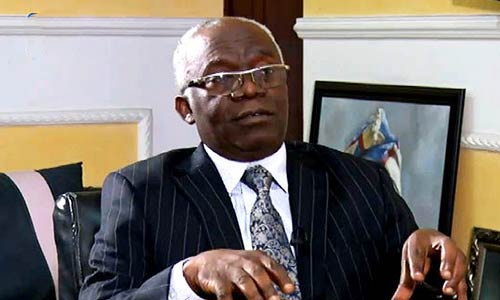
A Senior Advocate of Nigeria, Mr. Femi Falana, has called on the Federal Government to reduce the price of petrol without further delay, and to direct the Nigerian National Petroleum Company Limited (NNPCL) to refine the 450,000 barrels per day originally designated from the nation’s equity crude in local refineries and sell the product to Nigerians at an affordable price.

In a statement issued on 4 October 2026 on behalf of the Alliance on Surviving Covid 19 and Beyond (ASCAB), titled “FG Should Reduce Price Of Petrol,” Falana said the global oil market disruption arising from the conflict between the United States and Iran had placed the Nigerian consumer in an untenable position, and that the country’s own refining capacity had been destroyed “against the interests of the Nigerian people.”
Falana began with the state of the international market.
“No doubt, the ongoing war between the United States and Iran has disrupted crude oil supplies through the Strait of Hormuz, driving the international price of crude oil above $100 a barrel with dire consequences for the global economy,” he said.
He said there was no early end in sight. “Since the United States does not know how to end the war with Iran, the crisis will continue to disrupt major energy shipments and thereby endanger the global economy.”
Falana reported the findings of a presentation delivered at an ASCAB seminar on the state of the nation by Professor Izielen Agbon, a United States-based petroleum expert.
He said Professor Agbon told the seminar “that the Nigerian ruling class created the illusion of fuel subsidy by manipulating production methods and accounting statistics.”
The expert was quoted directly: “It does not make any economic sense Nigerians pay more for PMS in Nigeria than in Texas. A history of PMS price increases or subsidy removal in Nigeria shows that an implicit fuel subsidy never existed and the so called subsidy system was just a cesspool of corruption.”
According to the statement, Professor Agbon’s central technical objection was to the pricing methodology in use.
“He condemned the Import Parity Price method which assumes that the production and refining of crude oil are done overseas and the PMS imported into Nigeria,” Falana said. “He said that the method has been imposed on the country and subsists, hence the very high cost of the product.”
In its place, the statement said, the expert urged the adoption of a domestic model.
“As a matter of urgency, Professor Agbon asked the Government to adopt the Production Cost Pricing (PCP) method based on the cost of crude oil production, refining, transportation and distribution in the domestic market which eliminates the need for fuel subsidy and provides the affordable power and energy needed for the rapid industrialization of Nigeria.”
The statement set out the cost figures on which the argument rests.
“Specifically, Professor Agbon said the cost of producing one barrel of crude oil in Nigeria ranges from $31 to $48 compared to the global average of $12 per barrel,” Falana said.
The expert attributed the difference to structural factors, quoted in the statement as “aging infrastructure, insecurity, sabotage, theft, and the high cost of imported oilfield inputs.”
Even on those elevated costs, the statement said, the price at the pump should be considerably lower than it is.
“He said even at this and, exchange rate of N1333/$1, the PMS pump price should be between N435 and N687 per litre,” Falana said.
Falana contrasted the response of other states with Nigeria’s.
“Last Friday, the members of the G7 announced plans to release 100 million barrels of diesel and crude oil from emergency reserves to bring prices down,” he said. “Before then, many governments had adopted measures to alleviate the suffering of their people.”
He then turned to the condition of Nigeria’s own refining assets. “Even though Nigeria is a leading oil producing nation, the nation’s four refineries have been run aground against the interests of the Nigerian people.”
The statement made a direct allegation about the announcement of production at two of the refineries.
“In December 2024, the Nigerian National Petroleum Company Limited fraudulently announced the commencement of crude oil processing from the Port Harcourt and Warri refineries and delivery of petroleum products into the market,” Falana said.
Falana’s operative demand rested on the original purpose of the country’s equity crude allocation.
“While steps are being taken to fix the nation’s comatose refineries, the Federal Government should reduce the price of petrol without any further delay,” he said.
“It is public knowledge that the benchmark volume of 450,000 barrels per day was originally designated from the nation’s equity crude to supply the nation’s four refineries and guarantee energy security in the country.”
He concluded: “The Nigerian National Petroleum Company Limited should be directed to refine the said 450,000 bpd in local refineries and sell same to Nigerians at affordable price.”
[A MUST HAVE] Evidence Act Demystified With Recent And Contemporary Cases And Materials

Available now for NGN 40,000 at ASC Publications, 10, Boyle Street, Onikan, Lagos. Beside High Court, TBS. Email publications@ayindesanni.com or WhatsApp +2347056667384. Purchase Link: https://paystack.com/buy/evidence-act-complete-annotation
______________________________________________________________________ “Enhance Legal Practice With Authoritative Reports” — Alexander Payne Offers Comprehensive Law Reports, Spanning Over A Century Of Nigerian Jurisprudence Interested buyers are encouraged to place their orders and enquiries via:
0704 444 4777, 0704 444 4999, 0818 199 9888
Website: www.alexandernigeria.com
Interested buyers are encouraged to place their orders and enquiries via:
0704 444 4777, 0704 444 4999, 0818 199 9888
Website: www.alexandernigeria.com