
By Opatola Victor Esq.

Most laws begin with a worthy objective. Some seek to reduce crime. Others protect consumers, improve public health or make Nigeria’s roads safer. Good intentions are an indispensable part of governance. But in a constitutional democracy, they are never the end of the inquiry. Before asking whether a law is desirable, the Constitution asks a more fundamental question: did the legislature possess the authority to enact it?
That question lies at the heart of the controversy surrounding the Federal Road Safety Corps (Amendment) Act, 2026, which prohibits hawking, trading and preaching in commercial vehicles.
Public debate has largely focused on whether those activities distract drivers and contribute to road accidents. That is a legitimate concern. Nigeria’s roads are indeed dangerous, and government has a duty to make them safer not only by better roads and traffic management but also by appropriate legislation. But the importance of that objective does not answer the constitutional question. The issue is whether the Constitution authorises the National Assembly to enact this law.
The Constitution does not establish a National Assembly with unlimited authority to legislate on every matter affecting Nigerians. Instead, it distributes legislative power between the Federation and the States through the exclusive and concurrent legislative lists. Matters not entrusted to the Federation ordinarily remain within the legislative competence of the States. That allocation is not by accident, it reflects one of the defining features of Nigeria’s constitutional order: which is federalism. The Constitution deliberately disperses governmental power so that no single legislature may regulate every aspect of national life.
The constitutional question, therefore, is not whether hawking or preaching should be regulated. They undoubtedly may be. The real question is whether the Constitution assigns that responsibility to the National Assembly.
That may appear technical, but it is one of the most important safeguards of constitutional government. If legislative competence could expand whenever parliament pursued a desirable objective, the constitutional division of powers would soon become meaningless. Every aspect of human conduct could eventually be linked, however indirectly, to public safety, economic development or national security.
The Constitution deliberately prevents that result by allocating power according to subject matter, not according to the attractiveness of the objective government seeks to achieve.
Supporters of the amendment argue that the legislation is fundamentally about road safety. Hawkers moving through buses, exchanging goods and money, or preachers engaging passengers may distract drivers. Since the National Assembly has authority to legislate on matters relating to traffic on federal trunk roads, they contend that prohibiting those activities is simply another road safety measure that falls naturally within its constitutional competence.
It is an important argument, but constitutional authority is determined not by the importance of the objective Parliament seeks to achieve. It is determined by the subject the Constitution has actually entrusted to it.
Suppose National Assembly concluded that loud political debates inside commercial buses distract drivers. Could it criminalise political discussions during a journey? Suppose it found that quarrelling couples, football debates, noisy children or telephone conversations posed similar risks. Could those activities also become criminal offences in the name of road safety?
Most Nigerians would instinctively answer no. The reason is straightforward. At some point, legislation stops regulating traffic and begins regulating ordinary life. The Constitution exists to define where that boundary lies.
That is why constitutional courts do not simply accept Parliament’s description of its own legislation. If legislatures could determine the limits of their own authority merely by attaching attractive labels to laws, constitutional limits would cease to have any practical meaning. A restriction on speech could be dressed-up as a traffic law. A regulation of commerce could be disguised as a public safety measure. The scope of legislative power would now be dangerously determined by legislative drafting rather than constitutional text.
We should therefore ask a different question: what is this law truly about? This principle, often described as the doctrine of characterisation, is firmly established in constitutional jurisprudence. Rather than focusing solely on the label Parliament gives a law, courts examine its true nature and legal effect. In Attorney-General of Ogun State v. Aberuagba (1985), the Supreme Court looked beyond the description attached to legislation and examined its true nature in deciding whether it fell within the constitutional distribution of legislative powers. The Court made it clear that constitutional competence cannot be enlarged by legislative labels.
The Supreme Court adopted the same structural approach in Attorney-General of Lagos State v. Attorney-General of the Federation (2003). Although the facts were different, the underlying principle was the same: legislative authority must be found in the Constitution itself. The importance of the governmental objective cannot substitute for constitutional competence.
That principle becomes critical here. The constitutional provision most frequently relied upon is Item 63 of the exclusive legislative list in the second schedule of the 1999 Constitution, which empowers the National Assembly to legislate with respect to “traffic on Federal trunk roads.” Those words deserve careful attention.
The Constitution does not confer National Assembly general power over everything that happens on a Federal road. Nor does it authorise it to regulate every form of human behaviour occurring inside a vehicle. It speaks specifically of traffic on Federal trunk roads.
To be sure, the power to regulate traffic necessarily includes powers reasonably incidental to making that power effective. Parliament may prescribe speed limits, require seat belts, regulate vehicle standards, establish licensing systems and punish dangerous driving. Without such incidental authority, the constitutional power over traffic would be practically ineffective.
The real question, however, is how far incidental powers may extend. Do they permit Parliament to regulate any conduct occurring inside a commercial bus simply because that conduct might influence the driver’s concentration?
If that proposition were accepted without meaningful limits, the constitutional boundary would become increasingly difficult to identify. Political debates, private conversations, children crying, telephone calls, laughter among passengers or even celebratory singing might all be said to distract a driver. Once every form of passenger conduct becomes incidental to regulating traffic, the constitutional limitation itself begins to disappear.
Incidental powers exist to make an enumerated constitutional power effective. They do not transform a limited constitutional grant into a general power to regulate ordinary commercial or social life.
The structure of the offence reinforces that concern.
The law itself does not require the prosecution to prove that the driver’s attention was actually diverted, that traffic was impeded or that any danger to road safety arose. A passenger who quietly shares a religious message commits the offence simply because he preached. Likewise, a trader who quietly sells bottled water to a willing passenger commits the offence even if the transaction neither distracted the driver nor interfered with the movement of the vehicle.
That is constitutionally significant.
If the legislation were genuinely directed at preventing driver distraction, one would ordinarily expect liability to depend, at least in some measure, on proof that the prohibited conduct created or was capable of creating that danger. Instead, the offence criminalises broad categories of speech and commercial activity without requiring any connection between the conduct and the harm said to justify the legislation.
The mismatch is difficult to ignore. The offence is broader than its stated objective because it captures conduct that presents no demonstrable danger to road safety. At the same time, it is narrower than that objective because it leaves untouched countless other forms of passenger behaviour capable of causing precisely the same distraction. Political arguments, loud telephone conversations, heated family disputes and exuberant celebrations may all divert a driver’s attention, yet they remain outside the prohibition. But it must be stated clearly that the mismatch does not, by itself, determine the law’s constitutionality. Legislatures are entitled to make policy choices. But it does raise an important constitutional question. When the legal prohibition bears only a loose relationship to the harm said to justify it, courts are entitled to ask whether the legislation is truly directed at regulating traffic or whether it is, in substance, regulating selected forms of ordinary human conduct under the disguise of road safety.
There is another reason why the constitutional question cannot be dismissed. Nigerian law already criminalises dangerous and careless driving. Where a driver allows himself to become distracted—whether by a passenger, a mobile phone or any other cause—the law already provides sanctions against the person responsible for controlling the vehicle. The existence of those offences does not make further regulation impossible. It does, however, reinforce the need to rationalise why passengers should incur criminal liability without proof that their conduct actually interfered with the safe operation of the vehicle. This does not establishe that the amendment is unconstitutional. That is ultimately a persuasion for the courts. Nor does it suggest that hawking or preaching should never be regulated. States possess broad legislative authority within their constitutional sphere. Transport operators may impose reasonable conditions governing passenger conduct. Existing criminal laws remain available where conduct genuinely endangers public safety.
The Constitution also contemplates an important role for Local Governments. Through the Fourth Schedule, it entrusts them with functions relating to the establishment, maintenance and regulation of markets, motor parks, shops and kiosks. Those provisions do not, by themselves, determine the limits of federal legislative competence. They do, however, reflect the Constitution’s broader design of distributing regulatory responsibilities across different levels of government rather than concentrating them at the centre. They also caution against reading Item 63 so broadly that a federal power over traffic on Federal trunk roads becomes a general power to regulate commercial or social activity merely because it occurs on a federal road.
The issue, therefore, is institutional rather than moral. The question is not whether hawking is desirable or whether preaching should be encouraged or discouraged. Those are matters of policy upon which reasonable people may disagree. Constitutions are rarely tested when legislatures prohibit conduct almost everyone dislikes. They are tested when legislatures invoke worthy objectives to reach beyond the powers the Constitution has granted them. Good intentions do not diminish the importance of constitutional boundaries. If anything, they make those boundaries more important, because the temptation to overlook constitutional limits is greatest when the legislative objective appears unquestionably beneficial.
This debate is therefore not really about hawking. Nor is it truly about preaching. It is about whether the National Assembly may regulate ordinary human conduct simply because doing so might indirectly advance road safety. Yet, whether hawking or preaching should be regulated is a question of policy. Whether the National Assembly may regulate them is a question of constitutional power. A constitutional democracy requires that the second question be answered before the first. For the rule of law depends not only on good laws, but on laws made by institutions acting within the powers the Constitution has entrusted to them.
Opatola Victor is a legal practitioner and policy analyst. He writes on constitutional law, public policy and governance. He can be reached at victor@legalifyattorneys.com
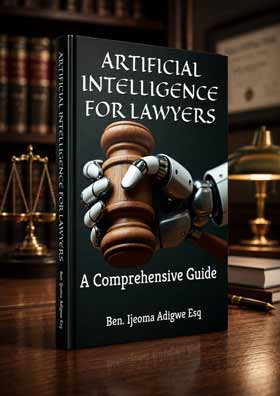 The book also examines Nigeria's legal ecosystem, focusing on the LPELR and NBA AI Guidelines. As a bonus, every purchase comes with a FREE eBook titled: How to Use the AI Features in LegalPedia and LawPavilion.
Ohio Books Ltd praises the publication, stating:
"....this is the only Nigerian book I know of on the topic."
How to Order:
📞 Call, Text, or WhatsApp: 08034917063 | 07055285878
📧 Email: benadigwe1@gmail.com
🌎 Website: www.benadigwe.com
Ebook Version: Access it directly online at https://selar.com/prv626
Authored by Ben Ijeoma Adigwe Esq., ACIarb (UK), LL.M, Dip. in Artificial Intelligence, Director at the Delta State Ministry of Justice, Asaba, Nigeria.
_______________________________________________________________________
“Enhance Legal Practice With Authoritative Reports” — Alexander Payne Offers Comprehensive Law Reports, Spanning Over A Century Of Nigerian Jurisprudence
The book also examines Nigeria's legal ecosystem, focusing on the LPELR and NBA AI Guidelines. As a bonus, every purchase comes with a FREE eBook titled: How to Use the AI Features in LegalPedia and LawPavilion.
Ohio Books Ltd praises the publication, stating:
"....this is the only Nigerian book I know of on the topic."
How to Order:
📞 Call, Text, or WhatsApp: 08034917063 | 07055285878
📧 Email: benadigwe1@gmail.com
🌎 Website: www.benadigwe.com
Ebook Version: Access it directly online at https://selar.com/prv626
Authored by Ben Ijeoma Adigwe Esq., ACIarb (UK), LL.M, Dip. in Artificial Intelligence, Director at the Delta State Ministry of Justice, Asaba, Nigeria.
_______________________________________________________________________
“Enhance Legal Practice With Authoritative Reports” — Alexander Payne Offers Comprehensive Law Reports, Spanning Over A Century Of Nigerian Jurisprudence
 Interested buyers are encouraged to place their orders and enquiries via:
0704 444 4777, 0704 444 4999, 0818 199 9888
Website: www.alexandernigeria.com
Interested buyers are encouraged to place their orders and enquiries via:
0704 444 4777, 0704 444 4999, 0818 199 9888
Website: www.alexandernigeria.com