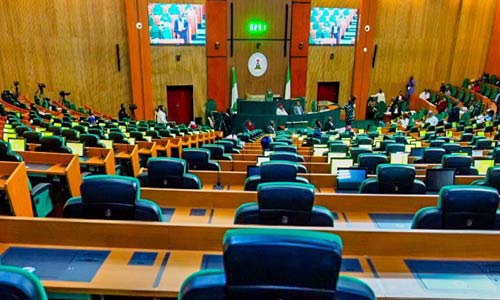
The House of Representatives has commenced a clause-by-clause review of President Bola Tinubu’s executive bill seeking constitutional backing for the establishment of state police services across Nigeria.


The exercise began on Monday at a meeting of the House Committee on Constitution Review chaired by Deputy Speaker Benjamin Kalu, who said lawmakers would use the version already passed by the Senate as their working document.
Kalu disclosed that the House could adopt the Senate’s amendments with only minor adjustments to accelerate the passage of the legislation, which he described as a priority security reform.
“The purpose of today’s meeting is to consider the Executive Bill clause by clause and make appropriate recommendations to the House,” he said.
“We must note that the Senate has already considered and adopted the bill with certain amendments, and copies of that version have been circulated to members. This document will serve as our working draft throughout this exercise.”
According to Kalu, the Senate made about eight minor amendments to the executive proposal, which the House committee would examine and adopt where appropriate.
He said the additions included provisions relating to the interpretation section of the Constitution, transitional and saving arrangements for implementing state police, as well as other consequential amendments required to establish the proposed dual policing system.
The latest consideration followed the House’s decision on July 14 to withdraw the state police constitutional amendment bill it had earlier passed and dissolve the conference committee set up to harmonise its version with that of the Senate.
The House had passed its original proposal on June 11 and constituted a 12-member conference committee on July 9. However, following Tinubu’s transmission of a fresh executive bill, the chamber rescinded its earlier decisions to allow the President’s proposal to undergo fresh consideration.
The motion to reverse the earlier passage was moved by the Chairman of the House Committee on Rules and Business, Francis Waive, who said new issues had emerged that required a comprehensive review to ensure the proposed framework aligned with Nigeria’s national security structure.
Tinubu, in his communication to the House, said the executive bill would amend the 1999 Constitution to provide a legal pathway for states to establish and operate their own police services alongside the Federal Police Service.
The President said the proposal built on the National Assembly’s previous work but introduced additional safeguards intended to address concerns about political interference, abuse of power and conflicts between federal and state security authorities.
He urged lawmakers to give the bill expedited consideration, describing it as a central component of his administration’s plan to reorganise Nigeria’s security architecture and provide more effective protection for citizens.
Kalu said the executive bill had already passed first and second readings in the House and was subsequently referred to the Constitution Review Committee for detailed scrutiny.
He added that consultations conducted during the National Assembly Open Week constituted extensive stakeholder engagement on the proposal.
The Deputy Speaker said lawmakers met on Monday, outside the House’s regular parliamentary schedule beginning on Tuesday, because of the urgency attached to the legislation.
“We are here today not because it is convenient for us. Our parliamentary week ordinarily begins on Tuesday, but duty calls, and time is of the essence,” he said.
“We are joining hands with the Executive to ensure that this collaborative effort results in the successful passage of this priority constitutional amendment.”
Kalu described the establishment of state police as one of Tinubu’s signature constitutional reform initiatives, noting that the President had advocated multi-layered policing since his tenure as Lagos State governor.
He maintained that although the executive, legislature and judiciary remained separate arms of government, they could collaborate on national priorities, particularly efforts to address insecurity.
Under the Senate-approved version being considered by the House, states would be constitutionally empowered to create police services operating alongside the federal police.
A state police service would be headed by a commissioner appointed by the governor upon the recommendation of the National Police Council and subject to confirmation by the relevant State House of Assembly.
The bill would also permit governors to issue lawful written directives of a general policy nature to state police commissioners on matters relating to public safety and order.
However, one of its proposed safeguards prohibits a state commissioner of police from arresting, detaining, investigating or deploying force against a person, political party or group merely for criticising a government, except where action is taken in accordance with the law.
The proposed amendment also outlines circumstances under which the Federal Police Service may temporarily intervene in a state’s internal security affairs.
Such intervention may occur where there is an actual or imminent breakdown of public order that the state police service is unable or unwilling to contain, or where the governor requests federal assistance.
The proposal requires presidential authorisation for such intervention, with the grounds, territory, functions and duration stated in writing. Relevant officials and institutions, including the governor, State House of Assembly, National Police Council and National Assembly, must also be notified within the stipulated period.
Supporters of state police argue that decentralisation would improve intelligence gathering, allow faster responses to emergencies and deploy personnel who better understand local communities and security threats.
Critics have, however, warned that governors could use state-controlled police formations against political opponents, journalists, activists and minority communities. Questions have also been raised about funding, recruitment standards, training, accountability and coordination between federal and state commands.
Kalu said the committee would closely examine the safeguards and Senate amendments before presenting its recommendations to the full House for further legislative action.
The proposal must obtain the constitutionally required support in both chambers of the National Assembly and approval from at least two-thirds of the 36 State Houses of Assembly before it can become part of the Constitution.

 Interested buyers are encouraged to place their orders and enquiries via:
0704 444 4777, 0704 444 4999, 0818 199 9888
Website: www.alexandernigeria.com
Interested buyers are encouraged to place their orders and enquiries via:
0704 444 4777, 0704 444 4999, 0818 199 9888
Website: www.alexandernigeria.com