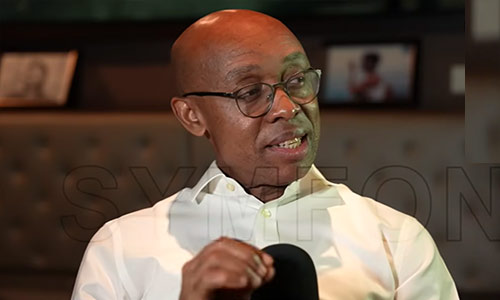
Prof. Chidi Anselm Odinkalu, CGoF, former Chairman of the National Human Rights Commission, has delivered what may be his most comprehensive and devastating critique of the Nigerian judiciary, declaring that the institution has been “captured” at a scale that surpasses the 1993 era, naming specific family syndicates that he says control judicial appointments, questioning whether Justice Peter Lifu physically wrote his own 103-page party deregistration judgment, describing the Lokoja ruling setting aside the NDC’s registration as “manifestly corrupt on the face of the record,” and arguing that the National Judicial Council has developed three doctrines that effectively shield corrupt judges from accountability by weeding out over 70 per cent of the complaints that should reach them.
Odinkalu spoke during an extensive interview with SYMFONI in which he addressed the historical roots of judicial capture, the “genitalisation” of the judiciary, the family networks controlling appointments, specific judicial decisions he described as corrupt, the NJC’s failure to act, and the office of the Attorney General of the Federation.
Odinkalu traced the capture of the judiciary to the events of 1993, when courts were used both to truncate the democratic process following the June 12 election and to establish the legitimacy of successive military regimes.
“The use of the judiciary to both truncate democratic process and also to establish legitimacy of regimes was established in 1993. Through the courts. Through the exercise of judicial powers in the ordinary adjudication of cases,” Odinkalu stated.
He said the consequences have been profound: “Voters don’t decide elections in Nigeria. Citizens don’t decide elections in Nigeria. Judges do. The judges decide elections in deals, backroom deals with politicians.”
“That means the politicians are now self-interested in who becomes a judge. The judges should control it, the profession should control it and come up with credible candidates. We now are coming up with truly incredible candidates or nominees as judges, and the worse or more venal a person is, the more you have over them to be able to control them or dictate to them, the more amenable and the more likely they are to become judges,” Odinkalu stated.
“So the idea that someone is independent-minded, professional, excellent, possessed of integrity, intelligent with proper qualifications is not a right qualification to become a judge. The opposite of those things will make it easier for you to become a judge. That is where we are,” the former NHRC Chairman declared.
Odinkalu introduced what he described as “the genitalisation of the Nigerian judiciary,” a term he used to describe the pattern by which political access to favourable judicial outcomes is secured through intimate relationships with persons connected to the judiciary.
“To become a successful politician, you need to have a judge in your bedroom. If it is not your bedroom of marriage, it’s your bedroom with a sidekick. The kind of skin you need to have in the game is skin from a particular part of the body of the opposite sex with whom you have genital contact and who can enable you to access certain kinds of decisions that are made at the highest levels of the judicial system,” Odinkalu stated.
“You now have wives and concubines and children, all of them making up a majority of the new appointments that are going into the judiciary,” he added.
Odinkalu provided specific examples of what he described as family capture of judicial appointments.
“These days when you see a list of judicial appointments, particularly at threshold level of the High Court, Federal High Court, FCT High Court in particular, and most state high courts, you give me the list, I’ll tell you who produced this one, this one is from that family, this one is produced by that person, this one is the allocation of that person,” Odinkalu stated.
He cited concrete data: “In the penultimate round at the FCT High Court, eight of the 12 were children of judges. Directly.”
He named a specific family: “There’s a particular family that has three of them from Ekiti. One is a judge of the Ekiti High Court. Another is a judge in the High Court here in the FCT. And the third is in the Federal High Court. Siblings. Their father was a judge. So there is this ‘judicial gene’ running in the veins of this fantastic family. All of them are produced to be judges. It doesn’t make sense. Of course, there is nothing like a judicial gene that exists. It’s all a corrupt system of capture.”
Odinkalu described former Chief Justice Olukayode Ariwoola’s tenure in damning terms, stating: “Ariwoola was a total complete something I cannot say on site.”
“He put his daughter, son-in-law, brother or cousin as accountant in charge of accounts, his son as a judge, his daughter-in-law as a judge, and so many other things I can’t even describe here,” Odinkalu alleged.
He noted that those who succeeded Ariwoola “are seeing the mess he created. It’s unspeakable.”
Odinkalu cited the cases of former Chief Justice Tanko Muhammad and former Court of Appeal President Zainab Bulkachuwa to illustrate the political-judicial nexus.
“Ahead of the last elections in 2022, while Tanko Muhammad was still Chief Justice, one of his sons became a nominee of APC to go to one chamber of the National Assembly. Another of his sons became a nominee of the PDP to go to one chamber of the National Assembly,” Odinkalu stated.
“When Zainab Bulkachuwa was President of the Court of Appeal, APC quickly nominated her husband to become a senator,” he added, noting that the husband subsequently “went to the Senate to celebrate how he was doing things in the bedroom with his wife to arrange judgments on behalf of his colleagues.”
“Their daughter is a judge. One of the youngest judges ever appointed in our system. That was the retirement benefit,” Odinkalu stated.
Odinkalu raised a question that has been whispered in legal circles but not previously stated publicly by a figure of his stature: whether Justice Peter Lifu physically wrote the 103-page judgment ordering the deregistration of five opposition parties.
“Peter Lifu, to the knowledge of anyone who has been to his court, is not well. He is recovering from what appears to have been an aneurysm. That’s a stroke. He’s got a partial paralysis. Go to his court. Ask anybody who has seen him. How does he write a 103-page judgment?” Odinkalu asked.
“I think it is important for us to start asking very brutal honest questions. How is a judge who is barely able to function write a 103-page judgment? Like seriously,” he stated.
On the substance of the judgment, Odinkalu repeated his earlier critique: “He converted a power to a statutory duty. The distinction between a power and a duty is one that a student in year one in law will recognise. You cannot transform a power into a duty.”
“The evidence before Peter Lifu was that the parties he was seeking to deregister had all won seats. He then invented something that section 225A does not contemplate: someone who after winning the election defects to a new party. That is nowhere in the constitution. That’s an invention. No judge who is conscious of their office would undertake that kind of invention. That is corrupt on the face of the record,” Odinkalu declared.
Odinkalu provided an equally detailed critique of Justice Isa Dashen’s ruling setting aside the NDC registration.
He noted that in Dashen’s original December 2025 judgment ordering the registration, the judge had explicitly considered the Peace Movement Party issue and held on page 21 that a logo resembling that of a registered party is not a ground for denying registration, and that the Peace Movement Party claim “had not been brought to the attention of NDC” and was “belated and an afterthought.”
“Fast forward, his judgment of 26th of June this year. Somebody else sues. This person is not a party to the case. He’s not seeking to be made a party to the original case. He understands he is out of time, so he applies to Isa Dashen asking him to grant him permission to apply to set aside the judgment. The judge does not consider the application for extension of time. There’s no application to be made a party to the case. The judge just moves and sets aside his judgment,” Odinkalu recounted.
“How then did he deal with the issue of logo not being a ground for setting aside? He did not deal with it. In my view, on the face of the record, that judgment is corrupt and we have a duty to say so. The ruling of 26th of June is manifestly corrupt,” Odinkalu declared.
“And my question is: do these judges actually write the judgments for themselves?” he asked.
Odinkalu paused to make a distinction he described as important.
“There are very honest judges still in Nigeria. I think it is important to say that. I’m not sitting down here saying every judge is corrupt. I focus on specific examples of manifest corruption on the record because those should not happen, and when they do, they tarnish the judges who are trying to do their work properly, who are making good effort in a bad system to try to live true to their conscience, to their profession, to their judicial oath, and to the law,” Odinkalu stated.
“We’ve got to continue to find ways of encouraging those people without endangering them, particularly while they are still in service in a system that does not like people who are upright,” he added.
He cited historical examples of judicial independence: Justice Emmanuel Araka, former Chief Judge of Old Anambra State, who was removed by military governor Allison Madueke because he refused to visit Madueke in his office; and Justice J.I.C. Taylor, former Chief Judge of Lagos State, who declined to stand in the receiving line for General Gowon when Gowon visited Lagos, telling the governor: “I have to adjudicate cases in which the military governor and the head of state are defendants institutionally before my court and I’ve got to maintain the appearance of independence.”
“These days judges wake up on Sunday, they are doing Owambe with politicians. On Monday, they are sitting in cases involving those same politicians in their own courts. There will be no independence,” Odinkalu observed.
Odinkalu identified what he described as three doctrines developed by the National Judicial Council that effectively shield corrupt judges from accountability.
First, that the NJC can only act on a written petition, whereas in the past it could take up cases of its own motion. Second, that a petition is only receivable if it is accompanied by an affidavit, which “weeds out most of the petitions because most people do not know that that’s what the rules require.” Third, that if a matter can be dealt with on appeal, the NJC will not hear it.
“When you add up these three doctrines, it weeds out over 70 per cent of the cases that are due to go to the NJC,” Odinkalu stated.
He argued that the third doctrine is particularly damaging: “The idea that a case can go on appeal is not incompatible with the existence of judicial malfeasance. But the NJC has developed this doctrine that appeals cure all things.”
“If you do not recognise that there is a distinction between the administrative disciplinary track and the judicial appellate track, and you’re conflating both, what you’re doing is giving cover to judges who may not actually be fit for the system to continue to do damage in the system,” Odinkalu stated.
When asked to identify the single biggest threat to judicial independence, Odinkalu’s answer was direct.
“The biggest threat to independence of the judiciary is the judiciary itself. It’s very simple,” he stated.
“I hear people say, ‘Well, we cannot blame the judges, these politicians come and…’ That’s not true. The politicians know the judges that they go to, who they can do business with. And there are some of them who you say, ‘Why don’t you go to this one?’ They say, ‘Ah, that one is a mad man or a mad woman. No, please, just leave them alone. Let them do their thing.’ Because they know the honest ones. And those, some of those still exist,” Odinkalu stated.
“But when the politicians know that they have you in their back pocket and they can always come to you and you issue an interim injunction ex parte in their favour at half past midnight, that says a lot,” he added.
He argued that independence must be actively claimed, not passively expected: “Independence is not donated. You have to work for independence. And assert it. Independence, for the most part, number one, is psychological. It’s an orientation. Number two, is your expertise. Because if you have expertise and the work you do is built on evidence, people may not like you, but they cannot fault you. Thirdly, independence is also a matter of assertion. You’ve actually got to claim it.”
Odinkalu addressed the quality of the office of the Attorney General, describing it as having “degenerated over the years.” He contrasted the current state with the example of Chief Kehinde Sofola, who in 1983 accepted President Shagari’s appointment as AGF only on the condition that he would not take dictation on legal matters and would be at liberty to quit if he felt he was being dictated to.
“That’s no longer possible. These days people believe that being Attorney General is a position you can take to advance your judicial career and your visibility,” Odinkalu stated.
He described former AGF Abubakar Malami as “the nadir” who “brought the office of Attorney General into disrepute.”
On Justice Lifu’s party deregistration case, Odinkalu noted that the plaintiffs were “a shadowy group” registered as Incorporated Trustees of former legislators, “clumped up together allegedly from the office of Femi Gbajabiamila, the Chief of Staff,” and that the Attorney General was a defendant in the case who then appeared to have facilitated the outcome.
“The judgment of Peter Lifu in this case is a scandal. It’s an absolute corrupt scandal,” Odinkalu declared.
The interview was conducted during a wide-ranging discussion on the state of the Nigerian judiciary. Prof. Chidi Anselm Odinkalu, CGoF, is a former Chairman of the National Human Rights Commission and a Senior Lecturer at the Fletcher School of Law and Diplomacy, Tufts University.
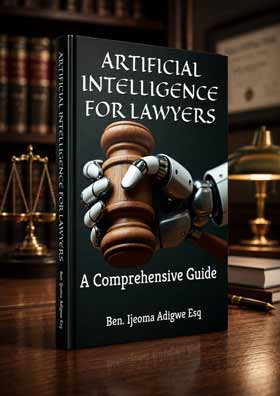 The book also examines Nigeria's legal ecosystem, focusing on the LPELR and NBA AI Guidelines. As a bonus, every purchase comes with a FREE eBook titled: How to Use the AI Features in LegalPedia and LawPavilion.
Ohio Books Ltd praises the publication, stating:
"....this is the only Nigerian book I know of on the topic."
How to Order:
📞 Call, Text, or WhatsApp: 08034917063 | 07055285878
📧 Email: benadigwe1@gmail.com
🌎 Website: www.benadigwe.com
Ebook Version: Access it directly online at https://selar.com/prv626
Authored by Ben Ijeoma Adigwe Esq., ACIarb (UK), LL.M, Dip. in Artificial Intelligence, Director at the Delta State Ministry of Justice, Asaba, Nigeria.
______________________________________________________________________
[A MUST HAVE] Evidence Act Demystified With Recent And Contemporary Cases And Materials
The book also examines Nigeria's legal ecosystem, focusing on the LPELR and NBA AI Guidelines. As a bonus, every purchase comes with a FREE eBook titled: How to Use the AI Features in LegalPedia and LawPavilion.
Ohio Books Ltd praises the publication, stating:
"....this is the only Nigerian book I know of on the topic."
How to Order:
📞 Call, Text, or WhatsApp: 08034917063 | 07055285878
📧 Email: benadigwe1@gmail.com
🌎 Website: www.benadigwe.com
Ebook Version: Access it directly online at https://selar.com/prv626
Authored by Ben Ijeoma Adigwe Esq., ACIarb (UK), LL.M, Dip. in Artificial Intelligence, Director at the Delta State Ministry of Justice, Asaba, Nigeria.
______________________________________________________________________
[A MUST HAVE] Evidence Act Demystified With Recent And Contemporary Cases And Materials

 Interested buyers are encouraged to place their orders and enquiries via:
0704 444 4777, 0704 444 4999, 0818 199 9888
Website: www.alexandernigeria.com
Interested buyers are encouraged to place their orders and enquiries via:
0704 444 4777, 0704 444 4999, 0818 199 9888
Website: www.alexandernigeria.com