The High Court of Lagos State, sitting as the Special Offences Court at Ikeja, has discharged and acquitted Tom Awhana and Paul Okoro, two former lawyers of the law firm of the late Mogbeyi Sagay SAN, on all 19 counts of conspiracy to steal contrary to Section 409 and stealing contrary to Section 285(1) of the Criminal Law of Lagos State, 2011, preferred against them by the Federal Republic of Nigeria through the Economic and Financial Crimes Commission (EFCC), after finding that the prosecution’s case was entirely based on suspicion, that the prosecution’s own witness admitted no money was alleged to be missing, that the prosecution was fishing for evidence by pressuring the 2nd Defendant to testify against the 1st Defendant and charged him when he refused, that the prosecution failed to tie any of the specific sums in the 18 substantive counts to any particular infraction, and that the prosecution failed to separate the firm’s income from the defendants’ legitimate entitlements.

The total sum allegedly stolen by both defendants across all counts was approximately N188 million, covering a period spanning from 2012 to 2018, during which the 1st Defendant served as Head of Chambers of the late Sagay SAN’s law firm.
The judgment was delivered on Thursday, June 4, 2026, by Hon. Justice M.A. Dada (Mrs.) in Suit No. LD/9456C/19.
Justice Dada concluded the 126-page judgment with the exclamation: “What a waste of time and life!”
The Charges
The defendants were arraigned on 19 counts. Count 1 charged both defendants with conspiracy to steal contrary to Section 409 of the Criminal Law of Lagos State, 2011, punishable under Section 285(1) of the same law, alleging that they conspired between 2012 and 2018 to steal monies, property of Mogbeyi Sagay & Co.
Count 2 charged the 2nd Defendant alone with stealing contrary to Section 285(1) of the Criminal Law of Lagos State, 2011. Counts 3 to 19 charged the 1st Defendant alone with stealing various sums at different times contrary to Section 285(1) of the same law, all described as property of Mogbeyi Sagay & Co. The first Defendant was alleged to have stolen N188 million while the 2nd defendant was alleged to have stolen N3,660,000. Total amount allegedly stolen across all counts was approximately N191,660+ million.
The Background
The case arose from the management of the law firm of the late Mogbeyi Sagay SAN, who died on February 28, 2012. After his death, the administration of his estate was entrusted to three administrators: Mrs Nneka Sagay, Mr Cliff Kokogho, and Mr Monima Lawson-Jack. Professor Itse Sagay SAN served as the firm’s long-time consultant.
The 1st Defendant, Tom Awhana, was a lawyer in the firm who was mandated by the administrators and Professor Sagay SAN to continue running the chambers as Head of Chambers after the principal’s death. He served in that capacity from 2012 until 2018 when he was asked to hand over. The administrators issued a “To Whom It May Concern” letter dated November 20, 2015, stating: “Mr Tom Awhana is the Head of Chambers of Mogbeyi Sagay & Co. He is in charge of the day to day running of the law firm. Please extend to him all necessary assistance.” The letter was signed by all three administrators.
The 2nd Defendant, Paul Okoro, was also a lawyer in the firm but left in 2013 after the late SAN’s death.
The firm’s known bank accounts were at Access Bank and Zenith Bank. However, during the 1st Defendant’s tenure as Head of Chambers between 2012 and 2018, two additional accounts were opened in the firm’s name at Heritage Bank and Union Bank, with the 1st Defendant as sole signatory on the Heritage Bank account and both defendants as signatories on the Union Bank account.
The dispute erupted in 2018 when a major client, Mr Babatunde Allen, visited the firm and mentioned that he had paid over N18 million to the firm, whereas only N5 million was reflected in the firm’s office account. An investigation revealed that approximately N16 million had cleared in the Heritage Bank account that the administrators did not know about. The administrators confronted the 1st Defendant, who initially denied the existence of additional accounts, then admitted opening them, claiming that “some clients who lured him to open it” and that it was a “Clients Account.”
The matter was referred to Professor Sagay SAN, who instructed that it be reported to the EFCC.
The Prosecution’s Case
The prosecution called seven witnesses, including bankers from Heritage Bank (PW1) and Union Bank (PW2) who produced account documentation, PW3 Chris Azubuike Okafor who authored the petition to the EFCC, and PW6 who was the firm’s former accountant and one of the administrators.
The prosecution’s case was that the defendants opened bank accounts in the firm’s name without authorisation and diverted monies totalling approximately N188 million belonging to the firm into those accounts for their personal use during the period 2012 to 2018.
The Defence
The defendants argued that the accounts were opened with knowledge and for legitimate purposes. They contended that after the late SAN’s death and before the Letters of Administration were issued, certain clients’ monies needed to be kept separate from the estate, necessitating new accounts. The 1st Defendant argued that he used funds from the accounts to augment the running of the chambers, which the estate was struggling to sustain.
The defence also established that PW3 admitted lawyers in the firm were at some point permitted to do private practice even while earning salaries, and that the 1st Defendant was entitled to 12 per cent and the 2nd Defendant to 10 per cent of the firm’s profits under an existing agreement.
The Court’s Findings
Justice Dada’s judgment systematically dismantled the prosecution’s case on multiple grounds.
“The Entire Case Is Based on Suspicion”
The court made what it described as the most damaging finding against the prosecution: its own witness admitted that no money was actually alleged to be missing.
“As a matter of fact, the evidence of PW7 who tendered Exhibit P31 was that no money was alleged to be missing, but that the activities of the Defendants were suspicious and the reason for filing the action against them,” Justice Dada stated.
“It is therefore admitted by the Prosecution that the entirety of this case is based on suspicion which can never ground conviction no matter how presented,” the court held.
Failure to Tie Specific Sums to Specific Infractions
The court found that the prosecution failed to connect any of the specific amounts charged in the 19 counts to any proven act of theft.
“None of the specific sums in the 18 Counts has been tied to any particular infraction by any of the Defendants by separating same from clients’ monies, what the Defendants ought to have earned as salaries and interests as agreed with the Firm on specific profits of the Firm,” Justice Dada stated.
“It appears the court has been plunged into the dark to be groping for what it did not lose,” the judge added.
Failure to Separate Legitimate Entitlements from Alleged Theft
The court held that the prosecution bore the burden of separating the firm’s income into its component parts: what should have gone to the firm, what went into running the chambers, and what percentage of profits the defendants were legitimately entitled to.
“The Prosecution should have been able to separate what exactly should have been for the benefit of the Firm, what went into the running of the Chambers and what should have been the percentage of the profits accruing to the Defendants,” Justice Dada stated.
PW3, who authored the petition, admitted that there was an agreement entitling the 1st Defendant to 12 per cent and the 2nd Defendant to 10 per cent of the firm’s profits. Without a clear accounting showing what the total profits were during the period 2012 to 2018, what the defendants were entitled to, and what specific amounts they took beyond their entitlements, the prosecution could not prove theft.
The Reconciliation Exercise That Proved Nothing
The court noted that the administrators had asked the 1st Defendant to do a proper handing over in 2018, which led to a series of meetings to reconcile figures. However, “no evidence was led to show the outcome of the alleged reconciliation exercise. The issue is left to mere conjecture which is not the duty of the court.”
The court held that this failure “cast a foreboding shadow on the case of the Prosecution as to how it arrived at the figures in Counts 2-19 of the Information.”
No Evidence of Any Client Being Deprived
The court found that the prosecution failed to produce any evidence that any client whose money was collected by the defendants had been deprived of their funds during the entire period from 2012 to 2018.
“There is no evidence from the Prosecution that since 2012 till date, any client whose monies were collected on their behalf by the Defendants or either of them has been withheld from them,” the court held.
“Fishing for Evidence”: The 2nd Defendant Was Charged for Refusing to Testify Against the 1st Defendant
The court made a particularly pointed finding regarding the 2nd Defendant, holding that the prosecution was fishing for evidence when it approached the 2nd Defendant to testify for the prosecution to implicate the 1st Defendant.
PW3 admitted that the firm did not identify any wrongdoing against the 2nd Defendant and that the petition to the EFCC did not include him. The court found that the 2nd Defendant “was charged along with the 1st Defendant because he refused to bow to pressure to make him one of the Prosecution witnesses.”
The court held that the prosecution’s approach to the 2nd Defendant constituted fishing for evidence, a practice that is impermissible in criminal proceedings. Rather than building a case based on independently gathered evidence, the prosecution attempted to recruit a potential co-accused as a witness, and when he refused to cooperate, charged him alongside the person they wanted him to implicate. The court’s finding that no infraction was identified against the 2nd Defendant by the firm itself, and that the petition to the EFCC did not include him, further undermined the basis for charging him and confirmed that his prosecution was retaliatory rather than evidence-based.
The 1st Defendant Had Authority
The court found that the 1st Defendant appeared to have been authorised by the administrators to run the firm throughout the period 2012 to 2018, citing the “To Whom It May Concern” letter of November 20, 2015, in which all three administrators confirmed his role as Head of Chambers in charge of day-to-day operations.
The court also noted that even Professor Sagay SAN himself had opened an Access Bank account for the estate in the firm’s name before the Letters of Administration were issued, and that it was the 1st Defendant whom Professor Sagay sent to collect cheques from Bayelsa State Government on behalf of the firm.
The Estate’s Own Difficulties
The court noted the evidence that the estate was struggling financially. PW6 testified that it wasn’t until 2018 when “it became difficult to sustain the family of the late SAN” that the 1st Defendant was asked to hand over. The court held that this was “a tacit admission that the Estate was also finding it difficult to assist in the running of the Chambers.”
PW6 also admitted his own personal benefit from the firm’s income and that over N43 million had been released to the wife of the late SAN during the period. The court noted: “There is no special heads for these expenses, no account of how much the Estate is alleged to have expended for the running of the Firm and how much actually came into the several Accounts after the demise of the late SAN. All these facts are locked up in murky waters which the court is expected to dive into and fish out without getting soiled?”
Proof Beyond Reasonable Doubt
The court cited Lord Denning’s dictum in Miller v. Minister of Pension (1947) on the standard of proof beyond reasonable doubt and the Supreme Court’s holding in Shande v. State (2005), where Pats-Acholonu JSC held that proof beyond reasonable doubt is “proof that excludes every reasonable or possible hypothesis except that which is wholly consistent with the guilt of the accused.”
The court also cited Bababe v. FRN (2019) 1 NWLR Pt. 1652, 100 and Mohammed v. State (2000) 12 NWLR Pt. 682, 596 for the principle that a person can only be convicted of stealing what is proved to exist.
“The proof presented by the Prosecution in this case carries no degree of probability. There is dearth of evidence to dislodge the doubt created in the totality of the case against the Defendants,” Justice Dada held.
The Verdict
“The totality of the case against the two Defendants therefore fails woefully and is hereby dismissed. The two Defendants are accordingly discharged and acquitted on all the 19 Counts preferred against them,” Justice Dada ordered.
Representation
The complainant (Federal Republic of Nigeria) was represented by A.O. Mohammed. The 1st Defendant was represented by Oluwatosin Adesioye. The 2nd Defendant was represented by Kemi Afesojaiye with B.C. Alekeh.
The judgment was delivered on Thursday, June 4, 2026, by Hon. Justice M.A. Dada (Mrs.), Special Offences Court, High Court of Lagos State, Ikeja.
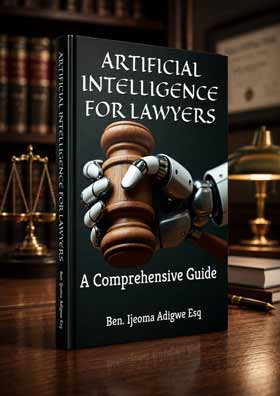 The book also examines Nigeria's legal ecosystem, focusing on the LPELR and NBA AI Guidelines. As a bonus, every purchase comes with a FREE eBook titled: How to Use the AI Features in LegalPedia and LawPavilion.
Ohio Books Ltd praises the publication, stating:
"....this is the only Nigerian book I know of on the topic."
How to Order:
📞 Call, Text, or WhatsApp: 08034917063 | 07055285878
📧 Email: benadigwe1@gmail.com
🌎 Website: www.benadigwe.com
Ebook Version: Access it directly online at https://selar.com/prv626
Authored by Ben Ijeoma Adigwe Esq., ACIarb (UK), LL.M, Dip. in Artificial Intelligence, Director at the Delta State Ministry of Justice, Asaba, Nigeria.
______________________________________________________________________
[A MUST HAVE] Evidence Act Demystified With Recent And Contemporary Cases And Materials
The book also examines Nigeria's legal ecosystem, focusing on the LPELR and NBA AI Guidelines. As a bonus, every purchase comes with a FREE eBook titled: How to Use the AI Features in LegalPedia and LawPavilion.
Ohio Books Ltd praises the publication, stating:
"....this is the only Nigerian book I know of on the topic."
How to Order:
📞 Call, Text, or WhatsApp: 08034917063 | 07055285878
📧 Email: benadigwe1@gmail.com
🌎 Website: www.benadigwe.com
Ebook Version: Access it directly online at https://selar.com/prv626
Authored by Ben Ijeoma Adigwe Esq., ACIarb (UK), LL.M, Dip. in Artificial Intelligence, Director at the Delta State Ministry of Justice, Asaba, Nigeria.
______________________________________________________________________
[A MUST HAVE] Evidence Act Demystified With Recent And Contemporary Cases And Materials

 Interested buyers are encouraged to place their orders and enquiries via:
0704 444 4777, 0704 444 4999, 0818 199 9888
Website: www.alexandernigeria.com
Interested buyers are encouraged to place their orders and enquiries via:
0704 444 4777, 0704 444 4999, 0818 199 9888
Website: www.alexandernigeria.com