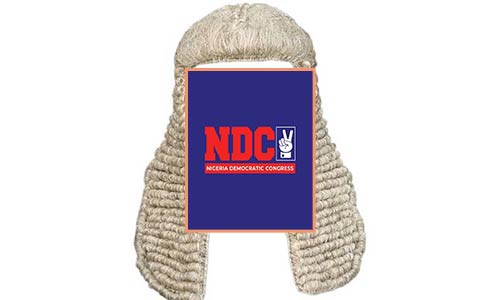
A Legal Analysis of the Federal High Court Lokoja Ruling Setting Aside the NDC Registration Judgment: The Doctrine Invoked, the Reasoning Applied, the Precedents Cited, and the Five Fundamental Questions the Ruling Leaves Unanswered

The certified true copy of the ruling delivered by Justice Isa H. Dashen of the Federal High Court, Lokoja, on Friday, June 26, 2026, in Suit No. FHC/LKJ/CS/49/2025, setting aside the same court’s December 10, 2025, judgment that had directed INEC to register the Nigeria Democratic Congress (NDC) as a political party, reveals a decision that rests on a specific doctrinal foundation the court’s inherent jurisdiction exercisable ex debito justitiae and a specific factual finding that a necessary party whose legal interests were directly affected was denied the constitutional right to fair hearing.
A close reading of the ruling, however, raises five fundamental questions about the legal reasoning, the procedural propriety, and the broader implications of the decision for Nigerian litigation practice.
What the Court Actually Ordered
The ruling granted the application of Barrister Emmanuel Uzowuru, described as the Pro Tem National Legal Adviser of the Peace Movement Party (PMP), who appeared “for himself and as representative of the Peace Movement Party.” The application was brought by Motion on Notice dated May 4, 2026, and filed May 5, 2026, pursuant to Order 26 Rules 1 and 8 and Rule 56 of the Federal High Court (Civil Procedure) Rules 2019 and the court’s inherent jurisdiction.
The court made five orders: granting the application; setting aside the December 10, 2025, judgment; reverting the suit to the stage it occupied immediately before the delivery of the set-aside judgment; granting parties liberty to take all necessary procedural steps for the determination of the substantive dispute; and making no order as to costs.
The application was supported by a 41-paragraph affidavit deposed to by Uzowuru, with Exhibits A through G. The NDC’s respondents filed a 54-paragraph counter-affidavit sworn to by one Kareem Henry, with Exhibit NDC “A.”
The Doctrinal Foundation: Inherent Jurisdiction and Ex Debito Justitiae
Justice Dashen grounded his ruling in the court’s inherent jurisdiction, which is the residual authority that every court of record possesses to do justice, to prevent abuse of its processes, and to ensure that its proceedings comply with fundamental principles of law.
The phrase “ex debito justitiae,” meaning “as a matter of right” or “as a debt of justice,” is a legal principle that holds that where a court’s proceedings are fundamentally flawed, the resulting judgment must be set aside as of right, not as a matter of discretion. It is typically invoked where a judgment is a nullity, for example because the court lacked jurisdiction, or because a party’s constitutional right to fair hearing was violated.
Justice Dashen held: “I further hold that the judgment delivered on 10th December 2025 was entered in proceedings conducted without the participation of a necessary party whose legal interests were directly affected and in circumstances amounting to a denial of the constitutional right to fair hearing. The said judgment is therefore liable to be set aside ex debito justitiae in order to preserve the integrity of the judicial process and prevent a miscarriage of justice.”
He cited Adigun v. Attorney-General of Oyo State and Pam v. Mohammed (2008) 16 NWLR (Pt. 1112) 1 for the proposition that once a breach of fair hearing is established, the resultant proceedings are rendered a nullity irrespective of the apparent correctness of the decision reached therein.
Question One: Is the Court Functus Officio?
The most fundamental question the ruling raises is whether Justice Dashen’s court had jurisdiction to entertain the application at all.
The doctrine of functus officio provides that once a court delivers a final judgment on the merits of a case, it has exhausted its jurisdiction over the subject matter and cannot revisit, review, or set aside its own decision. The remedy for a party aggrieved by a final judgment is to appeal to a higher court, not to return to the same court and ask it to undo what it has done.
Justice Dashen’s ruling does not appear to directly address the functus officio objection, at least not in the extracted portions. Instead, he proceeded on the basis that the court’s inherent jurisdiction, exercisable ex debito justitiae, empowers it to set aside its own judgment where that judgment was delivered in breach of fair hearing.
The legal question is whether the inherent jurisdiction exception is broad enough to override the functus officio principle in circumstances where the applicant seeking to set aside the judgment was not a party to the original proceedings, is not a registered political party, applied to be registered as a political party over a decade ago and was denied, and has no current registration or participation in the political process.
Nigerian jurisprudence recognises narrow exceptions to the functus officio doctrine. A court can set aside its own judgment where the judgment is a nullity, for example because the court lacked subject-matter jurisdiction. A court can also set aside its own judgment where it was obtained by fraud. The question is whether the denial of fair hearing to a third party who was not involved in the original proceedings constitutes a sufficient ground for the trial court itself, rather than the appellate court, to vacate its own final judgment.
Senior Advocates who have commented on the ruling have argued that the proper remedy for the PMP, if it believed its rights were affected, was to apply for leave to appeal as an interested party at the Court of Appeal, not to return to the same court that delivered the judgment. John Olusola Baiyeshea, SAN, stated that if a Federal High Court set aside a previous order by another judge of the same court, “that is abominably wrong.” While the Lokoja ruling involved the same judge setting aside his own earlier judgment rather than another judge’s, the functus officio principle applies with equal force to both scenarios once final judgment has been entered.
Question Two: Was the PMP a “Necessary Party”?
Justice Dashen’s ruling turns on his finding that the PMP was “a necessary party whose legal interests were directly affected” by the December 2025 judgment. This finding is the cornerstone of the fair hearing argument: if the PMP was not a necessary party, its absence from the original proceedings could not constitute a denial of fair hearing.
Under Nigerian law, a necessary party is one without whom the proceedings cannot be effectually and completely determined. The test is not whether a person might have an interest in the outcome, but whether the court cannot do complete justice between the existing parties without that person being present.
The PMP’s claimed interest is that the NDC was registered using a logo (the victory/peace sign) that the PMP had previously submitted to INEC as part of its own (unsuccessful) application for registration as a political party in 2015. The PMP was denied registration. It did not challenge the denial in court. It took no steps to pursue registration for approximately 10 years. It is not a registered political party. It does not sponsor candidates. It does not participate in political activities.
The question is whether an unregistered association that applied for registration over a decade ago, was denied, took no legal steps to challenge the denial, and has been dormant for 10 years can be classified as a “necessary party” to a later proceeding in which a different association successfully obtained a court order directing INEC to register it using a logo that the first association once proposed but was never granted.
NDC National Leader Seriake Dickson argued forcefully on Channels Television that the PMP is “unknown to the laws of Nigeria,” has no chairman, no secretary, no known members, no office, and no headquarters. He noted that the PMP’s sole representative before the court was someone described as a “pro tem national legal adviser,” not a trustee, chairman, or officer with clear authority to institute proceedings on behalf of the association.
The ruling does not address these objections in the extracted portions. The court simply found that the PMP had “a direct and legally recognisable interest” without, it appears, scrutinising whether an unregistered, dormant, decade-old association with a denied registration application possesses the kind of legal interest that makes it a necessary party whose absence renders proceedings a nullity.
Question Three: Was There Actually a Denial of Fair Hearing?
The fair hearing argument rests on the premise that the PMP was not afforded an opportunity to participate in proceedings whose outcome affected its interests. However, Dickson disclosed a critical fact that complicates this narrative: INEC itself raised the issue of the PMP’s prior application during the original December 2025 proceedings.
According to Dickson, INEC, which opposed the NDC’s application for registration, told the court that in 2015, an association had applied to use the same logo. Justice Dashen himself, during the original proceedings, asked INEC directly: were they registered? INEC said no. Were they seeking to be registered now, in the current exercise? INEC said no.
If these facts are accurate, and they have not been contradicted in the public domain, then the issue of the PMP’s prior application was not suppressed or concealed from the court. It was raised by INEC, examined by the judge, and found not to present a conflict. The court proceeded to grant the NDC’s registration on the basis that the PMP was not a registered political party, was not seeking registration, and had no subsisting claim to the symbol.
This raises the question: if the issue was fully ventilated during the original proceedings, can the PMP now claim that it was denied fair hearing on that same issue? Fair hearing requires that all interested parties be given an opportunity to be heard. But where the issue on which the absent party claims interest was raised, examined, and determined during the original proceedings, the argument that the proceedings were “conducted without the participation of a necessary party” becomes considerably weaker.
Question Four: The “Material Facts Suppressed” Finding
Justice Dashen reportedly found that “certain material facts were suppressed in the earlier proceedings.” This is a judicial finding of considerable gravity, as it implies that the original plaintiffs (the NDC representatives) deliberately withheld information from the court.
However, if INEC itself disclosed the PMP’s 2015 application during the original proceedings, as Dickson asserts, it is difficult to identify what material facts were suppressed. The existence of the PMP’s application was on the record. Its unsuccessful outcome was on the record. Its non-participation in the current registration exercise was on the record.
The ruling does not appear to specify, in the extracted portions, what particular material facts were suppressed or by whom. This is significant because a finding of suppression of material facts carries implications beyond the instant case. It could potentially ground an allegation of fraud against the original plaintiffs, it could affect the credibility of their legal representatives, and it could influence the outcome of the fresh hearing ordered by the court.
If the court cannot identify specific facts that were suppressed, the finding risks being characterised as conclusory rather than evidence-based, a vulnerability that the Court of Appeal may examine closely.
Question Five: The Precedential Implications
Perhaps the most far-reaching question raised by the ruling is its implication for the finality of judgments in Nigerian courts.
If a court can invoke its inherent jurisdiction to set aside a final judgment on the basis that a party who was not involved in the original proceedings claims to have been affected by the outcome, and if this can be done by motion rather than by appeal, and if the applicant need not be a registered entity with a subsisting legal interest but merely an association that once applied for something similar and was denied, then the implications extend far beyond the NDC case.
Under this reasoning, any person or entity that claims to have been affected by any judgment, even years after the judgment was delivered, could potentially apply to the same court to have the judgment set aside on fair hearing grounds, bypassing the appellate process entirely. This would undermine the doctrine of finality, which holds that litigation must come to an end and that judgments, once delivered, create rights and obligations that parties and third parties are entitled to rely upon.
The NDC relied on the December 2025 judgment for six months. During that period, INEC registered the party, the party conducted nationwide membership registration, held congresses at all levels, held a national convention, conducted primary elections monitored by INEC, participated in senatorial by-elections, and nominated candidates for all elective offices. Thousands of individuals invested time, money, and political capital on the strength of a subsisting judgment. Setting aside that judgment six months later, on a motion by an unregistered association, raises serious questions about the protection of vested interests and the reliance principle that undergirds the finality of judgments.
The NDC’s National Secretary, Ikenna Enekweizu, stated that there are only two recognised grounds upon which a court can set aside its own judgment: where the judgment is a nullity or where it was obtained through fraud or false representation. He argued that neither ground was established in this case.
The Authorities Cited
Justice Dashen cited Adigun v. Attorney-General of Oyo State and Pam v. Mohammed for the principle that a breach of fair hearing renders proceedings a nullity. These are well-established authorities. However, both cases involved situations where parties to the proceedings were denied an opportunity to be heard on matters that directly affected them, not situations where a third party who was never part of the proceedings sought to reopen a concluded case years or months later.
The applicability of these authorities to the present facts, where the applicant is not a party to the original suit, is not a registered political party, was denied registration 10 years ago, and took no steps to challenge that denial, may be scrutinised by the Court of Appeal.
The Order: “Revert to the Stage Immediately Before”
The court ordered that “Suit No. FHC/LKJ/CS/49/2025 shall revert to the stage it occupied immediately before the delivery of the judgment set aside herein.” This means the suit returns to the point just before judgment was delivered, not to the point before the suit was filed. The parties are given liberty to take all necessary procedural steps for the determination of the substantive dispute.
The practical effect is that the case will be reheard with the PMP now joined as a party. The NDC’s original claim for registration will be determined afresh, with the PMP having the opportunity to present its case.
The question left unanswered by the ruling is what happens to all the actions taken in reliance on the December 2025 judgment during the period between its delivery and its setting aside. If the judgment is now treated as if it never existed, does the NDC’s registration by INEC fall away? Do the primaries become invalid? Do the candidates’ nominations become void? Do the by-election results in Nasarawa and Enugu become affected?
The NDC argues that the ruling did not contain a positive mandatory order directing INEC to deregister the party, and that the court’s order to “revert to the stage immediately before” relates to the court proceedings, not to the administrative actions taken by INEC in compliance with the original judgment. This interpretation is legally arguable but will need to be tested before the Court of Appeal.
What the Court of Appeal Will Need to Decide
The NDC has announced it will file an appeal immediately. The Court of Appeal will likely need to address several questions.
First, whether the Federal High Court was functus officio and lacked jurisdiction to entertain the PMP’s application to set aside a final judgment delivered over six months earlier.
Second, whether the PMP qualifies as a “necessary party” whose absence from the original proceedings rendered them a nullity, given that the PMP is not a registered political party, was denied registration 10 years ago, took no steps to challenge the denial, and has been dormant throughout.
Third, whether fair hearing was actually denied, given the evidence that INEC raised the PMP’s prior application during the original proceedings and the judge himself examined and determined the issue.
Fourth, whether the court’s finding that “material facts were suppressed” is supported by the evidence, or whether it is a conclusory finding unsupported by specifics.
Fifth, whether the court’s inherent jurisdiction, exercisable ex debito justitiae, extends to setting aside a final judgment at the instance of a non-party whose claimed interest arises from a 10-year-old, unsuccessful, and unchallenged application for registration.
And sixth, whether the practical consequences of setting aside a judgment that has been relied upon for six months by INEC, the NDC, over 1,000 candidates, and millions of supporters are proportionate to the interest the PMP claims was affected.
The Representation
The PMP was represented by C.S. Ekocha, Esq. The NDC plaintiffs/respondents were represented by Reuben Egwuaba, Esq., with H.O. Yusuf, Esq.
The ruling was delivered on Friday, June 26, 2026, by Hon. Justice Isa H. Dashen, Presiding Judge, Federal High Court, Lokoja.
The NDC has indicated it will file its appeal at the Court of Appeal on Monday. The substantive suit, with the PMP now joined, is expected to proceed before Justice Dashen pending the outcome of the appeal, unless the Court of Appeal grants a stay of proceedings.
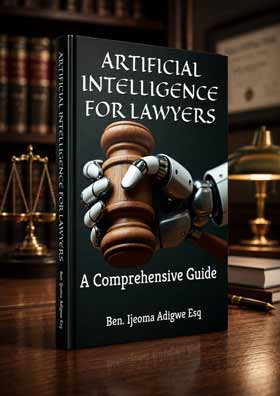 As an added bonus, every purchase comes with a FREE ebook titled: “How to use the AI in Legalpedia and Law Pavilion.”
Ohio Books Ltd praises the publication, stating:
"....this is the only Nigerian book I know of on the topic."
How to Order:
📞 Call, Text, or WhatsApp: 08034917063 | 07055285878
📧 Email: benadigwe1@gmail.com
🌎 Website: www.benadigwe.com
Ebook Version: Access it directly online at https://selar.com/prv626
Authored by Ben Ijeoma Adigwe Esq., ACiarb (UK), LL.M, Dip. in Artificial Intelligence, Director at the Delta State Ministry of Justice, Asaba, Nigeria.
_______________________________________________________________________
As an added bonus, every purchase comes with a FREE ebook titled: “How to use the AI in Legalpedia and Law Pavilion.”
Ohio Books Ltd praises the publication, stating:
"....this is the only Nigerian book I know of on the topic."
How to Order:
📞 Call, Text, or WhatsApp: 08034917063 | 07055285878
📧 Email: benadigwe1@gmail.com
🌎 Website: www.benadigwe.com
Ebook Version: Access it directly online at https://selar.com/prv626
Authored by Ben Ijeoma Adigwe Esq., ACiarb (UK), LL.M, Dip. in Artificial Intelligence, Director at the Delta State Ministry of Justice, Asaba, Nigeria.
_______________________________________________________________________
“Order Justice Omolaye-Ajileye’s Electronic Evidence Books Now” — Essential Guides On Evidence Act, Case Law And Digital Proof
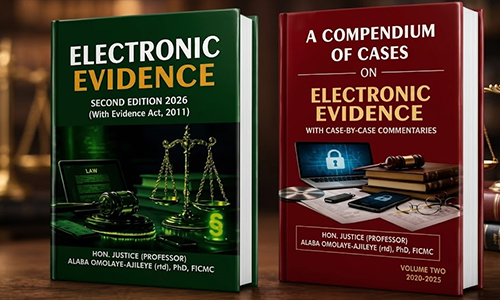
 Interested buyers are encouraged to place their orders and enquiries via:
0704 444 4777, 0704 444 4999, 0818 199 9888
Website: www.alexandernigeria.com
Interested buyers are encouraged to place their orders and enquiries via:
0704 444 4777, 0704 444 4999, 0818 199 9888
Website: www.alexandernigeria.com

 LAWBREED — Equipping You For Greater Success!
_______________________________________________________________________
LAWBREED — Equipping You For Greater Success!
_______________________________________________________________________