The Obi of Onitsha, His Majesty Igwe Nnaemeka Alfred Ugochukwu Achebe, who recently marked his 85th birthday, has spoken extensively on his 24 years on the throne, how he applied corporate governance principles from a 30-year career at Shell to transform the Onitsha community, the emerging fault lines threatening Nigeria’s future, and why citizens who leave the country because it is not functioning well are “leaving it in the hands of those who are probably responsible for this.”


In an interview with Tribune journalists Debo Abdulai, Sina Oladeinde, Lasisi Olagunju, and Akin Adewakun, the highly respected royal father offered a rare window into how traditional leadership, corporate management expertise, and community organising can produce tangible development outcomes at the grassroots level, while delivering a pointed critique of Nigeria’s political class and a call for the country to return to the federal structure that made it prosperous under the founding fathers.
“Everything Boils Down to Leadership”
The Obi of Onitsha framed Nigeria’s challenges in terms that cut through the complexity of policy debates to a single issue: the quality and honesty of leadership.
“Everything boils down to leadership. And what is leadership? It is making things happen and what you have to do, you do it honestly. Nobody should be discriminated against by any measure,” Igwe Achebe stated.
He posed a question that he left hanging for Nigeria’s political class to answer: “Can our political leaders put their hands on their chests and swear that they are doing their best?”
He drew a contrast with the simplicity of Nigeria’s founding leaders, recalling a visit to the Ikenne home of the late Chief Obafemi Awolowo. “So this ordinary-looking house was where Chief Awolowo was effectively ruling Western Nigeria. The only thing that could let you feel that the house was special was the photographs. We ate at the dining table of Obafemi Awolowo, so simple. Now, the same can be said of our leaders of today. You see, the values have changed.”
Nigeria’s Three Fault Lines
The Obi identified three emerging fault lines that he said pose the greatest threat to the country’s stability.
The first, and in his view the most dangerous, is economic. “The biggest fault line is between those at the bottom and those at the top. Those at the top have access to the bulk of the resources of this country and, of course, the large majority at the bottom have hardly anything, they feed from the dustbin,” Igwe Achebe stated.
He warned that the middle class, which traditionally serves as a stabilising force in any society, is being hollowed out. “The middle class cannot pay its bills anymore. So the middle class is gradually getting thinner while the people at the bottom are getting bigger.”
The second fault line is religious. The third, though not explicitly named, was implied in his reference to DNA and shared ancestry. “If we check our DNA, it will match by 95 per cent because almost all of us are interrelated. From the historical times, genes are genes. They don’t tell lies,” the monarch stated, suggesting that the ethnic and religious divisions that define Nigerian politics are largely artificial constructs that ignore the reality of shared ancestry.
“Return to Federalism”
The Obi made a direct call for Nigeria to return to the federal structure that he said produced prosperity under the founding fathers.
“The founding fathers: Nnamdi Azikiwe, Obafemi Awolowo and Ahmadu Bello negotiated a system that made Nigeria a proper federation. The regions were prosperous and were contributing to the centre, unlike now that governors go to Abuja every month to collect allocation. Nigeria worked well as a federation,” Igwe Achebe stated.
“So why can’t we now use our common sense and make Nigeria a better place for all of us?” he asked.
“Don’t Wait for Government”
The Obi delivered a message to Nigerians that was simultaneously pragmatic and challenging: stop waiting for the government to solve your problems.
“If you are expecting the government to do this for us, do that for us, you are lost,” Igwe Achebe stated.
He addressed the wave of emigration directly: “Anybody who leaves Nigeria because Nigeria is not functioning well is leaving it in the hands of those who are probably responsible for this. So you are not helping matters by going away.”
While acknowledging that he shares the frustration about when Nigeria will “get there” as a nation, the Obi maintained his optimism. “I’ve always been an optimist. I believe the present cannot be extrapolated into the future.”
How He Transformed Onitsha
The Obi described in detail how he applied corporate governance principles from his 30-year Shell career to transform the Onitsha community after ascending the throne in 2002.
“If you come to the job as a Shell career staff, in Shell it’s progression. Year one, you want to get what the challenges of the job are. Year two, you are doing what you think you ought to do to move the job to the next level. By the third year, if you are doing the right things, you are looking beyond,” Igwe Achebe explained.
Within two to three months of ascending the throne, he invited former Shell colleagues to run a two-day community development workshop. He established a “think tank” of educated Onitsha professionals in Lagos, Abuja, and the diaspora who met weekly to debate issues and develop a working template for community transformation.
“In twelve months, we had achieved or exceeded all the targets we set, except on security, where the state government has a role to play,” the Obi stated.
The community subsequently created 15 workgroups covering every aspect of development: youth challenges, women’s issues, ICT, commerce, and political engagement. The workgroups produced comprehensive reports that were presented at a town hall meeting and unanimously adopted.
COVID-19: “An Overall Positive Development for Onitsha”
The Obi described how the COVID-19 pandemic, despite its devastation, became a catalyst for community organisation.
“With all respect and reverence to those who lost their lives, COVID-19 turned out to be an overall positive development for Onitsha,” Igwe Achebe stated.
The community quickly converted its development study team into the Onitsha Community COVID Response Team. On prevention, they trained youths as “COVID Ambassadors” (now “Health and Wellbeing Ambassadors”) who visited every home. They manufactured their own nose masks and hand sanitisers, distributed them free, and created employment in the process. Diaspora members sponsored their villages, with each person required to have at least two masks.
“The Commissioner for Health in Anambra State started joining our Zoom meetings because he learned from us,” the Obi revealed.
For post-COVID recovery, the community created the Onitsha Advancement Foundation (OnAF) as an umbrella NGO, establishing cooperatives for micro-enterprise loans, an IT hub for self-employment, and a walk-in medical centre in the old palace with a nurse permanently on duty.
N12,500 Health Insurance
One of the community’s most innovative programmes is a community health insurance scheme costing N12,500 per year that provides comprehensive coverage “for literally everything, except maybe cancer surgeries.”
“I tell my people overseas that for N130,000 a year, which converted to dollars is like one or two dinners in a restaurant, you can keep 10 people in your village alive through this health insurance,” Igwe Achebe stated.
University Students Teaching Secondary School Pupils
The Obi described an educational programme where university students run tutorials for secondary school students during every long vacation, with two centres in Onitsha North and South Local Government Areas.
“Last year, we had over 1,200 students, and we had about 60 or more university students managing them,” the Obi revealed. “For the university students, we get our young professionals to run a weekly seminar for them on leadership, career choice, life planning, and others, which you can’t get in the universities anymore.”
“Every Programme I Have Is for Youths and Women”
The Obi explained the philosophy behind his focus on youths and women: “That is why every programme I have in Onitsha is for youths and women, because they are the neglected ones. If you manage them properly and encourage them, give them functional education, and create an enabling environment for them, they can do something with their lives and can be the biggest force for development.”
The community has a special programme addressing women’s issues, including adolescent pregnancies, described as one of the negative impacts of the civil war on personal behaviour and family structures. Professional women in the community initiated the programme, which provides a safe environment for discussing sensitive topics.
Family, Faith, and Discipline
The Obi attributed his personal values and leadership approach to his upbringing. “Everything. That’s the foundation. It’s the family, my parents,” he stated.
His father’s philosophy was uncompromising on honesty: “You must tell the truth, even if you are being killed. Tell the truth before they kill you.”
The household operated on shared responsibility. “As children, everybody had their own chores. At weekends, I washed cloth for everybody, except for my father, for very special family reasons. My sister would wash my father’s cloth. My little sister would fetch the water. So we worked with love.”
He shared a vivid anecdote about how his stepmother handled his childhood bullying. When he came home crying because a classmate kept knocking his head, she told him: “Get out of the house. Go back to Chuka. If you don’t knock his head back you won’t eat lunch.” He confronted the bully, who never troubled him again, and the two became close friends for life.
On his health at 85, the Obi offered a simple formula: “Discipline. However good anything is, take it in moderation. I sleep well. I take my medications very seriously. I was diagnosed with hypertension over 30 years ago and I have not missed my medication for one day. Don’t bear grudges in your mind at all.”
The American Education That Opened His Eyes
The Obi recalled leaving Nigeria for the first time in the early 1960s on a scholarship, arriving for the Lagos interview in his school uniform, buying a bow tie at Oyingbo market, and winning the scholarship over candidates who arrived in agbada and suits.
“In America, you’ve got to learn to move fast and work fast. The American system, if you believe in yourself and you work hard, you will get to any height. People like Bill Clinton became president from very poor and lowly background,” Igwe Achebe recalled.
After his chemistry degree, he made what he described as one of the best decisions of his life: taking an MBA at business school. “The rudiments of management, I learned from one of such professors. I came back in 1972. My American education was fantastic.”
“I’m as Confused as You People Are”
Despite his optimism and the tangible achievements in Onitsha, the Obi acknowledged the depth of Nigeria’s challenges with characteristic honesty.
“Talking about my prescriptions, I’m as confused as you people are,” Igwe Achebe admitted.
But he returned to the constant in his philosophy: that development begins at the community level, that leadership is about honesty and making things happen, and that waiting for government to solve problems is a dead end.
“Even in America, their local government is more important to every American. I have a house in the UK, and the Local Council has to keep you informed about what they are doing because it’s taxpayers’ money they are spending and they provide the amenities,” the Obi noted.
“I’m a traditional ruler today. I do my best every day for the community. I can be judged on whether my best is good enough, that is a different matter,” Igwe Achebe concluded.
The Obi of Onitsha disclosed that three books documenting the community’s development journey would be launched next year.
The interview was conducted by Tribune journalists Debo Abdulai, Sina Oladeinde, Lasisi Olagunju, and Akin Adewakun.
[A MUST HAVE] Evidence Act Demystified With Recent And Contemporary Cases And Materials

Available now for NGN 40,000 at ASC Publications, 10, Boyle Street, Onikan, Lagos. Beside High Court, TBS. Email publications@ayindesanni.com or WhatsApp +2347056667384. Purchase Link: https://paystack.com/buy/evidence-act-complete-annotation
______________________________________________________________________ “Enhance Legal Practice With Authoritative Reports” — Alexander Payne Offers Comprehensive Law Reports, Spanning Over A Century Of Nigerian Jurisprudence Interested buyers are encouraged to place their orders and enquiries via:
0704 444 4777, 0704 444 4999, 0818 199 9888
Website: www.alexandernigeria.com
Interested buyers are encouraged to place their orders and enquiries via:
0704 444 4777, 0704 444 4999, 0818 199 9888
Website: www.alexandernigeria.com
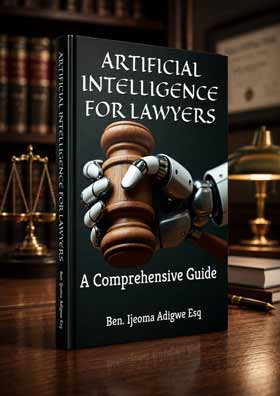 The book also examines Nigeria's legal ecosystem, focusing on the LPELR and NBA AI Guidelines. As a bonus, every purchase comes with a FREE eBook titled: How to Use the AI Features in LegalPedia and LawPavilion.
Ohio Books Ltd praises the publication, stating:
"....this is the only Nigerian book I know of on the topic."
How to Order:
📞 Call, Text, or WhatsApp: 08034917063 | 07055285878
📧 Email: benadigwe1@gmail.com
🌎 Website: www.benadigwe.com
Ebook Version: Access it directly online at https://selar.com/prv626
Authored by Ben Ijeoma Adigwe Esq., ACIarb (UK), LL.M, Dip. in Artificial Intelligence, Director at the Delta State Ministry of Justice, Asaba, Nigeria.
______________________________________________________________________
The book also examines Nigeria's legal ecosystem, focusing on the LPELR and NBA AI Guidelines. As a bonus, every purchase comes with a FREE eBook titled: How to Use the AI Features in LegalPedia and LawPavilion.
Ohio Books Ltd praises the publication, stating:
"....this is the only Nigerian book I know of on the topic."
How to Order:
📞 Call, Text, or WhatsApp: 08034917063 | 07055285878
📧 Email: benadigwe1@gmail.com
🌎 Website: www.benadigwe.com
Ebook Version: Access it directly online at https://selar.com/prv626
Authored by Ben Ijeoma Adigwe Esq., ACIarb (UK), LL.M, Dip. in Artificial Intelligence, Director at the Delta State Ministry of Justice, Asaba, Nigeria.
______________________________________________________________________