— Odinkalu Mocks Legal Chaos As Two Federal High Court Judges Clash Over INEC Timetable

A judge of the Federal High Court, Justice James Omotosho, has delivered a judgment affirming the Independent National Electoral Commission’s (INEC) timetable and schedule of activities for the 2027 general elections as lawful directly contradicting the judgment delivered just days earlier by his colleague on the same court, Justice Mohammed Umar, who had nullified key aspects of the same timetable and declared that INEC lacked the statutory power to prescribe timelines for party primaries, candidate submission, substitution, and campaign periods.
The conflicting judgments from two judges of the same Federal High Court have plunged Nigeria’s pre-election process into an unprecedented state of legal uncertainty, leaving political parties, aspirants, INEC, and the general public caught between two diametrically opposed judicial pronouncements on the same subject matter with neither judgment automatically superseding the other, and both carrying equal legal force until a higher court resolves the conflict.
In a detail that underscores the urgency and possibly the deliberateness of the timing, Justice Omotosho’s judgment was promptly certified and made ready for immediate use a turnaround speed that stands in contrast to the days it took for the certified true copy of Justice Umar’s judgment to become available, during which INEC publicly stated it could not act because it had not yet received the ruling.
The legal landscape is now defined by two Federal High Court judgments that cannot coexist.
Justice Umar, in Suit No. FHC/ABJ/CS/517/2026, delivered on May 20, 2026, following a suit filed by the Youth Party, held that INEC’s powers to receive notices of party primaries and observe them did not extend to fixing or prescribing the timetable within which political parties must conduct their primaries for the 2027 elections. He declared that INEC could not lawfully abridge the 120-day statutory window for candidate submission under Section 29(1) of the Electoral Act, the 90-day window for candidate substitution under Section 31, or the 60-day minimum period for publication of the final candidate list under Section 32. He nullified the timeframes in INEC’s revised timetable that were inconsistent with the Electoral Act 2026.
Justice Omotosho, in a separate suit, has now held the opposite affirming INEC’s timetable as lawful and effectively validating the commission’s authority to set the very timelines that Justice Umar declared ultra vires.
The result is that Nigeria now has two subsisting Federal High Court judgments on the same issue one saying INEC’s timetable is unlawful, the other saying it is lawful with no automatic mechanism for resolving the conflict at the same judicial level.
A notable aspect of Justice Omotosho’s judgment is the speed with which it was certified and made available. The judgment was delivered and the certified true copy was promptly prepared and ready for use on the same day.
This stands in sharp contrast to the experience with Justice Umar’s judgment, where INEC publicly stated through its Deputy Director of Publicity, Wilfred Osilama Ifogah, and its Director of Voter Education and Publicity, Victoria Eta-Messi, that the commission could not act on the ruling because it had not yet received a copy of the judgment a position the commission maintained for several days after the ruling was delivered.
The immediate certification of Justice Omotosho’s judgment means INEC now has a judicial pronouncement in hand that it can cite as legal authority for continuing to enforce its timetable even as the Youth Party and opposition parties rely on Justice Umar’s judgment as authority for the position that the timetable has been nullified.
Prominent legal scholar and former Chairman of the National Human Rights Commission, Prof. Chidi Anselm Odinkalu, CGoF, drew public attention to the conflicting judgments on social media, noting the irony and the legal chaos that the situation has created.
“James Omotosho, judge of the Federal High Court, has fired back today and affirmed the INEC timetable as lawful. The judgment delivered today is promptly certified and ready. Choose ye this day…!!” Odinkalu wrote on X (formerly Twitter).
Odinkalu’s biblical allusion “Choose ye this day” captures the impossible position in which political parties, aspirants, and INEC itself now find themselves: they must choose which of two contradictory Federal High Court judgments to follow, knowing that compliance with one necessarily means defiance of the other.
The phrase also carries an implicit commentary on the state of Nigeria’s judiciary, where the practice of forum shopping filing cases before judges perceived to be sympathetic to a particular position has produced a pattern of conflicting court orders that undermine legal certainty and public confidence in the judicial process.
The existence of two contradictory judgments from the same court on the same subject is possible because of the structure of Nigeria’s judicial system. The Federal High Court has multiple divisions across the country, each presided over by independent judges who exercise concurrent jurisdiction. Different parties can file different suits before different judges on substantially the same issues, and each judge renders judgment independently based on the arguments and evidence before them.
There is no automatic mechanism for consolidating related cases or preventing parallel proceedings that may produce conflicting outcomes. The result is that two judges of coordinate jurisdiction neither superior to the other can deliver opposite rulings, both of which are legally valid and enforceable until a higher court (the Court of Appeal) resolves the conflict.
This is precisely the scenario that has now materialised. Justice Umar ruled in favour of the Youth Party and against INEC. Justice Omotosho ruled in favour of INEC’s timetable. Both judgments emanate from the Federal High Court. Both are binding. And they directly contradict each other.
The conflicting judgments create a legal quagmire with several dimensions.
First, INEC now has judicial cover from both sides. The commission can point to Justice Omotosho’s judgment to justify enforcing its timetable, while parties seeking to exploit the expanded timelines can point to Justice Umar’s judgment. This effectively gives INEC the discretion to choose which judgment to follow a discretion that should not exist but has been created by the judicial conflict.
Second, INEC has already filed an appeal against Justice Umar’s judgment at the Court of Appeal through Chief Alex Izinyon, SAN, seeking to have it set aside and requesting a stay of execution. The existence of Justice Omotosho’s contradictory ruling strengthens INEC’s appeal by demonstrating that the legal position is genuinely contested and that a coordinate court has reached the opposite conclusion on the same issues.
Third, the party or parties that obtained the favourable judgment from Justice Omotosho may themselves face an appeal from aggrieved parties who rely on Justice Umar’s ruling creating the possibility of multiple appeals from multiple judgments on the same issue running simultaneously at the Court of Appeal.
Fourth, the conflicting judgments may ultimately need to be resolved by the Supreme Court if the Court of Appeal is unable to produce a definitive and consistent ruling a process that could take months and extend well into the 2027 election cycle.
The political implications are equally significant. The ADC had predicted a “mass exodus” from the APC following Justice Umar’s judgment, arguing that the ruling removed impediments designed to prevent politicians from leaving the ruling party. The PDP (Turaki camp) had described the ruling as a “breather” that allowed more time for member recruitment. The NDC had warned that the judgment was a “Greek Gift” that could destabilise opposition parties.
Justice Omotosho’s contradictory ruling now throws all of those political calculations into uncertainty. If INEC chooses to rely on Justice Omotosho’s judgment and enforce its original timetable, the expanded defection window that opposition parties were celebrating may effectively close. If political parties and aspirants choose to rely on Justice Umar’s judgment and act on the expanded timelines, they do so at the risk that the Court of Appeal may ultimately uphold INEC’s timetable and invalidate actions taken outside the commission’s prescribed windows.
The practical question for every aggrieved APC aspirant considering defection, every opposition party planning to recruit disaffected politicians, and every candidate calculating substitution timelines is now: which judgment do you follow? And if you follow the wrong one, what are the consequences?
The spectacle of two Federal High Court judges delivering opposite rulings on the same issue within days of each other is likely to intensify calls for reform of the judicial system to prevent what critics describe as “forum shopping” the practice of filing cases before judges perceived to be favourable to a particular outcome.
The problem is not new. Nigerian election litigation has long been characterised by competing court orders, with different parties obtaining injunctions and declarations from different courts that cancel each other out. The practice has been condemned by the Supreme Court, the National Judicial Council, and legal commentators, but structural reforms to prevent it have not been implemented.
The INEC timetable dispute is now the most prominent example of this systemic problem, with the country’s entire pre-election framework hanging on which of two contradictory judgments prevails a situation that Odinkalu’s “Choose ye this day” captures with uncomfortable precision.
The conflict between the two judgments can only be definitively resolved by the Court of Appeal, which now has before it INEC’s appeal against Justice Umar’s ruling (filed through Izinyon SAN on May 25, 2026) and may receive a separate appeal from parties aggrieved by Justice Omotosho’s ruling.
The Court of Appeal’s decision and ultimately the Supreme Court’s, if the matter is further appealed will determine the fundamental question at the heart of both cases: whether INEC possesses the administrative authority to set binding timetables for party primaries and other pre-election activities beyond the specific timelines expressly provided in the Electoral Act, or whether the commission must confine itself strictly to the statutory windows established by the National Assembly.
Until the appellate courts speak, Nigeria’s electoral process operates under two contradictory legal frameworks simultaneously a situation that serves neither INEC, nor political parties, nor the Nigerian electorate, and that underscores the urgent need for judicial reforms that prevent coordinate courts from delivering conflicting rulings on matters of such national importance.
As Odinkalu pointedly observed: “Choose ye this day.” The problem is that Nigeria’s legal system has not yet provided a mechanism for making that choice at the Federal High Court level. Only the appellate courts can now resolve what the trial courts have divided.
 As an added bonus, every purchase comes with a FREE ebook titled: “AI in Legalpedia and Law Pavilion: A Research Guide.”
Ohio Books Ltd praises the publication, stating:
"....this is the only Nigerian book I know of on the topic."
How to Order:
📞 Call, Text, or WhatsApp: 08034917063 | 07055285878
📧 Email: benadigwe1@gmail.com
🌎 Website: www.benadigwe.com
Ebook Version: Access it directly online at https://selar.com/prv626
______________________________________________________________________
“Enhance Legal Practice With Authoritative Reports” — Alexander Payne Offers Comprehensive Law Reports, Spanning Over A Century Of Nigerian Jurisprudence
As an added bonus, every purchase comes with a FREE ebook titled: “AI in Legalpedia and Law Pavilion: A Research Guide.”
Ohio Books Ltd praises the publication, stating:
"....this is the only Nigerian book I know of on the topic."
How to Order:
📞 Call, Text, or WhatsApp: 08034917063 | 07055285878
📧 Email: benadigwe1@gmail.com
🌎 Website: www.benadigwe.com
Ebook Version: Access it directly online at https://selar.com/prv626
______________________________________________________________________
“Enhance Legal Practice With Authoritative Reports” — Alexander Payne Offers Comprehensive Law Reports, Spanning Over A Century Of Nigerian Jurisprudence
 Interested buyers are encouraged to place their orders and enquiries via:
0704 444 4777, 0704 444 4999, 0818 199 9888
Website: www.alexandernigeria.com
Interested buyers are encouraged to place their orders and enquiries via:
0704 444 4777, 0704 444 4999, 0818 199 9888
Website: www.alexandernigeria.com

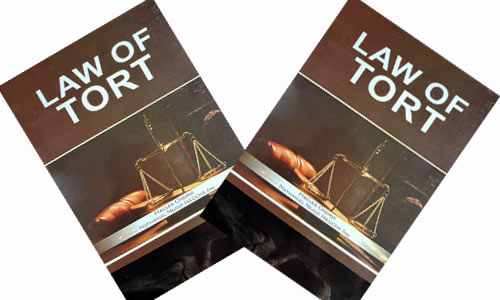 The book, titled The Law of Torts in Nigeria: A Functional Approach, authored by Professor Hagler Sunny Okorie Ph.D and Ikeocha, Nathaniel Ngozi Esq, offers law students, practitioners, and academics a comprehensive guide to understanding and applying tort law in Nigerian courts. Interested buyers can place orders via the following contact numbers: 08028636615, 08037667945, 08032253813, or +234 902 196 2209.
_______________________________________________________________________
The book, titled The Law of Torts in Nigeria: A Functional Approach, authored by Professor Hagler Sunny Okorie Ph.D and Ikeocha, Nathaniel Ngozi Esq, offers law students, practitioners, and academics a comprehensive guide to understanding and applying tort law in Nigerian courts. Interested buyers can place orders via the following contact numbers: 08028636615, 08037667945, 08032253813, or +234 902 196 2209.
_______________________________________________________________________
“Order Your Copy Now” — Basil Momodu, Esq. Unveils Second Edition Of His Book, "Civil Procedure In Nigeria"
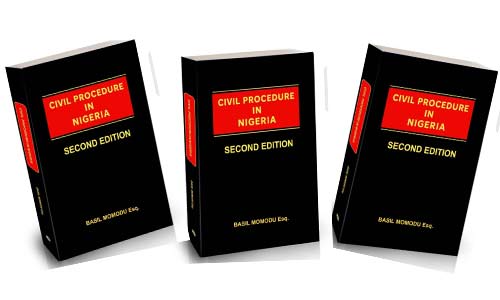 According to the learned author, Basil Momodu Esq. "Law review is a continuum. We will continue to track changes in the law to enrich future editions." Recommended Booksellers: Lagos: 08033855230, Abuja: 08035991379, and others.