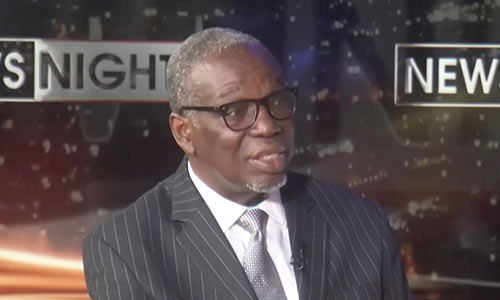
Oluwole Osaze-Uzzi, a prominent legal practitioner and former Independent National Electoral Commission (INEC) executive who served both as the Director of Legal Services and the Director of Voter Education and Publicity, has questioned the Youth Party’s public denial of involvement in the Federal High Court suit that led to the nullification of key aspects of INEC’s 2027 election timetable, stating that if the party’s legal adviser or chairman confirms the suit was filed without the party’s authority, the lawyer who instituted it committed professional misconduct.

Osaze-Uzzi made the remarks during an appearance on Channels Television’s News Night on Friday, where he provided a detailed and nuanced analysis of Justice M.G. Umar’s judgment, agreeing with the court’s ruling on candidate submission timelines but drawing a critical distinction on party primaries arguing that the Constitution and the Electoral Act are both silent on when parties must conduct their primaries, which means INEC may have had the discretion to set such timelines through its guidelines.
Osaze-Uzzi began by addressing a startling revelation that had emerged earlier in the programme that a representative of the Youth Party, identified as the party’s publicity secretary, had appeared and denied that the party filed the suit that produced the judgment.
The former INEC director explained that under Nigerian law, there is a legal assumption that when a lawyer files a court process stating that he represents a party, he has the authority of that party to do so.
“There’s an assumption when a lawyer files a process in court that ‘I represent XYZ.’ The assumption is that he has the authority of that person, body corporate, or an individual to represent that person,” Osaze-Uzzi stated.
He said the denial could only carry weight if it came from the party’s legal adviser or chairman the officials who, under most party constitutions, have the power and authority to brief lawyers on behalf of the party.
“Unless and until somebody with authority comes and says, speaking for himself, ‘He didn’t file this case on our behalf,’ then you get that and that’s professional misconduct on the part of the lawyer,” Osaze-Uzzi stated.
He noted that the person who appeared to deny the suit was identified as the party’s publicity secretary, not the legal adviser or chairman. “Most party constitutions give the power and authority to the legal adviser of the party to brief lawyers. So, possibly I don’t want to go into the merits of that but if it was the legal adviser saying so or the chairman of the party, then I would put more weight on what is said,” the former INEC director observed.
The implication of Osaze-Uzzi’s analysis is significant: if the Youth Party genuinely did not authorise the filing of the suit, the lawyer who filed it in the party’s name without authorisation may face disciplinary action for professional misconduct. However, if the denial is merely political distancing from a controversial judgment, the suit would remain validly filed as the party’s action.
On the substantive question of what the judgment means for INEC’s independence, Osaze-Uzzi rejected the suggestion which he noted some commentators had made that the ruling undermines the commission’s institutional independence.
“I don’t think it impugns in any way on the independence of the commission. I have seen some people take that position, but I don’t think it does, quite honestly,” Osaze-Uzzi stated.
He explained that INEC’s independence is primarily operational, but the commission is not independent of the law, the Constitution, or financial regulations.
“INEC is independent, especially operationally, but it’s not independent of law. It’s not independent of the Constitution. It’s not independent in terms of financial regulations, for example. Elections are rule-based, so we follow the rules,” the former director said.
Osaze-Uzzi laid out what he described as the hierarchy of laws governing Nigeria’s electoral process in clear terms.
At the apex is the Constitution, which is supreme. “If the Constitution has made a pronouncement about a specific thing, then nobody else no law, not the National Assembly, not INEC, nobody — can go contrary to what the Constitution has said, because the Constitution is supreme,” he stated.
Below the Constitution is the National Assembly, which exercises legislative powers donated to it by the Constitution. “As long as they don’t go contrary to what the Constitution says, then they’re in good stead,” Osaze-Uzzi explained.
Below the National Assembly is INEC, which has the power to make guidelines and regulations as empowered by the Constitution and the Electoral Act. “But as long as those guidelines do not conflict with the Electoral Act or with any act of the National Assembly or with the Constitution,” he cautioned.
“In the hierarchy of laws, it is the Constitution, the Electoral Act, and then the regulations, and of course case law,” Osaze-Uzzi summarised.
In what may be the most legally significant portion of his analysis, Osaze-Uzzi drew a sharp distinction between two issues that he argued the court and public commentators may have conflated: the timeline for submission of candidates’ lists, and the timeline for the conduct of party primaries.
On the submission of candidates’ lists, Osaze-Uzzi agreed with the court’s ruling. He noted that Section 29(1) of the Electoral Act 2026 is explicit: it speaks directly to political parties and says every political party intending to sponsor candidates shall submit their list “not later than 120 days” before the election.
“So, INEC cannot abridge that time. It’s donated by the Electoral Act. That’s why the court has said no, you cannot abridge it because that time has been set by the Electoral Act, by the National Assembly, elected members of the National Assembly. The commission cannot come now and do that,” Osaze-Uzzi stated.
However, on the conduct of party primaries, the former INEC director took a different view.
“The primaries are a different thing. The constitution and Electoral Act are silent about when you conduct your primaries. They’re silent. There is no provision during when time for conduct of primaries,” Osaze-Uzzi stated.
He explained that INEC set timelines for primaries precisely because of the 120-day deadline for candidate submission: “Because of the 120-day rule, they now said, ‘Okay, let us now set a time so that they can meet the 120-day deadline — so that not only just your primaries, but any appeals or resolution using your guidelines, any dispute that may arise, you must finish it within a certain time.’ I think that’s what the commission sought to do.”
Osaze-Uzzi articulated what he described as the argument in favour of INEC’s power to set primary timelines — an argument he suggested may have been insufficiently considered.
“Since there’s no time set for conduct of primaries in the Constitution and Electoral Act, then INEC, through the guidelines and regulations, ought to have the power to be able to do that, as long as it doesn’t break the 120-day rule set for submission of list of candidates,” the former director argued.
“They’re two different things time for conduct of primaries and time for submission of the list of candidates,” he emphasised.
The distinction is legally important. If Osaze-Uzzi is correct that the Constitution and Electoral Act are silent on when primaries must be conducted as opposed to when candidate lists must be submitted then INEC’s power to fill that legislative gap through its regulatory authority becomes a live question that the court may not have fully addressed. The court’s judgment appears to have treated both issues as part of the same statutory framework, while Osaze-Uzzi argues they are distinct legal questions with different answers.
Osaze-Uzzi urged caution among those reacting to the judgment, noting that most commentators had not actually read the full decision.
“Most people who have been commenting have not read the judgment. They’ve not read the affidavits, the evidence. Unless and until you do that, you should qualify and put a rider in everything that you say. But people are reading the bullet points and then running to town with it. So, we have to be very, very careful,” the former INEC director warned.
Asked what advice he would give INEC in the wake of the judgment, Osaze-Uzzi outlined a methodical approach.
First, the commission should sit down with the full judgment and its team of competent internal and retained lawyers. Second, it should examine the Constitution and identify which powers have been granted to the commission. Third, it should tabulate and list those powers alongside the applicable timelines. Fourth, it should ensure that everything in its timetable is aligned with those constitutional and statutory provisions.
“Look at the judgment. Look at the Constitution. The Constitution says which parts has it given us. Tabulate those things. List them. Say these are the parts that have been given. What can I do? What are the timelines? These are the timelines given. I must ensure that everything is aligned with those timelines,” Osaze-Uzzi advised.
The former INEC director pointedly noted that consultation with political parties was “so, so critical” and suggested it may have been insufficient in this case.
“If, for example, they had sat down with the parties and said, ‘Look and that’s what used to happen this is the new act, let us familiarise ourselves with the thing, and this is what we propose to do.’ And put it before them. ‘This is what we intend to do. This is the section that gives us power to do this.’ Then I think, get their buy-in. It’s modern policy formulation,” Osaze-Uzzi stated.
The implication is that had INEC engaged in more robust consultation before issuing its timetable, the parties’ concerns could have been addressed at the administrative level rather than through litigation and the commission might have avoided issuing guidelines that a court subsequently found to be inconsistent with the Electoral Act.
In a remark directed at the National Assembly rather than INEC, Osaze-Uzzi accused the lawmakers of doing the commission a “disservice” through provisions in the Electoral Act 2026 that compressed the commission’s operational timelines.
He cited the example of fund access, noting that the previous Electoral Act (2022) required that election budgets be appropriated and released within 360 days one year before the election. The new Act shortened this timeline, putting INEC in what Osaze-Uzzi described as a difficult position.
“The National Assembly did a disservice to INEC, honestly. In several ways. For example, it’s shortening the timelines of, for example, access to funds. The old act, 2022 act, said access to funds, funds must be released, budget appropriated and released within 360 days, one year before the election. Now you’ve reduced that. So yes, in that sense, it’s putting INEC in a very, very tight commission in a tight rope in many regards,” the former director stated.
The observation adds an important dimension to the debate that has been largely absent from public commentary: INEC’s decision to compress its timetable may not have been motivated solely by a desire to control the political process, but may also have been driven by the practical reality of operating within shorter financial and logistical timelines imposed by the very same National Assembly whose Electoral Act the court ruled INEC could not abridge.
Osaze-Uzzi’s analysis, coming from a former senior INEC official with intimate knowledge of the commission’s internal processes and legal framework, carries significant weight. His distinction between candidate submission timelines (where he agrees INEC overstepped) and primary election timelines (where he argues INEC may have had legitimate regulatory authority) provides a potential basis for INEC to challenge at least portions of the judgment on appeal.
His warning about the Youth Party’s denial of filing the suit also introduces a potentially destabilising element: if the party formally confirms that the suit was filed without its authorisation, questions about the standing and validity of the entire proceeding could arise though the judgment would remain binding unless set aside by a higher court.
INEC has reportedly stated that it is studying and reviewing the judgment before deciding on its next course of action. The commission has not indicated whether it will appeal.
[A MUST HAVE] Evidence Act Demystified With Recent And Contemporary Cases And Materials

Available now for NGN 40,000 at ASC Publications, 10, Boyle Street, Onikan, Lagos. Beside High Court, TBS. Email publications@ayindesanni.com or WhatsApp +2347056667384. Purchase Link: https://paystack.com/buy/evidence-act-complete-annotation
______________________________________________________________________ “Enhance Legal Practice With Authoritative Reports” — Alexander Payne Offers Comprehensive Law Reports, Spanning Over A Century Of Nigerian Jurisprudence Interested buyers are encouraged to place their orders and enquiries via:
0704 444 4777, 0704 444 4999, 0818 199 9888
Website: www.alexandernigeria.com
Interested buyers are encouraged to place their orders and enquiries via:
0704 444 4777, 0704 444 4999, 0818 199 9888
Website: www.alexandernigeria.com