*Warns Against Politically Motivated Persecution


The Supreme Council for Shari’ah in Nigeria has raised fresh concerns over the continued detention and prosecution of former Kaduna State Governor, Nasir El-Rufai, insisting that his constitutional rights, including the presumption of innocence, must be respected while the cases against him are determined by the courts.
El-Rufai is currently facing separate criminal proceedings arising from allegations linked to his tenure as governor and another matter involving the alleged unlawful recording of telephone conversations.
In one of the cases, the Independent Corrupt Practices and Other Related Offences Commission is prosecuting the former governor on an amended nine-count charge bordering on alleged abuse of office, fraud, irregular award and execution of public contracts, money laundering, conferring undue advantage and unlawful handling of public funds during his tenure as Kaduna State governor.
He is also facing a separate five-count amended charge instituted by the State Security Service over allegations relating to the unlawful recording of telephone conversations reportedly linked to the National Security Adviser, Nuhu Ribadu.
The allegations remain subject to determination by the courts, and El-Rufai is presumed innocent unless and until found guilty.
Reacting to the development, the Supreme Council for Shari’ah in Nigeria, in a statement signed by its Secretary-General, Nafiu Baba Ahmad, said El-Rufai, like every other Nigerian, was entitled to the protection of his fundamental rights and the presumption of innocence.
The Council stressed that strict adherence to the rule of law remained fundamental to Nigeria’s constitutional democracy and must apply equally to every citizen regardless of political affiliation, social standing or personal disposition.
It said the circumstances surrounding El-Rufai’s continued detention had raised questions about whether established legal procedures and constitutional safeguards were being fully observed.
“As an organization committed to justice, fairness, and the rule of law, the Supreme Council for Shariah in Nigeria believes that Nigeria operates under a constitutional democracy where the rights and liberties of all citizens must be respected, irrespective of status, political affiliation, or personal disposition,” the statement said.
According to the Council, the principles of due process, fair hearing and lawful detention are not privileges that authorities may choose whether or not to observe, but essential components of the justice system.
“The principles of due process, fair hearing, and lawful detention are not optional, but fundamental pillars of justice that must be upheld at all times,” it stated.
The Shari’ah Council, however, made clear that its intervention should not be interpreted as condoning criminality or seeking immunity for the former governor.
It said allegations of wrongdoing should be investigated and prosecuted where supported by evidence, but warned that the process adopted by state institutions must itself comply with the Constitution and existing laws.
“The Council therefore wishes to state unequivocally that it does not, under any circumstances, support or condone criminality in any form by anyone. However, the pursuit of justice must itself be just,” the statement said.
It warned that actions perceived as arbitrary, politically motivated or inconsistent with the rule of law could undermine public confidence in state institutions and weaken democratic governance.
The Council consequently called on all relevant authorities handling El-Rufai’s cases to act strictly within the confines of the Constitution and other applicable laws and to ensure that due process is observed at every stage.
It also urged the authorities to avoid actions capable of being perceived as politically motivated persecution and instead demonstrate fairness, transparency and impartiality in the handling of the cases.
“Actions perceived as arbitrary, politically motivated, or inconsistent with the rule of law risk undermining public confidence in state institutions and eroding the very fabric of democratic governance,” the Council said.
It added: “Accordingly, the Council calls on the relevant authorities to act strictly within the confines of the Constitution and all extant laws by ensuring that due process is followed at every stage.”
The Council further warned that Nigeria’s unity and long-term stability depended substantially on the credibility of public institutions and the confidence citizens had in their ability to dispense justice fairly.
“Nigeria’s unity and long-term stability are inextricably tied to the credibility of its institutions and the trust reposed in them by the citizenry. Justice must not only be done but must be manifestly seen to be done,” it stated.
According to the organisation, the consistent, impartial and lawful application of justice remains one of the strongest safeguards for national cohesion, democratic stability and sustainable development.
The Council reiterated its commitment to defending justice and the rights of all Nigerians while promoting peaceful coexistence across the country.
It also called on all stakeholders involved in the matter to exercise restraint, act responsibly and ensure that their actions remained within the limits of the law.
The Shari’ah Council’s intervention adds to the continuing public debate surrounding El-Rufai’s detention and prosecution, even as the substantive allegations against the former governor remain matters for judicial determination.
“Order Justice Omolaye-Ajileye’s Electronic Evidence Books Now” — Essential Guides On Evidence Act, Case Law And Digital Proof
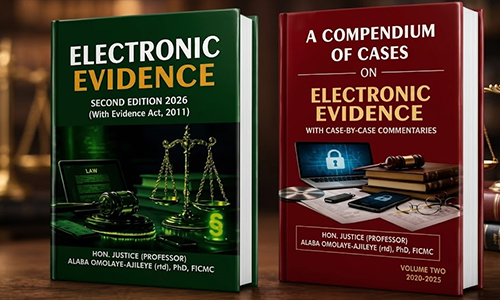
[A MUST HAVE] Evidence Act Demystified With Recent And Contemporary Cases And Materials

Available now for NGN 40,000 at ASC Publications, 10, Boyle Street, Onikan, Lagos. Beside High Court, TBS. Email publications@ayindesanni.com or WhatsApp +2347056667384. Purchase Link: https://paystack.com/buy/evidence-act-complete-annotation
______________________________________________________________________ “Enhance Legal Practice With Authoritative Reports” — Alexander Payne Offers Comprehensive Law Reports, Spanning Over A Century Of Nigerian Jurisprudence Interested buyers are encouraged to place their orders and enquiries via:
0704 444 4777, 0704 444 4999, 0818 199 9888
Website: www.alexandernigeria.com
Interested buyers are encouraged to place their orders and enquiries via:
0704 444 4777, 0704 444 4999, 0818 199 9888
Website: www.alexandernigeria.com
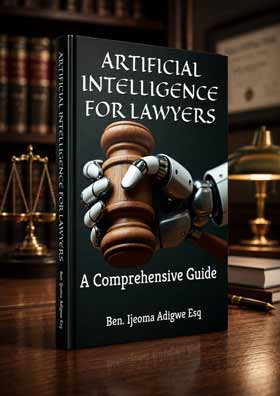 The book also examines Nigeria's legal ecosystem, focusing on the LPELR and NBA AI Guidelines. As a bonus, every purchase comes with a FREE eBook titled: How to Use the AI Features in LegalPedia and LawPavilion.
Ohio Books Ltd praises the publication, stating:
"....this is the only Nigerian book I know of on the topic."
How to Order:
📞 Call, Text, or WhatsApp: 08034917063 | 07055285878
📧 Email: benadigwe1@gmail.com
🌎 Website: www.benadigwe.com
Ebook Version: Access it directly online at https://selar.com/prv626
Authored by Ben Ijeoma Adigwe Esq., ACIarb (UK), LL.M, Dip. in Artificial Intelligence, Director at the Delta State Ministry of Justice, Asaba, Nigeria.
______________________________________________________________________
The book also examines Nigeria's legal ecosystem, focusing on the LPELR and NBA AI Guidelines. As a bonus, every purchase comes with a FREE eBook titled: How to Use the AI Features in LegalPedia and LawPavilion.
Ohio Books Ltd praises the publication, stating:
"....this is the only Nigerian book I know of on the topic."
How to Order:
📞 Call, Text, or WhatsApp: 08034917063 | 07055285878
📧 Email: benadigwe1@gmail.com
🌎 Website: www.benadigwe.com
Ebook Version: Access it directly online at https://selar.com/prv626
Authored by Ben Ijeoma Adigwe Esq., ACIarb (UK), LL.M, Dip. in Artificial Intelligence, Director at the Delta State Ministry of Justice, Asaba, Nigeria.
______________________________________________________________________