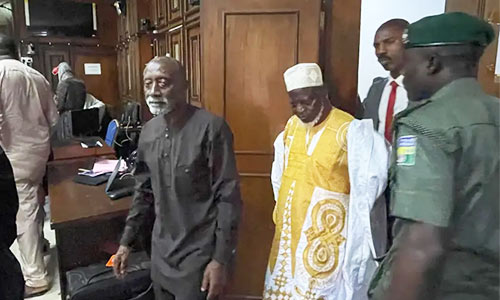
Sheikh Abdulkadir, the sixth defendant in the trial of alleged coup plotters has told investigators in a video evidence that he warned others that the plan would fail and that they would eventually be exposed.

The video was played by the prosecution during the continuation of trial proceedings, at the Abuja division of the Federal High Court.
In the recording previewed before the court, Abdulkadir, who described himself as an Islamic cleric, said he knew the alleged ringleader, one Colonel Maaji for less than a year and was approached through a man identified as Sanda for prayers concerning the alleged coup plot.
In his confessional statement, Sheikh said Sanda informed him that his “oga” intended to stage a coup and needed spiritual prayers and divination regarding its success.
Abdulkadir told investigators that after conducting prayers, he informed them the operation would fail and that two persons would eventually betray those involved.
He said a message was later relayed back to him through Sanda requesting further prayers so that the two individuals would not betray the group.
The defendant further stated that money was subsequently sent to him for prayers and charity, while names of individuals allegedly involved in the plot were also forwarded to him for inclusion in the prayers.
He said shortly after the prayers commenced, Sanda informed him that Colonel Maaji had not been seen for four days, adding that he later learnt through media reports that arrests had been made over an alleged coup plot.
In the video, Abdulkadir maintained that the funds transferred to him were not payments for supporting a coup but were meant for prayers.
He also told investigators that he never reported the alleged plot because he did not know who to report to, despite admitting that he understood a coup to mean a military overthrow of government.
The defendant narrated that he was eventually arrested after visiting the Economic and Financial Crimes Commission, EFCC, over restrictions placed on his bank account.
According to him, he had gone to withdraw from the money transferred to him when he discovered that the account had been flagged.
He said after contacting an EFCC deputy director, he was invited to the commission’s office where he explained that the money was meant for prayers.
Abdulkadir insisted in the recording that he did not make any statement relating to a coup while in EFCC custody.
Before the video ended, the defendant also stated that nobody assaulted or tortured him and that his statements were made voluntarily.
Following the playback, the prosecution sought to tender the extra-judicial statements allegedly made by the first to fifth defendants before a Special Investigation Panel and military police authorities, as well as the sixth defendant’s statement made before military police investigators.
However, counsel to all six defendants separately objected to the admissibility of the statements and accompanying video recordings.
Lawyers to the defendants argued that the statements were either not voluntarily made or were obtained in violation of provisions of the Administration of Criminal Justice Act, ACJA.
Counsel to the first defendant argued that the written statement sought to be tendered did not correspond with what was shown in the video evidence regarding voluntariness.
The second defendant’s lawyer contended that his client was neither informed of his right to legal representation nor provided access to counsel before the statement was recorded, adding that the video shown in court was not a recording of the making of the written statement sought to be tendered.
The third defendant equally challenged the admissibility of the statement, arguing that the contents of the video differed from the written extra-judicial statement.
Counsel to the fourth defendant argued that the video and statement contravened Sections 15 and 17 of the ACJA, which provide for the presence of legal representation during statement-taking.
He further alleged that his client was coerced into making the statement and argued that the recording failed to show whether the defendant’s legs were free at the time the video was made.
The fifth defendant’s lawyer also opposed the admissibility of the statements on grounds of alleged inducement, torture and non-compliance with provisions of the ACJA and the Evidence Act.
He further argued that since there were multiple defendants in the matter, the court ought to conduct separate trial-within-trial proceedings for each disputed statement rather than a joint exercise.
Counsel to the sixth defendant similarly objected to the admissibility of both the written and video statements credited to Abdulkadir, insisting they were obtained through inducement and were not voluntarily made.
Responding, the prosecution urged the court to reject the defence arguments and order a single trial-within-trial proceeding for all the disputed statements.
The prosecution argued that the law did not require separate proceedings for each defendant and maintained that the trial judge retained discretion over how evidence is received.
In a ruling, Justice Joyce Abdulmalik ordered a joint trial-within-trial to determine the voluntariness and admissibility of both the written and video statements of all six defendants.
The matter was subsequently adjourned until May 12 at 12 noon for continuation of proceedings.
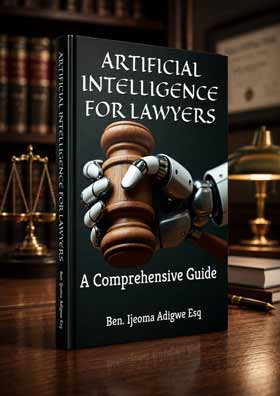 The book also examines Nigeria's legal ecosystem, focusing on the LPELR and NBA AI Guidelines. As a bonus, every purchase comes with a FREE eBook titled: How to Use the AI Features in LegalPedia and LawPavilion.
Ohio Books Ltd praises the publication, stating:
"....this is the only Nigerian book I know of on the topic."
How to Order:
📞 Call, Text, or WhatsApp: 08034917063 | 07055285878
📧 Email: benadigwe1@gmail.com
🌎 Website: www.benadigwe.com
Ebook Version: Access it directly online at https://selar.com/prv626
Authored by Ben Ijeoma Adigwe Esq., ACIarb (UK), LL.M, Dip. in Artificial Intelligence, Director at the Delta State Ministry of Justice, Asaba, Nigeria.
_______________________________________________________________________
“Enhance Legal Practice With Authoritative Reports” — Alexander Payne Offers Comprehensive Law Reports, Spanning Over A Century Of Nigerian Jurisprudence
The book also examines Nigeria's legal ecosystem, focusing on the LPELR and NBA AI Guidelines. As a bonus, every purchase comes with a FREE eBook titled: How to Use the AI Features in LegalPedia and LawPavilion.
Ohio Books Ltd praises the publication, stating:
"....this is the only Nigerian book I know of on the topic."
How to Order:
📞 Call, Text, or WhatsApp: 08034917063 | 07055285878
📧 Email: benadigwe1@gmail.com
🌎 Website: www.benadigwe.com
Ebook Version: Access it directly online at https://selar.com/prv626
Authored by Ben Ijeoma Adigwe Esq., ACIarb (UK), LL.M, Dip. in Artificial Intelligence, Director at the Delta State Ministry of Justice, Asaba, Nigeria.
_______________________________________________________________________
“Enhance Legal Practice With Authoritative Reports” — Alexander Payne Offers Comprehensive Law Reports, Spanning Over A Century Of Nigerian Jurisprudence
 Interested buyers are encouraged to place their orders and enquiries via:
0704 444 4777, 0704 444 4999, 0818 199 9888
Website: www.alexandernigeria.com
Interested buyers are encouraged to place their orders and enquiries via:
0704 444 4777, 0704 444 4999, 0818 199 9888
Website: www.alexandernigeria.com