The Federal Government on Wednesday banned recipients of honorary degrees from prefixing “Dr” to their names in official, academic, or professional usage.
It declared that the use of the title by such recipients constitutes a misrepresentation of academic credentials, which will henceforth be treated as academic fraud, with attendant legal and reputational consequences.
The Minister of Education, Tunji Alausa, disclosed this on Wednesday at the Presidential Villa, Abuja, while briefing State House correspondents on two Federal Executive Council approvals that had not been announced at the last cabinet meeting, which held on April 30.
Alausa, who appeared alongside the Minister of State for Education, Prof Suwaiba Ahmad, said the FEC approved a uniform policy for the award and use of honorary degrees by Nigerian universities.
The policy, he explained, is designed to end what he described as decades of indiscriminate conferral of degrees for political patronage and financial gain, and to restore public confidence in the integrity of academic titles.
He said, “The recent trend we’ve seen with the award of honorary degrees has revealed a growing abuse and politicisation of this academic privilege.
“We’ve seen awards being used for political patronage, for financial gain, as well as the conferral of awards on serving public officials, which, as part of the ethics of honorary degree awards, should not happen.”
Under the new policy, recipients of honorary degrees may no longer put “Dr” before their names.
Instead, they must cite the full honorary designation after their name.
Giving examples, Alausa explained, “For instance, you can use Chief Louis Clark, D.Lit. (Doctor of Literature, Honoris Causa)” or “Mrs Miriam Adamu, LL.D. Hons.”
Alausa said this format clearly reflects the honorary rather than earned academic nature of the award.
“Recipients shall not prefix doctor to their names in official, academic or professional usage,” the minister said, adding, “Misrepresentation of honorary degrees as earned academic credentials shall be considered academic fraud and subject to legal and reputational consequences.”
The policy also restricts the types of honorary degrees Nigerian universities can confer to four: Doctor of Laws (LL.D), Doctor of Letters (D.Lit), Doctor of Science (D.Sc), and Doctor of Humanities (D.Arts).
It further bars universities without active PhD-awarding programmes from conferring honorary degrees at all.
Alausa said the restriction was aimed at addressing the proliferation of newer institutions that have been awarding honorary doctorates despite being less than five years old and lacking postgraduate research programmes.
The minister noted that all honorary degrees must carry the words “honorary” or “Honoris Causa” on the award certificate and in all references.
For over a decade, concerns over the commercialisation and politicisation of honorary degrees have been raised in Nigeria’s academic community, with universities often accused of awarding the degrees to wealthy donors and public officials in exchange for financial patronage rather than merit.
In 2012, the Association of Vice-Chancellors of Nigerian Universities attempted to address the challenge in what became known as the Keffi Declaration.
The declaration outlined guiding principles for the award of honorary degrees. However, it had no legal or executive backing and was therefore largely ignored, Alausa said on Wednesday.
He explained, “The association doesn’t have any legal backing to enforce anything.
“That is why we brought this to the Federal Executive Council, which now gives it legal and executive backing.”
The minister said the Federal Ministry of Education and the National Universities Commission (NUC) will issue a circular to all vice-chancellors, registrars, and governing councils in this regard.
He also noted that convocation programmes will be monitored for compliance with the policy, and the government will collaborate with the media to discourage improper attribution of academic titles to honorary recipients.
The ministry will also publish annually a list of legitimate honorary degree recipients to protect the integrity of earned academic qualifications, Alausa said.
He noted that the NUC has the statutory power to enforce the policy.
 Interested buyers are encouraged to place their orders and enquiries via:
0704 444 4777, 0704 444 4999, 0818 199 9888
Website: www.alexandernigeria.com
Interested buyers are encouraged to place their orders and enquiries via:
0704 444 4777, 0704 444 4999, 0818 199 9888
Website: www.alexandernigeria.com

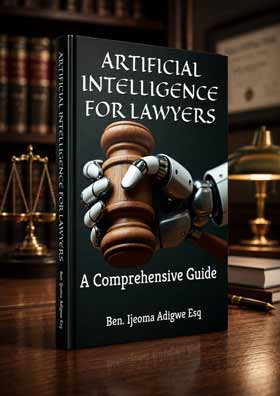 The book also examines Nigeria's legal ecosystem, focusing on the LPELR and NBA AI Guidelines. As a bonus, every purchase comes with a FREE eBook titled: How to Use the AI Features in LegalPedia and LawPavilion.
Ohio Books Ltd praises the publication, stating:
"....this is the only Nigerian book I know of on the topic."
How to Order:
📞 Call, Text, or WhatsApp: 08034917063 | 07055285878
📧 Email: benadigwe1@gmail.com
🌎 Website: www.benadigwe.com
Ebook Version: Access it directly online at https://selar.com/prv626
Authored by Ben Ijeoma Adigwe Esq., ACIarb (UK), LL.M, Dip. in Artificial Intelligence, Director at the Delta State Ministry of Justice, Asaba, Nigeria.
_______________________________________________________________________
The book also examines Nigeria's legal ecosystem, focusing on the LPELR and NBA AI Guidelines. As a bonus, every purchase comes with a FREE eBook titled: How to Use the AI Features in LegalPedia and LawPavilion.
Ohio Books Ltd praises the publication, stating:
"....this is the only Nigerian book I know of on the topic."
How to Order:
📞 Call, Text, or WhatsApp: 08034917063 | 07055285878
📧 Email: benadigwe1@gmail.com
🌎 Website: www.benadigwe.com
Ebook Version: Access it directly online at https://selar.com/prv626
Authored by Ben Ijeoma Adigwe Esq., ACIarb (UK), LL.M, Dip. in Artificial Intelligence, Director at the Delta State Ministry of Justice, Asaba, Nigeria.
_______________________________________________________________________