By Oliver Azi


Introduction
There are cases that arrive at the Supreme Court carrying one question on their face but hiding a far more important one underneath. Mai-Jega v. Haruna is precisely such a case. Few months back the Supreme Court was bothered with a big question, not the conventional one; what does it mean to be learned in Islamic personal law? The Coram of the court led by Mohammed Lawal Garba, J.S.C. delivered a landmark judgment that has (and will) shaped our constitutional and judicial jurisprudence. On the surface, it was an inheritance dispute between brothers over a piece of farmland left behind by their deceased father. Underneath, it was a direct constitutional challenge to the legitimacy of Nigeria’s Court of Appeal when it sits to hear appeals from Sharia Courts and specifically questioned; Who qualifies to sit on such a panel? Whether being a woman or a Christian automatically renders a judge unfit?
These are not abstract, idealistic or academic questions. They go to the heart of how Nigeria has chosen to govern itself as a multi-religious, pluralist constitutional democracy while simultaneously accommodating Islamic personal law within its formal court structure. The Supreme Court’s answers, delivered unanimously on 7th March 2025, are authoritative, carefully reasoned, and deserve to be studied in full, hence, the need for this review.
Facts of the Case:
The late Alhaji Haruna III, Sarkin Kabi Jega who was a traditional ruler in the Jega Emirate of Kebbi State died in 2006, leaving behind four (4) wives, twenty-five (25) male children, and thirteen (13) female children. Among the assets of his large estate was a piece of farmland situated along the bank of a lake, known as a Fadama farm, which had been in the possession of his son, the Appellant, Alhaji Haruna Haruna Mai-Jega.
The Appellant’s defence was straightforward: the farmland was not part of the estate. He claimed his father had gifted it to him personally in 1983, more than two decades before the father’s death, and that this gift, known in Islamic jurisprudence as Hibah inter vivos (a gift made during one’s lifetime) had transferred ownership to him exclusively. He named his three stepmothers as witnesses to the gift and urged the court to summon them.
The stepmothers appeared. They testified. And every single one of them said they had no knowledge of any such gift. With his own witnesses against him, the Appellant tendered a document, Exhibit ‘A’, to support his claim, but the document was unsigned, did not identify the specific farmland, and did not name the person to whom the gift was allegedly made. It was vague, uncorroborated, and of little evidential use.
The trial court dismissed the Appellant’s claim on 22nd November 2016, declared the farmland part of the estate, and ordered it distributed to all the heirs. The Appellant appealed to the Sharia Court of Appeal, Kebbi State, which reversed the trial court and upheld the gift in his favour. The Respondents appealed further to the Court of Appeal, Sokoto Division, which on 7th October 2018 set aside the Sharia Court of Appeal’s decision and restored the trial court’s ruling. The Appellant then appealed to the Supreme Court on three grounds, filing his notice of appeal on 15th February 2019. And it was at the Supreme Court that the case transformed entirely.
The Issues for Determination
The Appellant raised three issues for the Supreme Court’s determination, but for particularity and focus, one will be reproduced here:
Whether, having regard to the clear and unambiguous provisions of Section 247(a) of the 1999 Constitution (as amended) and Section 9(a) of the Court of Appeal Act, 2010, the Court of Appeal was duly constituted when it heard and determined the appeal from the Sharia Court of Appeal.
The Central Constitutional Question: Section 247 And the Composition of the Court of Appeal
This is the beating heart of the case and the issue that gives it its lasting constitutional importance. The Appellant’s counsel, arguing Issue 1, submitted that two members of the Court of Appeal panel that determined the appeal were constitutionally unqualified to sit. The two justices challenged were: Hon. Justice Fredrick O. Oho, J.C.A., on the ground that he being a Christian and therefore not learned in Islamic personal law; and Hon. Justice Amina A. Wambai, J.C.A., who is alleged to be disqualified by virtue of her female gender, based on the principles of Islamic law which hold that a judge must be male.
The Counsel for the Appellant anchored this argument in classical Islamic legal authorities and reference was made to Asalul Madari, Vol. 3, p. 196, which states: “It is a condition precedent that a judge should be a man not a female.” In furthering their arguments, counsel for the appellants relied on on Tuhfa (Ihkamul Ahkam) — Babu Qadai Wamatuammalu Bihi, p.10, which states that: “A judge must be a man not female, son not servant.”
And from Qawa Ninul Fiqhiyy, p.228, the classical author states categorically that the necessary conditions of being a judge under Islamic law include: He must be Muslim; He must be sane, and He must be male.
On the strength of these authorities, counsel submitted that having sat in clear disregard of Section 247(a) of the 1999 Constitution (as altered), the entire proceedings before the Court of Appeal were rendered null and void. The argument was intellectually structured and had the appearance of strength. It drew from genuine classical Islamic scholarship and framed itself in constitutional language. It deserved and received a serious response.
WHAT SECTION 247(1)(a) ACTUALLY SAYS
The Supreme Court, per Tukur, J.S.C. delivering the leading judgment, went directly to the text of the Constitution. Section 247(1) of the 1999 Constitution (as amended) provides:
“For the purpose of exercising any jurisdiction conferred upon it by this Constitution or any other law, the Court of Appeal shall be duly constituted if it consists of not less than three Justices of the Court of Appeal and in the case of appeals from (a) A Sharia Court of Appeal, if it consists of not less than three Justices of the Court of Appeal learned in Islamic personal law.”
The court read this provision carefully and identified precisely one constitutional requirement: that for appeals from a Sharia Court of Appeal, the Court of Appeal must consist of not less than three Justices who are learned in Islamic personal law. That is what the law says and it’s the entire requirement. The Constitution says nothing, not a single word about the gender of those justices. It says nothing about their religion. It does not say they must be Muslim; it does not say they must be male. It only imposes exactly one qualification, and one qualification only: learning in Islamic personal law.
His Lordship Tukur, J.S.C. was emphatic:
“The key requirement under the Constitution is that not less than three of the Justices who are called upon to sit must be learned in Islamic Personal Law. That is the only condition placed by the Constitution. Nothing is said of the religion or gender of the Justices that are to sit on appeal from the Sharia Court of Appeal in respect of Islamic Personal Law.”
The consequence of this finding was fatal to the Appellant’s first argument. The contention that the two named Justices were not qualified remained, as the court held, a mere conjecture in the realm of speculation, presumably on account of their religion and gender respectively, since there was nothing before the Supreme Court to show that the named Justices did not possess the required qualification to sit as they did over the appeal from the Sharia Court of Appeal.
The Question the Constitution Left Open
Here is where the case opens into territory that even the Supreme Court acknowledged is not fully resolved, and identifies as the most intellectually rich aspect of this judgment. The Constitution uses the phrase “learned in Islamic personal law” without defining it. This is a significant gap. What does it mean to be “learned” in Islamic personal law? Does it require a formal academic degree, a Bachelor of Laws degree with specialization in Islamic law, or a Bachelor of Islamic Law? Is it sufficient that a justice has decided cases involving Islamic personal law over many years of judicial service? Does exposure to Sharia court proceedings during one’s career as a lawyer or judge constitute “learning”? The Constitution gives no answer.
This gap matters enormously in practice. If the threshold is interpreted strictly as a formal academic qualification, such as a degree in Islamic personal law, then many sitting justices of the Court of Appeal, who routinely hear Sharia appeals, could find themselves technically disqualified. However, if the requirement is understood more broadly to include any demonstrable knowledge of Islamic personal law, whether gained through academic study, legal practice, or judicial experience then the scope expands significantly. In that case, challenging the competence of any individual justice becomes extremely difficult to sustain without clear and specific evidence.
The Supreme Court in this case implicitly adopted the broader interpretation. When the Appellant alleged that Justice Oho was not learned in Islamic personal law, the court’s response was that this allegation was mere speculation because no evidence was brought to demonstrate the lack of qualification. The burden of proof lay on the Appellant to show that Justice Oho did not possess the required learning, and he failed to discharge that burden. This tells us that the court views the question of “learning” as a matter of fact, provable by evidence and not a matter of presumption arising from one’s religion or gender.
The practical implication is striking: a Christian justice who has studied Islamic personal law; whether through formal academic training, years of legal practice in courts that apply Islamic law, or extensive judicial experience in that area is constitutionally qualified to sit on a Sharia appeal panel. Their Christianity is legally irrelevant. What matters is whether they possess the knowledge. And unless someone places evidence before a court that they do not, the presumption is that they do, particularly if they have been appointed and assigned to sit on such a panel by the appropriate judicial authority. This is a fundamentally important principle that the Nigerian legal system should take seriously. It means qualification is knowledge-based, not identity-based and the Bench is defined by competence, not creed.
The Decision of the Court
While the Supreme Court resolved the immediate dispute clearly and correctly by applying the existing constitutional text, Tukur, J.S.C. went out of his way to acknowledge something important: there is a lacuna, a gap, in the Constitution.
The court stated:
“Regrettably, that is the state of things as per the provisions of the Constitution. This lacuna can only be filled by an amendment of the relevant provisions of the Constitution by inserting where necessary the provision that the ‘Justices learned in Islamic Personal Law must also be male Muslim Justices’ to bring same in line with the principles of Islamic Law, and that can only be done by the legislature not the Court, because to import such requirements into the provision, by the court, would be to legislate from the bench, something the judiciary must never do.”
This passage is remarkable for several reasons. First, the use of the word “regrettably” is a judicial signal, it tells us the court was not entirely comfortable with the outcome, even as it correctly applied the law. The court was effectively saying: we see the tension between Islamic jurisprudential tradition and constitutional text, we acknowledge it is real, and we recognize it creates an imperfect situation but our job is to apply the Constitution as it is, not as we or classical Islamic scholarship might wish it to be.
Second, the court was performing its proper constitutional role by identifying the gap and pointing the legislature toward it. This is what courts should do when they encounter constitutional deficiencies, they apply the existing text, identify the problem, and leave the remedy to the branch of government entrusted with law-making. The Supreme Court would rather not legislate from the bench. The Supreme Court cannot amend the Constitution. Only the National Assembly, through the process prescribed in Section 9 of the 1999 Constitution, can do that.
Third, and most profoundly, this passage invites a national conversation: should Section 247 be amended to require that justices sitting on Sharia appeal panels must be male Muslims, in alignment with classical Islamic jurisprudence? That is a question of constitutional policy that belongs to the Nigerian people and their elected representatives. The Supreme Court has done its part. The ball is now in the legislature’s court.
THE FINAL DECISION
The Supreme Court was unanimous in its verdict. The appeal lacked merit and was accordingly dismissed, with the judgment of the Court of Appeal delivered on 7th December 2018 which affirmed its entirety. The farmland, having failed to be established as a personal gift, remained what the Respondents always insisted it was, part of the estate of the late Alhaji Haruna III, Sarkin Kabi Jega, subject to distribution among his rightful heirs in accordance with Islamic inheritance law. Each party was ordered to bear their own costs.
Oliver Azi recently passed the 2025 Bar Final Examinations and will be called to the Nigerian Bar in 2026. He lives in Abuja and can be reached at: oliverazi20@gmail.com or varexlaw@gmail.com
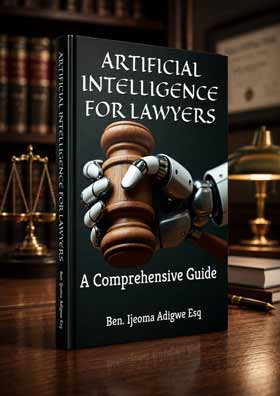 As an added bonus, every purchase comes with a FREE ebook titled: “How to use the AI in Legalpedia and Law Pavilion.”
Ohio Books Ltd praises the publication, stating:
"....this is the only Nigerian book I know of on the topic."
How to Order:
📞 Call, Text, or WhatsApp: 08034917063 | 07055285878
📧 Email: benadigwe1@gmail.com
🌎 Website: www.benadigwe.com
Ebook Version: Access it directly online at https://selar.com/prv626
Authored by Ben Ijeoma Adigwe Esq., ACiarb (UK), LL.M, Dip. in Artificial Intelligence, Director at the Delta State Ministry of Justice, Asaba, Nigeria.
_______________________________________________________________________
As an added bonus, every purchase comes with a FREE ebook titled: “How to use the AI in Legalpedia and Law Pavilion.”
Ohio Books Ltd praises the publication, stating:
"....this is the only Nigerian book I know of on the topic."
How to Order:
📞 Call, Text, or WhatsApp: 08034917063 | 07055285878
📧 Email: benadigwe1@gmail.com
🌎 Website: www.benadigwe.com
Ebook Version: Access it directly online at https://selar.com/prv626
Authored by Ben Ijeoma Adigwe Esq., ACiarb (UK), LL.M, Dip. in Artificial Intelligence, Director at the Delta State Ministry of Justice, Asaba, Nigeria.
_______________________________________________________________________
“Order Justice Omolaye-Ajileye’s Electronic Evidence Books Now” — Essential Guides On Evidence Act, Case Law And Digital Proof
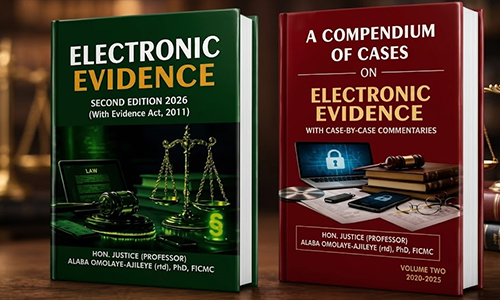
 Interested buyers are encouraged to place their orders and enquiries via:
0704 444 4777, 0704 444 4999, 0818 199 9888
Website: www.alexandernigeria.com
Interested buyers are encouraged to place their orders and enquiries via:
0704 444 4777, 0704 444 4999, 0818 199 9888
Website: www.alexandernigeria.com

 LAWBREED — Equipping You For Greater Success!
_______________________________________________________________________
LAWBREED — Equipping You For Greater Success!
_______________________________________________________________________