*Urges Military To Withdraw Robing Requirement For Trial Of 36 Accused Coup Plotters

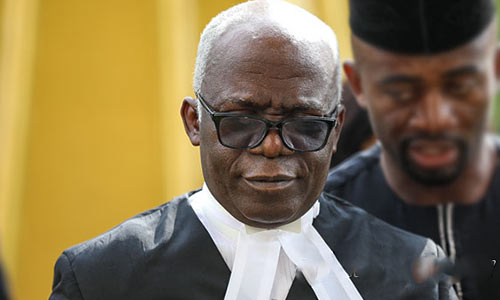
Senior Advocate of Nigeria Femi Falana has warned that defence counsel and military prosecutors who wear legal robes before the General Court-Martial convened to try 36 military officers accused of plotting to overthrow President Bola Tinubu risk being dragged before the Legal Practitioners Disciplinary Committee for professional misconduct, arguing that the military’s dress code directive is “completely at variance” with the Rules of Professional Conduct for Legal Practitioners 2023.
In a statement issued on Sunday, Falana cited specific provisions of the professional rules that restrict when and how lawyers may wear robes and that define the capacity in which military officers who are also lawyers may appear before courts-martial, warning that compliance with the military’s directive rather than the professional rules could result in disciplinary proceedings against the lawyers involved.
The intervention adds a new dimension to an already controversial trial that Falana has opposed from the outset, shifting the debate from the propriety of trying the accused before a military tribunal to the specific procedural and ethical framework within which the trial will be conducted.
The General Court-Martial was constituted following a Convening Order issued on April 23, 2026, by Major General A.M. Alechenu. The order sets out the framework for the trial of 36 military officers accused of attempting to overthrow the President.
Item 9(g) of the Convening Order prescribes the mode of dress for all participants in the proceedings. All officers are required to appear in “No 4 dress (or equivalent)” — the standard military service dress uniform. Soldiers must appear in “No 5 dress (or equivalent)” — the military working dress.
The directive then addresses lawyers specifically: all civilian lawyers appearing before the court-martial must be robed, wearing the traditional barristers’ robes associated with court appearances. Serving military officers who are also lawyers are given the option of either wearing their No 4 military uniform or being robed.
It is this dress code directive that Falana has challenged as contrary to the professional rules governing legal practitioners in Nigeria.
Falana’s first objection centres on Rule 8(5) of the Rules of Professional Conduct for Legal Practitioners, which governs the position of lawyers who are also serving members of the armed forces.
The rule states: “An officer in the Armed Forces who is a lawyer may discharge any duties devolving on him as such officer and may appear at a Court Martial as long as he does so in his capacity as an officer and not as a lawyer.”
The provision draws a clear distinction between two capacities in which a military lawyer may act. As an officer, the lawyer may perform any duties assigned to them, including appearing at a court-martial. But they do so as a military officer discharging military duties, not as a legal practitioner exercising the rights and privileges of a lawyer.
This distinction has practical consequences. If a military lawyer appears at a court-martial “in his capacity as an officer and not as a lawyer,” it follows that he should not wear the robes that signify his identity as a legal practitioner. The appropriate dress is military uniform, which reflects his capacity as an officer, not barrister’s robes, which reflect his capacity as a lawyer.
The Convening Order’s provision allowing military lawyers to choose between uniform and robes therefore contradicts Rule 8(5) by suggesting that military lawyers can appear at the court-martial in their capacity as lawyers, an option the professional rules do not permit.
Falana’s second objection targets Rule 45(2) of the Rules of Professional Conduct, which governs when lawyers may wear their professional robes.
The rule states: “A lawyer shall not wear the Barrister’s or Senior Advocate’s robe (a) on any occasion other than in Court except as may be directed or permitted by the Bar Council.”
The key question is whether a General Court-Martial qualifies as “Court” within the meaning of Rule 45(2). Falana’s position, implied by his citation of the rule, is that a military court-martial is not a “Court” in the sense contemplated by the Rules of Professional Conduct, which govern appearances before the regular courts of the Nigerian judiciary. A court-martial is a military tribunal, constituted under military law and administered by military officers, not a court established under the Constitution’s provisions for the judiciary.
If a court-martial is not a “Court” under the professional rules, then lawyers who wear robes before it are wearing their robes “on an occasion other than in Court” without the direction or permission of the Bar Council, which constitutes a breach of Rule 45(2).
Falana warned that the consequences of non-compliance with the professional rules are serious.
“Defence counsel and military prosecutors who may be robed before the General Court Martial stand the risk of being dragged before the Legal Practitioners Disciplinary Committee for professional misconduct,” Falana stated.
The LPDC has the power to impose sanctions on lawyers found guilty of professional misconduct, ranging from admonishment to suspension from practice to striking off the roll of legal practitioners. For lawyers involved in a trial of national significance, being sanctioned by the LPDC for a dress code violation would carry both professional and reputational consequences.
Falana’s warning places lawyers assigned to the court-martial, both prosecutors and defence counsel, in a difficult position. They face a choice between complying with the military’s Convening Order, which requires or permits robing, and complying with the Rules of Professional Conduct, which Falana argues prohibit it. Obeying one authority means disobeying the other.
Falana urged the military authorities to resolve the conflict by withdrawing the robing requirement from the Convening Order.
“In view of the fact that the directive is completely at variance with the Rules of Professional Conduct for Legal Practitioners 2023, the military authorities should jettison it,” Falana stated.
However, he acknowledged that his advice may be ignored. “Since our position may be ignored by the military authorities, it is necessary to draw the attention of the legal practitioners including military prosecutors who are going to appear before the General Court Martial, to Rules 8(5) and 45 of the Rules of Professional Conduct,” Falana stated.
By directing his warning to individual lawyers rather than relying solely on the military authorities to amend their order, Falana is placing personal responsibility on each lawyer who appears before the tribunal. If the military does not change its directive, each lawyer must individually decide whether to comply with the military’s order or with the professional rules, knowing that Falana has publicly flagged the consequences of choosing wrongly.
Falana prefaced his intervention by reiterating his opposition to the military trial itself.
“Notwithstanding our strident opposition to the setting up of a military court to try the alleged coup plotters, the military authorities have been allowed to convene a General Court Martial for the trial of the 36 military officers accused of attempting to overthrow President Bola Tinubu,” Falana stated.
The acknowledgment that the court-martial is proceeding “notwithstanding” his opposition signals that Falana, while continuing to object to the forum, is now engaging with the procedural details of the trial to ensure that, at minimum, professional standards are maintained within a process he considers fundamentally flawed.
The trial of 36 military officers on coup charges is one of the most significant military justice proceedings in Nigeria’s recent history. The accused face charges that could carry the most severe penalties under military law, and the conduct of the trial will be scrutinised by both domestic and international observers.
The dress code issue, while seemingly minor in comparison to the gravity of the charges, touches on a fundamental question about the relationship between military authority and civilian professional standards. If the military can override the Rules of Professional Conduct governing legal practitioners, it raises broader questions about the independence of lawyers appearing before military tribunals and whether the accused will receive representation that meets civilian professional standards.
The practical question for lawyers assigned to or retained for the court-martial is straightforward but consequential.
Civilian defence counsel must decide whether to appear robed, as the Convening Order requires, knowing that Falana has argued this violates Rule 45(2) and could result in LPDC proceedings. The alternative is to appear unrobed, potentially in defiance of the military’s order, which could have its own consequences within the military tribunal setting.
Military prosecutors and military defence counsel who are also lawyers must decide whether to appear in uniform, as Rule 8(5) contemplates, or robed, as the Convening Order permits. Choosing robes would mean appearing “as a lawyer” rather than “as an officer,” contrary to the professional rule. Choosing uniform would mean complying with the professional rule but potentially signalling something about their capacity that the military may not intend.
The NBA has not yet issued guidance on the matter. Whether the Association’s leadership will intervene to clarify the position for lawyers appearing before the court-martial, or leave individual practitioners to navigate the conflict between military orders and professional rules on their own, remains to be seen.
Falana has drawn the line. The lawyers must choose which side of it to stand on.
[A MUST HAVE] Evidence Act Demystified With Recent And Contemporary Cases And Materials

Available now for NGN 40,000 at ASC Publications, 10, Boyle Street, Onikan, Lagos. Beside High Court, TBS. Email publications@ayindesanni.com or WhatsApp +2347056667384. Purchase Link: https://paystack.com/buy/evidence-act-complete-annotation
______________________________________________________________________ “Enhance Legal Practice With Authoritative Reports” — Alexander Payne Offers Comprehensive Law Reports, Spanning Over A Century Of Nigerian Jurisprudence Interested buyers are encouraged to place their orders and enquiries via:
0704 444 4777, 0704 444 4999, 0818 199 9888
Website: www.alexandernigeria.com
Interested buyers are encouraged to place their orders and enquiries via:
0704 444 4777, 0704 444 4999, 0818 199 9888
Website: www.alexandernigeria.com