As Forensic Analysis Exposes Doctored Images Falsely Claiming Government Distributed Pants As Empowerment Gifts

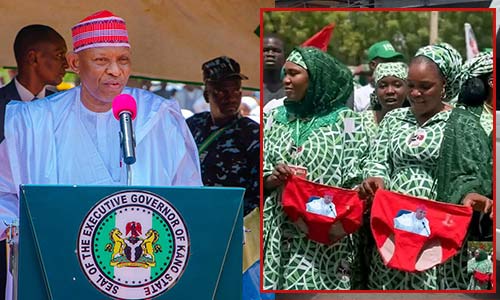
Kano State Governor Abba Yusuf has publicly condemned a group of his own supporters whose display of red underwear while chanting derogatory songs about political rival Rabiu Musa Kwankwaso during the official visit of Nigeria’s First Lady, Senator Oluremi Tinubu, sparked outrage across the state and spawned a viral misinformation campaign involving digitally altered images falsely claiming the state government distributed pants to women as empowerment gifts.
The governor described the incident as “offensive,” “unacceptable,” and contrary to the moral, religious, and cultural values of Kano State, distancing himself and his administration from the conduct while calling on the youths involved to seek God’s forgiveness and apologise to the people of Kano.
Meanwhile, a forensic investigation by Daily Trust has confirmed that viral images purporting to show Governor Yusuf distributing underwear to women were digitally fabricated, with Error Level Analysis revealing that the governor’s image was inserted into manipulated photographs to create a false narrative that only began circulating a full day after the original political stunt occurred.
The controversy originated during the First Lady’s official visit to Kano on Thursday, when a group of supporters of Governor Yusuf, popularly known as “Gida-Gida TikTokers,” staged a provocative political stunt in front of the Kano Government House.
In a video that quickly went viral, the group was seen displaying red underwear while chanting songs mocking Senator Rabiu Musa Kwankwaso, the former Kano governor and current leader of the NNPP who remains a powerful political force in the state.
The group repeatedly used the phrase “Dan kamfan tsula,” loosely translated as “Tsula’s pants.” “Tsula,” a Hausa term for a small monkey, is a derogatory label frequently used in political rhetoric targeting Kwankwaso that gained popularity through songs by APC praise singer Dauda Kahutu Rarara.
The video reportedly surfaced through a TikTok influencer known as Teemah Cool, described as a leader among the Gida-Gida TikTokers. It triggered immediate backlash, particularly from Kwankwaso’s supporters, who condemned the act as indecent and reflective of declining political standards.
Teemah Cool later defended the action, stating she did not regret leading the display and arguing it was a response to earlier provocations by Kwankwasiyya supporters who had publicly waved wrappers while chanting “Falle daya ce,” implying Governor Yusuf would serve only one term.
Within a day of the original video circulating, a separate and more damaging narrative emerged: viral posts on social media alleged that the Kano State Government had distributed pants to women as empowerment or campaign gifts.
The claims were accompanied by photographs showing women holding red underwear, with captions suggesting the items were officially handed out by the government, and manipulated images falsely showing Governor Yusuf personally involved in the distribution.
Daily Trust conducted a forensic verification of the viral images using Error Level Analysis, a technique used to detect image manipulation.
The analysis found that in the suspected doctored image, a noticeably brighter patch appeared on the pants area, an inconsistency indicating that part of the image was edited or inserted separately before being recompressed. In the original version of the same image, brightness and noise levels were uniform across the same area, indicating no alteration.
“The bright patch in the viral image is a red flag, suggesting that the photo was tampered with,” the verification report stated.
Further forensic checks confirmed that the original image was altered to insert the image of Governor Yusuf, creating the false impression that he personally distributed the underwear.
Daily Trust’s investigation established that the images were extracted from the viral video of the TikTokers’ political stunt and then digitally manipulated to construct a false narrative of government-sponsored underwear distribution.
The “pants empowerment” narrative only began circulating on Friday, a full day after the original video was recorded on Thursday, indicating it was a deliberate distortion fabricated after the fact, not a documentation of an actual event.
Governor Yusuf addressed the controversy during the Third Special Prayer for Lasting Peace held at the Government House, where 4,444 Qur’anic reciters gathered to pray for peace, stability, and prosperity in Kano and Nigeria.
In a statement issued through his Chief Press Secretary, Mustapha Muhammad, the governor described the youths’ conduct as a disturbing departure from the principles of his administration’s “Kano First Agenda” and a violation of Islamic teachings on modesty, discipline, and respect for constituted authority.
“Our youths should be symbols of hope and development, not tools for mockery or moral decadence,” Yusuf stated.
“I urge my fellow politicians to lead by example, cease the culture of insults, and focus on the Kano First Agenda rather than inciting our children toward indecency,” the governor added.
He called on the youths involved to seek God’s forgiveness and tender an apology to the people of Kano for the embarrassment caused.
The governor warned politicians against exploiting young people for political gains “capable of damaging the moral fabric of society” and reaffirmed his administration’s commitment to youth mentorship, discipline, and the preservation of Kano’s cultural heritage.
“The state would continue to uphold its reputation as a centre of hospitality, religious devotion, and respect for elders and leaders,” the governor stated.
The Emir of Kano, Muhammadu Sanusi II, represented by Alhaji Aliyu Harazumi, stated that the emirate would continue to organise Qur’anic recitations to promote lasting peace in the state.
Islamic scholars who spoke at the prayer event included Sheikh Nasir Kabara, Sheikh Ali Dan Abba, Sheikh Jamilu Al-Qadiri, Sheikh Bala Kalarawi, Prof. Abdallah Pakistan, and Sheikh Maihula, underscoring the religious establishment’s concern about the moral implications of the political stunt.
Sule Ya’u Tariwa, Special Reporter with the Kano State Government, condemned the original stunt in unsparing terms.
“I have never seen such foolishness done in the name of politics. This is madness in its rawest form. There are different approaches to express political opinions or to send a message to opponents, but this one defies reason,” Tariwa stated.
Reacting to the subsequent doctored images claiming government distribution of underwear, Tariwa acknowledged the damage done to the administration’s reputation.
“The damage has been done, and no amount of explanation can convince these people otherwise. God forbid,” he stated, reflecting the frustration of officials dealing with a misinformation campaign built on the foundation of a genuine but embarrassing act by the governor’s own supporters.
Public opinion was sharply divided, reflecting the deep political polarisation in Kano State between supporters of Governor Yusuf and the APC on one side and supporters of Kwankwaso and the NNPP on the other.
One defender, Wali Halliru Habib, was defiant: “We will chant it again, Tsula’s pants. Just because we said Tsula’s pants and you are saying we are wrong? We will continue to say it.”
A critic, Sanusi Yahuza, condemned the act: “This is very wrong. Who is Tsula again? What kind of thinking is this?”
The division in public response illustrates how partisan loyalty can override even widely shared cultural and religious values of modesty and decorum, with some supporters defending conduct that the governor himself has condemned as contrary to Islamic teachings and Kano’s cultural heritage.
The Kano pants controversy provides a textbook illustration of how political misinformation is manufactured and spread in Nigeria’s charged political environment.
The sequence followed a recognisable pattern. First, a genuine but provocative political act was recorded and shared on social media. Then, the footage was extracted, manipulated, and repackaged with false captions to create a more damaging narrative than the original event warranted. Finally, the doctored content was circulated widely before verification could catch up, causing reputational damage that, as the government’s own reporter acknowledged, “no amount of explanation can convince these people otherwise.”
The forensic analysis confirming the manipulation came after the damage was done, highlighting the asymmetry between the speed of misinformation and the pace of verification.
Daily Trust’s verdict was unequivocal: “The claim that the Kano State Government distributed pants to women as empowerment or campaign gifts is false. The viral content originated from a political stunt by supporters, and the images were digitally altered to misrepresent the situation.”
The incident unfolds against the backdrop of intense political rivalry in Kano State between the APC-aligned Governor Yusuf and NNPP leader Kwankwaso, who recently hosted Peter Obi, Seyi Makinde, and Seriake Dickson in Kano for Sallah celebrations and has been at the centre of opposition coalition-building efforts.
Governor Yusuf, despite retaining the Kwankwasiyya red cap associated with Kwankwaso’s political movement, defected to the APC, creating a bitter political divide in a state where loyalty to political leaders runs deep.
The underwear stunt by the governor’s supporters, while condemned by the governor himself, reflects the crude and often degrading nature of political expression at the grassroots level in Nigerian politics, where insults, mockery, and deliberate provocation are deployed as weapons of political warfare, often by young people who are encouraged or instrumentalised by more senior political actors.
The governor’s call on “fellow politicians to lead by example” and “cease the culture of insults” implicitly acknowledges that the political class bears responsibility for creating the environment in which such conduct occurs, even when the specific actors are young supporters acting without official direction.
For Kano State, a centre of Islamic learning, commercial enterprise, and political significance, the spectacle of supporters displaying underwear in front of the Government House during the First Lady’s visit, followed by a misinformation campaign involving doctored images, represents a low point in the state’s political culture that its governor, its emir, and its religious leaders have all felt compelled to address.

 Interested buyers are encouraged to place their orders and enquiries via:
0704 444 4777, 0704 444 4999, 0818 199 9888
Website: www.alexandernigeria.com
Interested buyers are encouraged to place their orders and enquiries via:
0704 444 4777, 0704 444 4999, 0818 199 9888
Website: www.alexandernigeria.com