By Victor Sunday


There is an old legal maxim that says qui tacet consentire videtur. This mean silence implies consent. Bon Bread appears to have flipped this principle on its head. By choosing to identify itself in response to a viral video that never mentioned its name, the company may have handed its opponent the very weapon she needs to survive a 50 million naira lawsuit.
The Facts
A TikTok user identified simply as Love posted a video expressing concern about a loaf of bread that had reportedly remained fresh in her shop for over two months without spoiling. She showed no brand name, logo or manufacturer. The video went viral, and within days, a bread company called Bon Bread sent her a legal letter through its solicitors, demanding she retract the video, delete the post, and pay 50 million naira in damages, alleging that the video caused it financial losses of exactly that sum within three days.
Now, the big legal question is this: Can Bon Bread successfully sue a content creator for defamation or economic loss when the creator never mentioned the company’s name, logo, or any identifying information in her video?
Defamation Under Nigerian Law
For Bon Bread to succeed in a defamation claim, it must satisfy the classic tripartite test established in Sketch Publications Ltd v. Ajagbemokeferi [1989] 1 NWLR (Pt. 100) 678 and affirmed consistently by the Supreme Court: first, that the statement complained of is defamatory in nature; second, that it refers to the claimant; and third, that it was published to at least one person other than the claimant.
The second element i.e, reference to the claimant, is where Bon Bread’s case collapses almost immediately. In Abalaka v. Akinsete (2023) 13 NWLR (Pt. 1901) 343, the court held that a statement must be identifiable, by reasonable inference, as being about the claimant. The test is whether a reasonable person, upon watching the video, would conclude it referred to Bon Bread specifically. Given that no name, logo, or identifying mark appeared in the video, this test cannot be satisfied on the available facts.
The tragic irony for Bon Bread is that it was its own legal letter that identified itself publicly. By dispatching solicitors who confirmed the company’s connection to the product, Bon Bread arguably authored the very identification it now seeks to litigate.
Even if one were to concede, for argument’s sake, that the video was defamatory, the damages claim presents a second insurmountable wall. The courts require that a claimant establish a direct, proximate causal link between the alleged wrong and the damage suffered.
The court in Labati v. Badmus (2007) 1 NWLR (Pt. 1014) 199 affirmed that damages must not be remote; they must flow naturally and directly from the defendant’s act.
The company claims 50 million naira in losses over three days. However, any competent defence counsel would raise the question: how much of those losses were caused by Love’s video, which named no one, and how much were caused by Bon Bread’s own very public response to it?
The decision to send a solicitor’s letter, the contents of which were subsequently shared online, effectively confirmed that the bread in the video was Bon Bread’s product. The principle of novus actus interveniens (a new intervening act breaking the chain of causation) arguably applies here, with Bon Bread itself being the intervening act.
Food Safety, Consumer Rights, and the Public Interest Shield
There is a broader dimension to this matter that the courts cannot ignore. Several legislation recognises the right of consumers to receive accurate information about the products they purchase, particularly where health and safety are implicated. Similarly, the NAFDAC Act imposes strict standards on food manufacturers regarding shelf life, preservatives, and labelling. A piece of bread that remains visibly unspoiled for two months raises legitimate questions that fall squarely within the public’s right to know.
Similarly, the defence of fair comment on a matter of public interest would likely be available to Love if this matter proceeds to trial. Bread is a staple food consumed daily by millions of Nigerians. Concerns about unusual shelf life are not idle gossip; they engage real questions about food safety that regulators, not lawyers, are best positioned to investigate. An English court in Reynolds v. Times Newspapers Ltd [2001] 2 AC 127 emphasized the importance of responsible publication on matters of genuine public concern. A consumer sharing a personal experience about a food product fits this description comfortably!
Is This a SLAPP Suit?
There is a growing body of literature and jurisprudence around what are called Strategic Lawsuits Against Public Participation (SLAPP suits) where litigation is used not as a genuine legal remedy but as a mechanism to intimidate, silence, or financially exhaust individuals who speak out on matters of public interest. While Nigeria has not enacted specific anti-SLAPP legislation as some jurisdictions have, the courts’ inherent jurisdiction to prevent abuse of process provides a relevant check. A lawsuit that demands 50 million naira from a private citizen who never named your company in her video carries at least the hallmarks of litigation designed to silence rather than to remedy.
Conclusion
On the law as it stands, Bon Bread faces a steep climb. The foundational requirement of identification in defamation is fatally weakened by the fact that the creator never mentioned the company. The causation chain for ₦50 million in damages is tenuous at best, self-inflicted at worst. The public interest dimension of food safety lends the creator a powerful shield. And the optics of a corporation suing a private consumer for raising concerns about shelf life in a country where food safety standards remain a live issue are, to put it diplomatically, unfavourable.
The wiser counsel for Bon Bread would have been transparency. A public statement about its ingredients, preservation methods, and regulatory compliance would have addressed consumer concerns far more effectively than a solicitor’s letter. Instead, the company has turned a passing viral moment into a conversation, one that now has its name squarely at the centre.
Victor Sunday is an orator, legal writer, researcher and public affairs commentator. He can be reached via victorsundayonwukwe@gmail.com
 LAWBREED — Equipping You For Greater Success!
_______________________________________________________________________
LAWBREED — Equipping You For Greater Success!
_______________________________________________________________________
“Order Justice Omolaye-Ajileye’s Electronic Evidence Books Now” — Essential Guides On Evidence Act, Case Law And Digital Proof
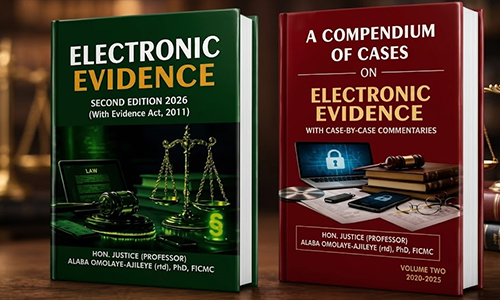
[A MUST HAVE] Evidence Act Demystified With Recent And Contemporary Cases And Materials

Available now for NGN 40,000 at ASC Publications, 10, Boyle Street, Onikan, Lagos. Beside High Court, TBS. Email publications@ayindesanni.com or WhatsApp +2347056667384. Purchase Link: https://paystack.com/buy/evidence-act-complete-annotation
______________________________________________________________________ “Enhance Legal Practice With Authoritative Reports” — Alexander Payne Offers Comprehensive Law Reports, Spanning Over A Century Of Nigerian Jurisprudence Interested buyers are encouraged to place their orders and enquiries via:
0704 444 4777, 0704 444 4999, 0818 199 9888
Website: www.alexandernigeria.com
Interested buyers are encouraged to place their orders and enquiries via:
0704 444 4777, 0704 444 4999, 0818 199 9888
Website: www.alexandernigeria.com
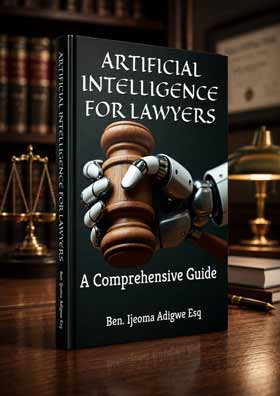 As an added bonus, every purchase comes with a FREE ebook titled: “How to use the AI in Legalpedia and Law Pavilion.”
Ohio Books Ltd praises the publication, stating:
"....this is the only Nigerian book I know of on the topic."
How to Order:
📞 Call, Text, or WhatsApp: 08034917063 | 07055285878
📧 Email: benadigwe1@gmail.com
🌎 Website: www.benadigwe.com
Ebook Version: Access it directly online at https://selar.com/prv626
Authored by Ben Ijeoma Adigwe Esq., ACiarb (UK), LL.M, Dip. in Artificial Intelligence, Director at the Delta State Ministry of Justice, Asaba, Nigeria.
As an added bonus, every purchase comes with a FREE ebook titled: “How to use the AI in Legalpedia and Law Pavilion.”
Ohio Books Ltd praises the publication, stating:
"....this is the only Nigerian book I know of on the topic."
How to Order:
📞 Call, Text, or WhatsApp: 08034917063 | 07055285878
📧 Email: benadigwe1@gmail.com
🌎 Website: www.benadigwe.com
Ebook Version: Access it directly online at https://selar.com/prv626
Authored by Ben Ijeoma Adigwe Esq., ACiarb (UK), LL.M, Dip. in Artificial Intelligence, Director at the Delta State Ministry of Justice, Asaba, Nigeria.