*When Lawyers Accept Briefs And Judges Issue “Bandit, Corrupt Orders” They Know Are Beyond Their Jurisdiction

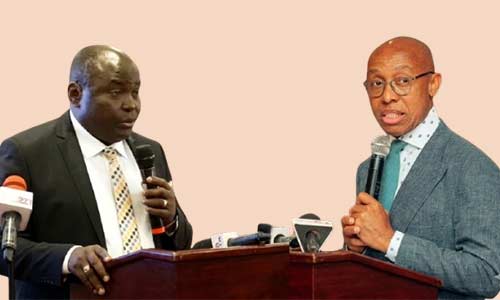
In a rare and significant concession, Senior Advocate of Nigeria Jibrin Samuel Okutepa has acknowledged that lawyers including Senior Advocates and judges are equally part of the problem of political cases flooding Nigerian courts, after former Chairman of the National Human Rights Commission, Professor Chidi Anselm Odinkalu, challenged his earlier criticism that placed the blame squarely on politicians.
“Both the SANs, non-SANs/lawyers and judges are also parts of the problems. There is no smoke without fire,” Okutepa responded on X, effectively accepting Odinkalu’s central argument that politicians cannot abuse the court system without the active participation of the lawyers who file the cases and the judges who entertain them.
The exchange which moved from Okutepa’s initial criticism of politicians, through Odinkalu’s sharp redirection of blame toward the Bar and the Bench, to Okutepa’s concession that all three are culpable has produced a rare consensus between two of Nigeria’s most prominent legal voices on one of the most pressing issues facing the country’s democratic process ahead of the 2027 elections.
The exchange began when Okutepa, in a series of remarks shared on his official X account, criticised the ongoing wave of political realignments in Nigeria, questioning whether they serve the interests of citizens or merely advance the personal ambitions of the political class.
“Politicians are not fighting for the interests of Nigerians. It is about how they want to share power among themselves,” Okutepa stated.
He painted a grim picture of Nigeria’s socio-economic condition, describing the country as “bleeding” while ordinary citizens endure hardship, poverty, and declining living standards. He accused politicians of deliberately weaponising poverty to manipulate voters, leading to situations where citizens sell their votes out of economic desperation.
“In Nigeria, power is snatched from those the people want and handed to those the godfathers prefer,” Okutepa stated.
On the judicial dimension, Okutepa criticised what he described as the misuse of the court system in political disputes, noting that many politicians flood courts with cases that fall outside the scope of legally permissible electoral matters.
Citing specific provisions of the Constitution and the Electoral Act including Section 88(2) and Section 285(14) he maintained that only specific disputes, particularly those relating to party primaries and candidate nomination, are justiciable. He accused some politicians of deliberately filing frivolous suits to create confusion and destabilise the political process.
He warned that such actions undermine both the rule of law and democratic institutions, as those responsible for enforcing accountability are either compromised or unable to act independently.
Odinkalu’s response, posted as a quote-tweet of TheNigeriaLawyer’s report on Okutepa’s remarks, was direct and devastating in its simplicity.
“How is that the problem of the politicians?” Odinkalu asked, addressing Okutepa directly. “What about the SANs who accept the briefs and those judges who issue these bandit, corrupt orders in cases in which they absolutely know they have no jurisdiction?”
The intervention shifted the entire framework of accountability. Where Okutepa placed the blame on politicians who file frivolous cases, Odinkalu argued that politicians are merely doing what politicians do pursuing advantage through every available avenue. The real failure, he contended, lies with the two categories of professionals who are supposed to prevent the abuse of the judicial process: the lawyers who accept and prosecute the briefs, and the judges who entertain and grant orders in cases they know are beyond their jurisdiction.
Odinkalu’s use of the phrase “bandit, corrupt orders” was particularly explosive describing certain court orders not as errors of judgment or misinterpretations of law, but as deliberate acts of judicial corruption by judges who “absolutely know” they lack jurisdiction but proceed anyway.
Rather than defending his original position or pushing back against Odinkalu’s challenge, Okutepa conceded the point — acknowledging that the problem is not limited to politicians but extends to the legal profession and the judiciary.
“Both the SANs, non-SANs/lawyers and judges are also parts of the problems. There is no smoke without fire,” Okutepa responded.
The concession is significant for several reasons.
First, it comes from one of Nigeria’s most senior and outspoken legal practitioners a former Chief Prosecutor of the NBA at the LPDC, a Bencher, and a Senior Advocate whose professional standing gives weight to his acknowledgment.
Second, the phrase “there is no smoke without fire” implies that the political cases flooding the courts are not merely the result of opportunistic politicians but are enabled by a systemic failure in which lawyers and judges are active and willing participants. Politicians provide the demand; lawyers and judges provide the supply.
Third, by including “SANs” specifically in his concession, Okutepa acknowledged that the most senior members of the legal profession the very individuals entrusted with maintaining the highest standards of professional conduct are among those enabling the abuse.
The Okutepa-Odinkalu exchange, taken together with Okutepa’s concession, establishes a clear framework for understanding how political cases flood Nigerian courts.
Politicians file the cases driven by the desire to gain legal advantage, destabilise opponents, or create confusion in the political process. They seek out lawyers willing to draft and prosecute cases they know are non-justiciable under the Electoral Act and the Constitution.
Lawyers accept the briefs including Senior Advocates of Nigeria who lend their prestige and expertise to cases they know fall outside the court’s jurisdiction. They draft originating processes, argue motions, and prosecute matters that the law expressly bars courts from entertaining, earning fees while enabling the abuse of process.
Judges entertain the cases granting ex parte orders, interim injunctions, and status quo directives in matters where Section 83 of the Electoral Act 2026 explicitly bars them from assuming jurisdiction and prohibits the granting of interim or temporary orders.
Each actor enables the others. Politicians cannot flood courts without lawyers to file the cases. Lawyers cannot prosecute non-justiciable cases without judges willing to hear them. And judges who issue orders in cases beyond their jurisdiction do so knowing that lawyers will enforce those orders and politicians will use them as leverage.
The result is a self-reinforcing cycle of judicial abuse that serves the interests of all three participants — politicians, lawyers, and judges — at the expense of the democratic process and the Nigerian public.
Odinkalu’s specific reference to “SANs who accept the briefs” strikes at a particularly sensitive nerve within the legal profession.
Senior Advocates of Nigeria are conferred with the rank in recognition of their expertise, integrity, and contribution to the development of the law. They are expected to uphold the highest standards of professional conduct including the obligation not to lend their name and expertise to frivolous or abusive litigation.
When a politician seeks to file a non-justiciable case, it is the lawyer’s professional duty to advise the client that the case has no legal basis and to decline the brief if the client insists on proceeding. If Senior Advocates are accepting these briefs and prosecuting cases they know are non-justiciable, they are not merely facilitating abuse — they are actively enabling it with the credibility and prestige that the SAN title confers.
Okutepa’s concession that “SANs are also parts of the problems” is an acknowledgment from within the SAN community itself that the rank is being used to legitimise litigation that the law does not permit.
Odinkalu’s characterisation of certain court orders as “bandit, corrupt orders” carries significant weight coming from a former chairman of the National Human Rights Commission and one of Nigeria’s most respected public intellectuals.
The description targets judges who grant ex parte orders, interim injunctions, and other judicial reliefs in political cases where they “absolutely know they have no jurisdiction.”
Under the Electoral Act 2026, Section 83(5) explicitly bars courts from entertaining jurisdiction over suits pertaining to the internal affairs of political parties and prohibits the granting of interim or interlocutory orders in such cases. Yet multiple courts across Nigeria have done precisely that issuing restraining orders, status quo directives, and other injunctions in cases that the law places beyond their reach.
The NBA itself has warned against this practice. The Katsina State High Court under Justice A.K. Tukur recently applied Section 83 to strike out an ADC-related suit the first court to do so demonstrating that the legal provisions are clear enough to be applied when judges choose to follow them.
Odinkalu’s question unanswered by his phrase but implicit in it is why other judges choose not to follow the law, and whether the explanation lies in corruption rather than confusion.
The consensus reached by Okutepa and Odinkalu exposes a critical accountability gap in the Nigerian legal system.
Politicians who file frivolous political cases face no consequences the worst outcome is their case being struck out, after which they file another in a different court.
Lawyers who accept and prosecute these briefs face no consequences despite the Rules of Professional Conduct prohibiting frivolous proceedings and despite the NBA’s recent warnings about disciplinary action.
Judges who grant orders in cases where they lack jurisdiction face no consequences despite the NJC’s disciplinary powers and despite the clear provisions of the Electoral Act.
The result is a system where all three actors benefit from the abuse, with politicians gaining legal ammunition, lawyers earning fees, and judges potentially receiving gratification while the democratic process and the Nigerian public bear the costs.
The exchange is particularly timely given the current state of political litigation in Nigeria.
The ADC leadership crisis alone has generated at least six active cases across the Supreme Court, multiple Federal High Court divisions, and state high courts — with competing orders, contradictory injunctions, and status quo directives that have paralysed the party’s ability to function.
The PDP is similarly entangled in litigation over its conventions, leadership, and the expulsion of key members.
In each case, the pattern is the same: politicians file cases, lawyers prosecute them, and judges entertain them — despite clear legal provisions that should bar judicial intervention in internal party affairs.
Okutepa’s original criticism identified the first link in the chain. Odinkalu’s challenge identified the second and third. And Okutepa’s concession acknowledged that the chain is only as strong as its weakest link and all three links are broken.
Okutepa’s concluding proverb “there is no smoke without fire” carries a deeper meaning in this context.
If courts are issuing orders in cases they have no jurisdiction to hear, there must be a reason. If Senior Advocates are filing cases they know are non-justiciable, there must be an incentive. If politicians continue to flood courts with political cases despite clear legal prohibitions, it is because they know the system will accommodate them.
The “fire” that produces the “smoke” of political litigation is a system where professional ethics, judicial integrity, and legal compliance have all been subordinated to the pursuit of political advantage and personal enrichment.
Until all three actors politicians, lawyers, and judges face genuine consequences for their respective roles in the abuse, the smoke will continue to rise.
As Okutepa and Odinkalu now agree: the problem belongs to all of them.
[A MUST HAVE] Evidence Act Demystified With Recent And Contemporary Cases And Materials

Available now for NGN 40,000 at ASC Publications, 10, Boyle Street, Onikan, Lagos. Beside High Court, TBS. Email publications@ayindesanni.com or WhatsApp +2347056667384. Purchase Link: https://paystack.com/buy/evidence-act-complete-annotation
______________________________________________________________________ “Enhance Legal Practice With Authoritative Reports” — Alexander Payne Offers Comprehensive Law Reports, Spanning Over A Century Of Nigerian Jurisprudence Interested buyers are encouraged to place their orders and enquiries via:
0704 444 4777, 0704 444 4999, 0818 199 9888
Website: www.alexandernigeria.com
Interested buyers are encouraged to place their orders and enquiries via:
0704 444 4777, 0704 444 4999, 0818 199 9888
Website: www.alexandernigeria.com