*Alleged Pattern Of Relocating Prisoners To Deceive Inspection Teams, Calls For Immediate Investigation

A Nigerian lawyer and former Secretary of the Nigerian Bar Association, Owerri Branch, Chinedu Agu, has raised an urgent human rights alarm over what he describes as a systematic and years-long practice by the Tigerbase police detention facility in Owerri, Imo State, of secretly relocating detainees and staging fake cell decongestion whenever inspection teams are expected leaving prisoners held for over eleven hours without food or water purely to manipulate the outcome of oversight visits.
In a detailed statement addressed to the NBA, the National Human Rights Commission, the Inspector-General of Police, Amnesty International, and dozens of civil society and media organisations, Agu described events he witnessed on Thursday and Friday at the Magistrate Court premises in Owerri as “a damning indictment of a system that has normalised deception, cruelty, and the systematic violation of human dignity.”
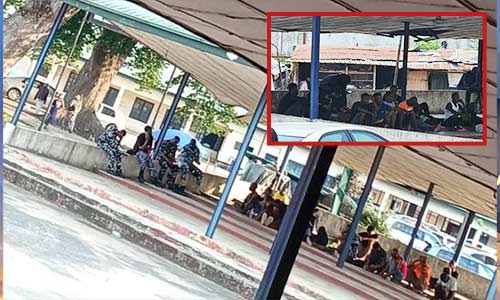
Agu disclosed that on Thursday, April 16, 2026, numerous Tigerbase detainees were brought out of the detention facility’s cells and assembled at the Hon. Justice P.C. Onumajulu Pavilion a structure within the Magistrate Court premises in Owerri.
The detainees were kept at the pavilion from as early as 7:00 a.m. until approximately 6:30 p.m. over eleven hours without food, without water, and without any regard for their basic humanity.
“This was not done for their welfare, for any lawful purpose or for arraignment,” Agu stated. “It was rather done because it was alleged that a certain team from Abuja some said from the IGP was scheduled to inspect the Tigerbase detention facilities yesterday and today.”
View this post on Instagram
On Friday, April 17, the same process was repeated the same detainees removed from their cells, the same assembly at the pavilion, the same hours-long detention without sustenance, all to present a false picture of compliance to visiting inspectors.
“This is a calculated pattern and a well-rehearsed charade,” Agu declared.
Agu revealed that the practice is not new but has been occurring systematically for years — a claim he said is supported by the testimony of detainees he is currently representing in court.
Seven women detained at the Owerri Correctional Centre whom Agu describes as “victims of sustained Tigerbase victimisation” have attested that throughout their period of detention at Tigerbase from October 2023 to December 16, 2025, they witnessed the same routine unfold repeatedly, often on a monthly basis.
“Whenever inspection teams, including those from the National Human Rights Commission and other oversight bodies, were expected, detainees would be hurriedly evacuated, hidden away, and displaced to create a false impression of order, compliance, and humane conditions,” Agu stated.
“Once the inspectors departed, the detainees would be returned to the very conditions that had been deliberately concealed.”
The pattern, as described by Agu, reveals a sophisticated deception operation: intelligence about upcoming inspections is received in advance, detainees are moved out of the cells to create the appearance of compliance with capacity standards, the detainees are held elsewhere under inhumane conditions throughout the inspection, and once the oversight team departs, the detainees are returned to the same overcrowded and abusive conditions.
Agu did not mince words in characterising the treatment of detainees during the staged exercises.
“To hold human beings for over eleven hours without food or water, purely to manipulate the outcome of an inspection, is inhuman, degrading, and unconscionable. It is psychological torture. It is a calculated abuse of power designed to evade accountability,” Agu stated.
He cited multiple legal instruments that the practice violates, including the Constitution of the Federal Republic of Nigeria particularly the guaranteed right to dignity of the human person the African Charter on Human and Peoples’ Rights, and the United Nations Standard Minimum Rules for the Treatment of Prisoners, known as the Nelson Mandela Rules.
Agu highlighted what he described as the most troubling implication of the practice: that official inspections designed to safeguard rights and ensure compliance are being actively undermined and rendered meaningless by the very people entrusted with enforcing the law.
“A system that relocates detainees to deceive inspectors is a system that is consciously hiding abuse. A system that prioritises appearances over human life has lost all moral and legal legitimacy,” Agu stated.
The allegation raises fundamental questions about the effectiveness of Nigeria’s detention oversight mechanisms. If facilities can successfully stage compliance whenever inspectors arrive — and have been doing so for years without detection it means the inspection reports filed by the National Human Rights Commission and other oversight bodies may be based on fabricated conditions rather than the reality of what detainees experience.
“If those entrusted with oversight continue to accept staged realities, then the very purpose of oversight collapses,” Agu warned.
Agu described the practice as “institutional deception of the highest order” a phrase that places responsibility not on individual officers but on the systematic nature of the operation.
The level of coordination required advance intelligence about inspections, organised movement of detainees, provision of alternative holding locations, timing the return of detainees after inspectors depart, and repeating the process monthly for years indicates that the practice is not the work of rogue officers but an institutionalised protocol within the Tigerbase facility.
“Even more troubling is the implication that official inspections, which are meant to safeguard rights and ensure compliance, are being actively undermined and rendered meaningless by those entrusted with enforcing the law,” Agu stated.
The Tigerbase in Owerri formally known as the Imo State Police Command’s Special Anti-Robbery Squad or tactical operations base has long been a subject of human rights concerns. Like similar police tactical facilities across Nigeria, it serves as a detention centre for suspects in serious criminal cases, but has been repeatedly accused of overcrowding, prolonged detention without trial, torture, and inhumane conditions.
The facility operates outside the conventional correctional system managed by the Nigerian Correctional Service, meaning it often falls outside the regular oversight mechanisms that apply to prisons and correctional centres.
Agu called for immediate action from multiple authorities and institutions.
He demanded a full and transparent inquiry into the recurring practice of detainee concealment and inhumane treatment. He called for those responsible — both directly and indirectly to be identified and sanctioned. He insisted that conditions within Tigerbase detention facilities must be subjected to genuine scrutiny rather than stage-managed inspections.
Most critically, he demanded that future inspections be unannounced removing the advance warning that enables the facility to stage compliance.
“This is not a matter for routine correspondence or delayed inquiry. This demands immediate, unannounced, and independent investigation. It demands accountability. It demands consequences,” Agu stated.
He addressed his appeal to the NBA and its Human Rights Committee, the Chief Judge and Chief Registrar of the Imo State High Court, the Inspector-General of Police, the Police Service Commission, the National Human Rights Commission, Amnesty International, Avocats Sans Frontières, and dozens of other civil society organisations including Spaces for Change, RULAAC, CLEEN Foundation, LEDAP, Global Rights, and Hope Behind Bars Africa, as well as media organisations including Sahara Reporters, Al Jazeera, BBC, Arise TV, and Channels Television.
Agu’s alarm connects to a broader crisis in Nigeria’s detention and criminal justice system. The country’s correctional facilities are severely overcrowded, with a significant proportion of inmates being awaiting-trial detainees who have not been convicted. Police detention facilities like Tigerbase often hold suspects far beyond the constitutionally permitted period, without arraignment or access to legal representation.
The Administration of Criminal Justice Act 2015 whose National Minimum Standards were just unveiled this week by the Attorney-General of the Federation specifically prohibits prolonged detention without charge and requires suspects to be brought before a court within a prescribed period. Yet the gap between the law’s provisions and the reality of detention in facilities like Tigerbase remains vast.
The federal government’s unveiling of the National Minimum Standards for ACJA implementation and the Harmonised Restorative Justice Training Manual on Tuesday just two days before the Tigerbase incidents Agu describes illustrates the stark disconnect between policy pronouncements in Abuja and the treatment of detainees in facilities across the country.
Agu concluded his statement with a declaration that captures the essence of the human rights crisis he has exposed.
“A justice system that permits this level of manipulation and cruelty is not merely failing but complicit. The law cannot be reduced to performance. Human dignity cannot be suspended for convenience. The continued silence or inaction of relevant authorities will only deepen the injustice and embolden its perpetrators,” Agu stated.
“This must stop. Now.”
[A MUST HAVE] Evidence Act Demystified With Recent And Contemporary Cases And Materials

Available now for NGN 40,000 at ASC Publications, 10, Boyle Street, Onikan, Lagos. Beside High Court, TBS. Email publications@ayindesanni.com or WhatsApp +2347056667384. Purchase Link: https://paystack.com/buy/evidence-act-complete-annotation
______________________________________________________________________ “Enhance Legal Practice With Authoritative Reports” — Alexander Payne Offers Comprehensive Law Reports, Spanning Over A Century Of Nigerian Jurisprudence Interested buyers are encouraged to place their orders and enquiries via:
0704 444 4777, 0704 444 4999, 0818 199 9888
Website: www.alexandernigeria.com
Interested buyers are encouraged to place their orders and enquiries via:
0704 444 4777, 0704 444 4999, 0818 199 9888
Website: www.alexandernigeria.com