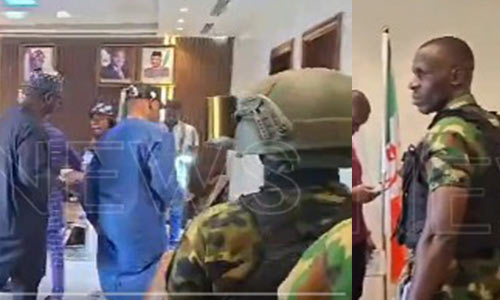
Public outrage has erupted across Nigeria after Nigerian Army personnel were spotted accompanying the National President of the National Union of Road Transport Workers, Musiliu Akinsanya, popularly known as MC Oluomo, during his retaking of the union’s national secretariat in Abuja — just hours after a rival faction backed by court judgments had peacefully taken possession of the facility.

The presence of military personnel in what is essentially a civil dispute between rival factions of a transport workers’ union has raised fundamental questions about the deployment of the armed forces, the rule of law, and the use of state security apparatus to settle private organisational disputes.
Videos posted by TVC on X showed Akinsanya visiting the secretariat to assess damaged property after regaining control, with armed military personnel visibly present at the scene — prompting Nigerians to ask why soldiers, rather than police officers or court bailiffs, were involved in enforcing the will of one faction over another in a union leadership dispute.
The public reaction on social media was swift and scathing. Nigerians expressed shock and anger at the deployment of military personnel to protect a transport union official.
“Wait a minute. Did I just see military men with MC Oluomo? Like Nigerian Army? Soldiers now guard Agbero? Not even police,” one user wrote, using the colloquial term “agbero” — a derogatory reference to transport touts and union enforcers.
“The lawlessness in Nigeria is on another level. Even after being sacked by court ruling, he went there with military to protect him,” another stated.
@thenigerialawyer“Soldiers Now Guard Agbero?” — Outrage As Nigerian Army Personnel Spotted With MC Oluomo During Forceful Retaking Of NURTW Secretariat Despite Court Rulings Favouring Rival Faction♬ original sound – TheNigeriaLawyer
“When these kind of people keep holding offices in this country, then our country is in deep mess. There’s no single sign of diligence and integrity attached to this association,” a third user added.
The core of the public anger centres on two issues: the apparent use of military force to override court judgments, and the broader question of why the Nigerian Army — constitutionally mandated to defend the nation against external aggression and assist in maintaining internal security during emergencies — would be deployed to settle a leadership dispute within a transport workers’ union.
The drama began on Monday when a faction led by Tajudeen Baruwa occupied the NURTW national secretariat in Abuja, citing court rulings in his favour at both the lower court and the Court of Appeal.
Baruwa said his faction had waited for approximately two years for the judgments to be obeyed but that the MC Oluomo-led faction had refused to comply with the court orders. He said his group had formally notified the police, attaching copies of the judgments to facilitate the recovery of the secretariat, but claimed the police response was not encouraging.
“We are taking over in a peaceful manner, and it is not a forceful takeover but just carrying out the court’s orders,” Baruwa told journalists at the scene.
“Again, please be aware that our coming here after two years is to occupy our office, having obtained judgments at both the lower court and the Appeal Court, but they refused to obey court orders after waiting for about two years. We decided to resume at the office today without causing any violence,” he stated.
Baruwa alleged that a member of his faction was attacked during the process and was hospitalised, but said the situation was under control and his group remained open to reconciliation.
Hours after Baruwa’s takeover, Akinsanya struck back, retaking the secretariat — this time with military personnel in tow.
In a statement posted on his Instagram page, Akinsanya described the Baruwa faction’s earlier occupation as a “forceful takeover” and maintained that due legal processes were still ongoing.
He made two key legal claims. First, that he was not a defendant in the judgment relied upon by Baruwa, meaning the court orders cited by the rival faction may not directly apply to him. Second, that the judgment has been appealed and a stay of execution has been duly entered — meaning that if a valid stay order exists, the judgment Baruwa relies on would be suspended pending the appeal.
“The National President wishes to inform members of the union and the general public that he was not a defendant in the purported judgment. The judgment has been appealed, and a stay of execution has been duly entered. He has not engaged with Mr Baruwa or any individual, aware that cases are pending in court,” Akinsanya stated.
He urged members of the union to remain calm, peaceful, and law-abiding as the dispute continues.
The central controversy, however, is not the merits of either faction’s legal claims but the deployment of Nigerian Army personnel to enforce MC Oluomo’s retaking of the secretariat.
Under the Nigerian Constitution, the armed forces are established for the defence of the territorial integrity and sovereignty of the nation and for such other purposes as the National Assembly may prescribe. The deployment of military personnel for internal security purposes is governed by specific constitutional and statutory provisions that typically require formal authorisation.
The use of soldiers to settle a civil dispute between factions of a transport workers’ union falls outside any recognised constitutional or statutory basis for military deployment. The appropriate authorities for enforcing court orders in civil disputes are the Nigeria Police Force and court bailiffs — not the military.
The presence of military personnel at the scene therefore raises several critical questions. Who authorised the deployment of soldiers to the NURTW secretariat? Under what legal authority were they deployed? Was the deployment requested by Akinsanya’s faction, and if so, through what channels? Does the military command authorise or condone the use of soldiers as personal security for civilian union officials?
The underlying legal dispute is itself complex and unresolved. Baruwa claims to have judgments from both the lower court and the Court of Appeal supporting his claim to the NURTW leadership. Akinsanya claims he was not a party to those proceedings and has obtained a stay of execution.
If Baruwa’s court orders are valid and subsisting, then his faction’s occupation of the secretariat was a lawful enforcement of court judgments, and the forceful retaking by Akinsanya’s faction — with or without military backing — would constitute defiance of court orders.
If, however, Akinsanya’s stay of execution is valid, then Baruwa’s court orders are suspended and the status quo ante should be maintained pending the appeal.
The resolution of these competing legal claims lies with the courts, not with the deployment of military force. The involvement of soldiers in the dispute, regardless of which faction’s legal position is ultimately upheld, undermines the rule of law and sets a dangerous precedent for the resolution of organisational disputes through force rather than judicial process.
The incident highlights persistent concerns about the militarisation of civilian life in Nigeria, where soldiers are frequently deployed for tasks that should be handled by the police or other civilian authorities.
The NURTW — which controls road transport operations across Nigeria — has historically been associated with violence, political patronage, and the use of force to maintain control over transport routes and revenue collection. The involvement of military personnel in the union’s internal power struggles represents an escalation that many Nigerians find deeply troubling.
The fact that the military was apparently deployed on behalf of one faction in a disputed leadership contest — rather than to maintain neutral security — is particularly concerning, as it suggests that access to military protection may depend on political connections rather than legal entitlement.
Neither the Nigerian Army nor the Ministry of Defence has issued a statement on the deployment of military personnel to the NURTW secretariat or the authorisation for their presence at the scene.
The NURTW leadership dispute is expected to continue through the courts, though the events of the past 48 hours have demonstrated that the battle for control of the union is being fought not only in courtrooms but on the ground, with force — and apparently with military backing.
[A MUST HAVE] Evidence Act Demystified With Recent And Contemporary Cases And Materials

Available now for NGN 40,000 at ASC Publications, 10, Boyle Street, Onikan, Lagos. Beside High Court, TBS. Email publications@ayindesanni.com or WhatsApp +2347056667384. Purchase Link: https://paystack.com/buy/evidence-act-complete-annotation
______________________________________________________________________ “Enhance Legal Practice With Authoritative Reports” — Alexander Payne Offers Comprehensive Law Reports, Spanning Over A Century Of Nigerian Jurisprudence Interested buyers are encouraged to place their orders and enquiries via:
0704 444 4777, 0704 444 4999, 0818 199 9888
Website: www.alexandernigeria.com
Interested buyers are encouraged to place their orders and enquiries via:
0704 444 4777, 0704 444 4999, 0818 199 9888
Website: www.alexandernigeria.com